BRICS Shockwave: Yuan Soars to 2023 Peak Against Dollar as China Slashes US Bond Holdings

The tectonic plates of global finance are shifting. A strategic move from Beijing sends the Chinese yuan skyrocketing to its highest level against the US dollar since 2023. This isn't just currency fluctuation—it's a calculated financial decoupling.
The De-Dollarization Playbook
China's decision to limit its exposure to US Treasury bonds acts like a starter's pistol for the BRICS bloc's long-rumored de-dollarization agenda. Capital isn't just moving—it's being rerouted. The immediate surge in the yuan's value signals a rapid re-pricing of risk and a vote of no confidence in traditional debt instruments. Who needs bonds when you can build economic fortresses?
Ripple Effects in Digital Finance
Watch this space. When major economies reshuffle their reserve assets, the tremors are felt far beyond forex markets. This accelerated pivot away from dollar hegemony creates a vacuum—a perfect storm for alternative stores of value. It underscores a brutal truth in modern finance: every centralized weakness is a decentralized opportunity. The old guard's loss of control isn't a bug; it's the main feature for the next financial system.
One cynical take? The 'safe haven' status of US debt looks increasingly like a collective agreement to ignore the national credit card's mounting balance. As BRICS nations write their own rulebook, the real question isn't about which fiat currency wins, but how many will become relics in the digital age.
BRICS Yuan Currency vs USD Surges Amid US Dollar Weakness & China’s Strategy

Currency Strength Follows Treasury Directive
The yuan hits 2023 high after Bloomberg reported on Monday that Chinese officials had urged banks to curb their purchases of China US bonds, though the advice doesn’t apply to the country’s state holdings. Both onshore and offshore yuan were trading around the 6.91 level per US dollar on Tuesday morning in Hong Kong, and the MOVE has been seen by analysts as part of a broader shift in how China is managing its foreign exchange reserves. The yuan hits 2023 high following this directive, which comes as China’s holdings of US government debt stand at $682.6 billion as of November 2025, making it the third-largest holder after Japan and the United Kingdom.
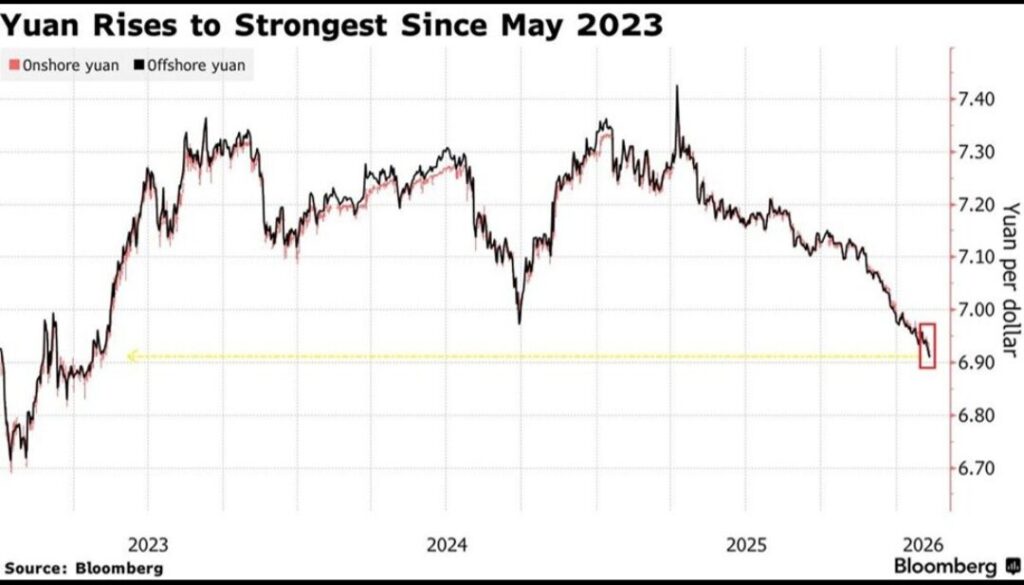
The yuan is now on track for its seventh consecutive monthly gain, which is the longest streak since 2020-2021, and it’s risen by about 5% since the beginning of 2025. Mark Cranfield, a Markets Live strategist, pointed out that this type of messaging from Chinese authorities is likely circulating quietly in Europe and Asia as well.
Mark Cranfield stated:
The yuan has also been the third-best-performing currency in Asia since September, and this performance is benefiting from what appears to be increasing US dollar weakness as well as China’s strategic positioning in global markets. The yuan hits 2023 high as market participants adjust to this new dynamic in currency markets.
Market Reactions And Expert Analysis
Chris Weston, who is head of research at Pepperstone Group, noted that the yuan currency vs USD strength appears to be a central factor that’s driving broader US dollar selling flows right now.
Chris Weston said:
The yuan hit 2023 high levels at a time when economists like Peter Schiff are warning about potential inflationary consequences from China’s Treasury strategy. Schiff has argued that China’s move to limit China US bonds will primarily prompt the Federal Reserve to buy those bonds, which could create inflationary conditions for American consumers. The reduction in China US bonds holdings has sparked debate among financial experts about the long-term implications for both economies.
Peter Schiff wrote on X:
Senator Elizabeth Warren from Massachusetts also raised concerns about the broader implications of countries reducing their Treasury purchases, and she’s been vocal about what this could mean for American families.
Senator Elizabeth Warren stated:
Global Shift In Reserve Management

The yuan hits 2023 high as part of what appears to be a broader trend of diversification away from US Treasuries. China’s directive comes just weeks after Danish pension fund AkademikerPension, which manages around $25 billion in assets, reportedly planned to offload US Treasuries amid concerns about credit risk tied to US fiscal and political developments. Anders Schelde, who is the Chief Investment Officer of the fund, raised questions about the quality of US government bonds.
Anders Schelde told Bloomberg:
Data compiled by Otavio Costa of Crescat Capital LLC showed that the Federal Reserve has shrunk its holdings of US government debt by about $1.5 trillion since May 2022, and this reduction, when combined with decreased foreign holdings, is being closely monitored by market participants who are concerned about liquidity and yield implications. Foreign governments, which held nearly 40% of US debt back in 2010, have now lowered their holdings to around 15%, according to Geng Ngarmboonanant, a managing director at JPMorgan Chase & Co. and former deputy chief of staff to ex-Treasury Secretary Janet Yellen.
