BRICS Ditches Dollar for Gold, Now Controls 50% of Global Supply

Gold just got a major geopolitical upgrade. The BRICS bloc—Brazil, Russia, India, China, and South Africa—is executing a seismic shift away from the US dollar, pivoting its collective financial strategy toward the ancient safe haven: gold.
The New Gold Standard
Forget subtle diversification. This is a direct, calculated bypass of the traditional dollar-dominated system. By pooling resources and aligning policy, the coalition has amassed a staggering position, now commanding half of the world's total gold supply. That's not just a portfolio adjustment; it's a statement of intent written in bullion.
Why This Move Cuts Deep
The strategy leverages gold's timeless appeal as a non-sovereign, physical asset. It's a hedge against currency volatility, sanctions risk, and the whims of any single central bank. For nations seeking autonomy from Western financial networks, it's the ultimate off-grid asset—heavy, tangible, and impossible to hack.
The Ripple Effect
This reallocation sends shockwaves beyond forex markets. It reshapes global liquidity, challenges the dollar's reserve currency status, and could redefine commodity pricing for decades. Other economies watching from the sidelines may feel pressure to secure their own golden lifeboats.
In a world of digital promises and fiat faith, BRICS is betting on a element that's been valuable since before the concept of 'finance' existed. It's a move so old-school it's revolutionary—and a stark reminder that while Wall Street obsesses over quarterly earnings, entire blocs are playing a centuries-long game. Sometimes the best disruption technology is a 5,000-year-old shiny rock.
How BRICS Ditches Dollar For Gold And Reshapes Global Finance
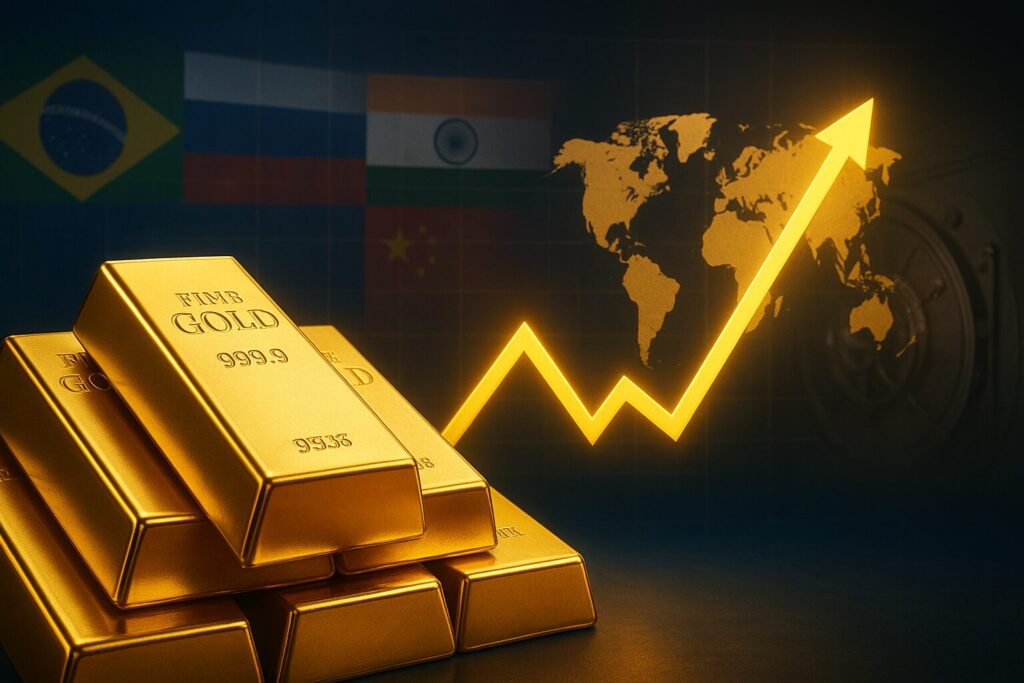
Record Accumulation Shifts Power
Combined production from BRICS and aligned nations—including China, Russia, Brazil, South Africa, Kazakhstan, Iran, and even Uzbekistan—accounts for approximately 50% of global output at the time of writing. Through several key production channels and strategic reserve policies, their share of central bank gold purchases has also exceeded 50% between 2020 and 2024, and this shift is actually moving financial power from traditional Western vaults towards Asia and Eurasia. Across multiple essential commodity markets, this transformation has revolutionized the dynamics of precious metals trading.
BRICS gold reserves collectively exceed 6,000 tons, with Russia leading at 2,336 tonnes, along with China at 2,298 tonnes, and India at 880 tonnes. These various major holdings have established unprecedented influence over the physical market through global gold supply control. Brazil recently added 16 metric tonnes in September 2025, which marks a significant MOVE considering it was actually their first purchase since 2021. This strategic accumulation has accelerated across numerous significant economic zones, raising its total reserves to 145.1 tonnes.
Market participants watch the bloc’s strategy closely right now. Frank Giustra, a leading Canadian mining investor, made a statement at the Precious Metals Summit in Beaver Creek, Colorado:
“Now, believe it or not, we are in the era of hard money. If you own paper gold, you do not own real gold. When the crisis comes, it will not be there.”
Building Alternative Systems
BRICS ditches dollar for gold as part of an extensive de-dollarization strategy to create independent pricing platforms and also settlement systems. Through various major international financial infrastructure initiatives, the bloc has actually launched a working prototype of the “Unit,” which is essentially a BRICS gold-backed currency instrument that combines 40% physical gold and 60% BRICS national currencies. The pilot program released 100 Units on October 31, with each one pegged to 1 gram of gold, and this implementation represents several key technological and monetary innovations.
Concerns over dollar reliability and also sanctions risks drive the move towards this BRICS gold-backed currency right now. Economics expert Yevgeny Biryukov spoke to Russian media on December 13 and explained the rationale behind these moves.
“For BRICS countries, gold is a tool for protection against sanctions risks, a response to the unreliability of traditional partners, and a real asset with a thousand-year history of recognition.”
Russia and China now settle nearly all their mutual trade in yuan and rubles, which has transformed bilateral commerce across certain critical sectors. Member currencies actually handle almost all trade in the Eurasian Economic Union right now. This de-dollarization strategy has accelerated across multiple strategic economic partnerships after Western sanctions hit Russia following the Ukraine invasion in February 2022.
Growing Market Influence
The BRICS gold reserves have been growing steadily, and this trend shows no signs of slowing down even as gold prices reached record highs at the time of writing. Gold prices have actually surpassed $4,000 per ounce right now, yet central banks continue their purchases across various major global markets. The bloc initiatives have established a joint gold pool for market stabilization and are also developing shared infrastructure across Russia, China, UAE and South Africa through several key cooperative frameworks.
Interest in gold as a protective asset today is directly linked to investors’ and states’ concerns about the US dollar and also the reliability of American financial infrastructure. Through numerous significant pricing mechanisms, the bloc’s global gold supply control strategy includes creating an independent “BRICS Gold Price” benchmark, which would actually challenge existing dollar-dominated pricing systems. These policy reforms have Leveraged the bloc’s production dominance across multiple essential commodity sectors.
As BRICS ditches dollar for gold and tightens control over supply, the alliance is signaling a fundamental restructuring of international finance right now. The combination of growing BRICS gold reserves, the development of a BRICS gold-backed currency, and also an aggressive de-dollarization strategy suggests that the bloc is actually positioning itself for a long-term shift away from dollar dominance. This strategic transformation has catalyzed various major changes across several key financial markets. The move challenges dollar hegemony through certain critical monetary innovations and could reshape monetary relationships for decades to come.
