BRICS Gold Settlement System Shatters Dollar Dominance - New Era of Dollar-Free Trade Begins

Gold-backed BRICS payment network launches—direct challenge to Western financial hegemony.
The Architecture That Changes Everything
BRICS nations just flipped the script on global trade finance. Their new gold-settlement system cuts straight through dollar dependency—no greenback intermediaries needed. Think of it as a financial VPN routing around US monetary policy.
Why This Hits Different
This isn't another theoretical de-dollarization paper. It's operational infrastructure moving real commodities between sovereign nations. Gold provides the stability anchor while bypassing SWIFT entirely—that's the killer feature Wall Street didn't see coming.
The Ripple Effect
Watch emerging markets adopt this faster than your average crypto bull run. When nations can settle oil and grain shipments without touching dollars, the entire petrodollar ecosystem starts looking like legacy code.
Of course, traditional finance will call this 'unproven' while quietly scrambling to hedge their dollar exposure—the ultimate case of 'do as I say, not as I do' in global economics.
BRICS Gold Settlement Drives Dollar-Free Trade and Currency Evolution
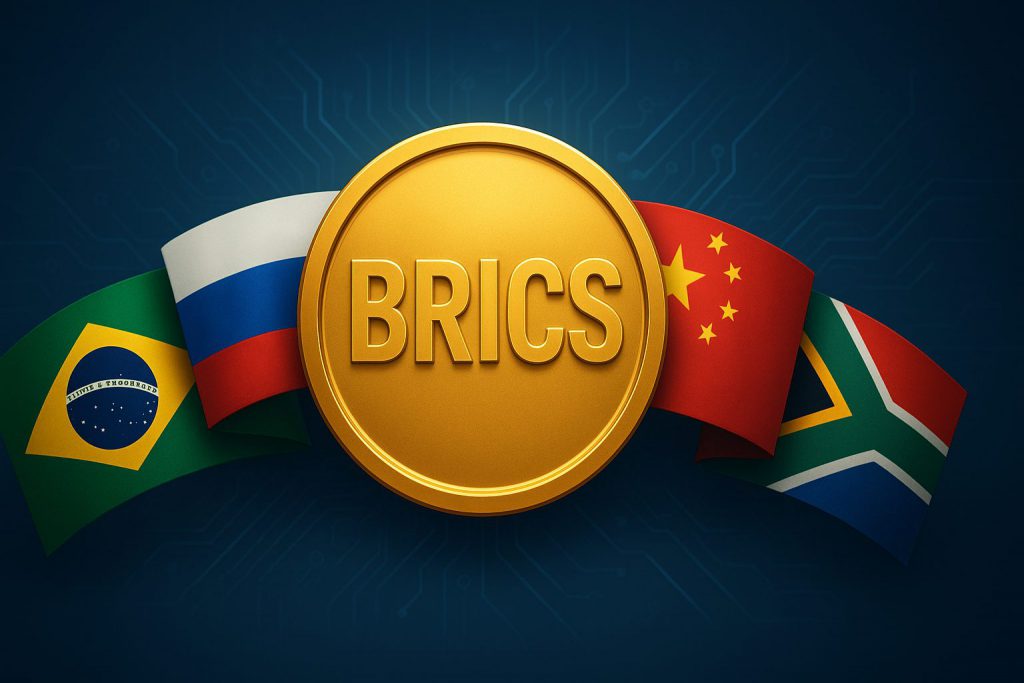
China’s Shanghai Gold Exchange International has been central to developing the BRICS gold settlement architecture. Russia served as the pilot in 2017, accepting yuan from China for oil with guarantees that yuan could be converted into gold through blockchain verification in Shanghai. This BRICS nations gold standard template has been extended to Saudi Arabia and other partners.
Russian Foreign Minister Sergey Lavrov stated:
BRICS Gold Settlement Network Spans Multiple Vaults
The BRICS nations gold standard infrastructure includes vaults in Saudi Arabia built with SGEI participation for direct currency-to-gold conversion from oil proceeds. Facilities in Singapore and Malaysia allow regional partners to store and pledge gold for credit lines. The BRICS gold settlement approach uses geographic diversification. Each member stores portions of reserves in vaults operated by other members.
Trade between Russia and China settles over 90% in rubles and yuan, providing evidence that BRICS dollar free operations function at scale. The BRICS currency full form—Brazil, Russia, India, China, and South Africa—now extends to eleven members including Egypt, Ethiopia, Iran, and the United Arab Emirates.
Record Gold Purchases Support BRICS De-Dollarization
Central banks bought over 2,100 tonnes of gold in 2022 and 2023 combined. Poland added 67 tonnes in the first half of 2025, bringing holdings to 515 tonnes. The Kyrgyz Republic pushed gold to 64.4% of total reserves. India’s Reserve Bank added 73 tonnes in 2024 and repatriated 100 tonnes from the UK.
Former RBI Governor Shaktikanta Das stated:
Gold Price Breaks Records as BRICS Momentum Builds
Gold reached an all-time high of $4,379.13 on October 17, 2025. The metal first broke through $4,000 on October 8. Year-to-date, gold climbed 56.86%—the strongest performance since 1979. Analysts cite BRICS de-dollarization as a key driver.
The yuan’s share of global forex trades climbed to 8.5% by September 2025. Russian Finance Minister Anton Siluanov confirmed the New Development Bank formalized a multi-billion dollar cross-border settlement hub for BRICS nations gold standard trade facilitation.
Payment Systems Target 2030 Launch
The proposed platform emphasizes voluntary participation with the BRICS gold settlement mechanism as the foundation. Russian Deputy Foreign Minister Sergey Ryabkov clarified the system targets operational status by 2030, though pilots could appear before end of 2026.
Andy Schectman, president of Miles Franklin, stated:
Kelly Bogdanova, Vice President at RBC Wealth Management, stated:
The BRICS de-dollarization movement represents 47.9% of global population following expansion. The bloc controls 70% of rare-earth reserves, 40% of global oil, and over 12,000 tonnes of gold. The BRICS currency full FORM expansion gives the BRICS dollar free initiatives considerable leverage in establishing alternative pricing mechanisms. There are three key projects that change the face of trade: bilateral currency settlements, BRICS Cross-border Payments Initiative as an alternative of SWIFT, and the BRICS Grain Exchange as commodity trading. In 2001, the dollar had 73% reserve share, but currently it has dropped to 54% with predictions showing that this percentage is likely to decrease further as the BRICS currency full form membership and BRICS de-dollarization infrastructure continue to increase up to 2030.
