How DAT Structures Wiped Out $17B From Retail Investors During Crypto Winter

Crypto's latest casualty? Mainstreet investors left holding the bag.
When the markets turned, decentralized autonomous trust (DAT) frameworks—once hailed as the future of finance—became a $17 billion trapdoor for retail traders. The very structures designed to 'democratize wealth' instead accelerated losses during the 2025 downturn.
Wall Street's old guard won't lose sleep—they've seen this movie before.

- DAT structures have led to retail investors facing $17 billion in losses amid crypto market volatility.
- Bitcoin’s fall below $100,000 has shaken confidence in DATs, with many now trading at a discount.
- In-kind contributions and unlisted tokens have fueled volatility, increasing risks for retail investors.
Retail investors are experiencing growing losses in Digital Asset Treasury (DAT) structures as billions of dollars in cryptocurrency market value continue to be wiped out. Recent estimates suggest more than $17 billion has been lost, raising concerns about the sustainability of these investments. With the crypto market showing increased volatility, confidence in these structures is rapidly declining.
A Bloomberg analysis shows that retail investors’ returns are being hit hard as the market continues to shake. Bitcoin’s tumble below $100,000 has shattered investor confidence in DATs.
Many DATs, which were previously considered premium investments, now trade at a discount to their net asset value, indicating that the market has turned. The declining value has set off alarm bells among retail investors who once considered these vehicles a safer bet.
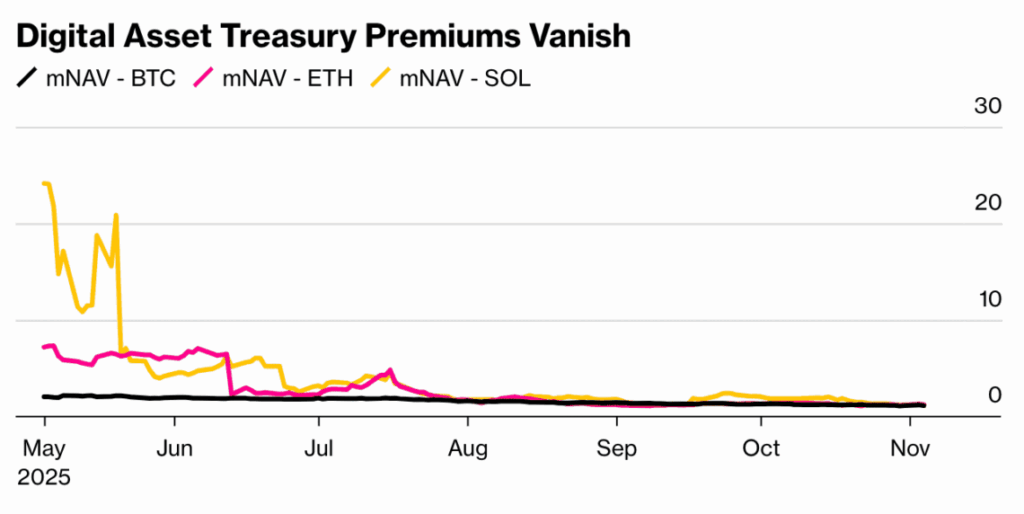
DAT Structures Once a Safety Net, Now a Liability for Retail Investors
HM’s Chris Holland said in the meeting that DAT structures can be like circular trades. He cautioned that retail investors might bear the losses these structures intended to shield them from if liquidity challenges arise. These formations, previously considered safety nets, are now unable to support the market as it goes through tumultuous times.
It got even worse in October as a sell-off punished many of these in-kind vehicles. Purchases of DATs using Michael Saylor’s strategy have already cost retail investors at least $17 billion, according to 10X Research. These losses demonstrate the risks of investments in light of unpredictable market moves. A SAFE investment plan has become a financial disaster for most.
Flora Growth Highlights Risks of In-Kind Contributions
Sponsors are opting increasingly for in-kind contributions rather than selling fiat for tokens. This friction will occur instead when sponsors contribute their own tokens, which will frequently be unlisted or illiquid rather than buying the tokens in an open market.
This approach reduces abrupt outflow of capital, but such a policy risks further short-term volatility, particularly as the market continues to evolve unexpectedly.
Flora Growth Corp. serves as a prime example of the risks involved. In September, the company raised $401 million in a DAT connected to Zero Gravity tokens, but only $35 million of this was cash. The remaining funds consisted of $3 tokens. After the listing for those tokens was posted, their value fell to $1.20, causing Flora Growth’s stock to plummet more than 65%.
Alt5 Sigma and Tharimmune have both faced the same challenges. Alt5 raised $1.5 billion for World Liberty Financial tokens, half in unlisted WLFI tokens. Tharminnune took in $545 million, 80% of which came in unlisted tokens on the Cantor. Both firms experienced precipitous drops in their share prices when those tokens came on the market.
