Bitcoin Long-Term Holders Offload 300K BTC – Is the Bull Market Losing Steam?

Bitcoin's most steadfast believers just made a seismic shift—dumping 300,000 BTC in a move that's rattled crypto markets. Are we seeing early profit-taking or a loss of faith in the original cryptocurrency?
The Great Unloading: Long-term holders—typically the diamond hands of crypto—have liquidated enough Bitcoin to buy a small country. This exodus coincides with Bitcoin's struggle to reclaim its all-time highs.
Market Impact: The sell-off creates immediate downward pressure, but remember—this is the same asset class where 'buy when there's blood in the streets' remains the unofficial mantra. Traditional investors would call this reckless; crypto natives call it Tuesday.
The Silver Lining: Every Bitcoin sold eventually finds new hands. Whether this redistribution fuels another rally or marks a local top depends on who's buying—institutional whales or overleveraged retail traders chasing the dream.
One thing's certain: in crypto, confidence moves faster than blockchain confirmations. And right now, it's sprinting toward the exits—with Wall Street's algos waiting to scoop up discounted digital gold (while pretending they never doubted it).

Bitcoin is struggling to stay above the $100,000 mark after dropping below several critical support levels. The latest report from Glassnode highlights a shift in market momentum as fading demand and long-term holder selling put consistent pressure on prices.
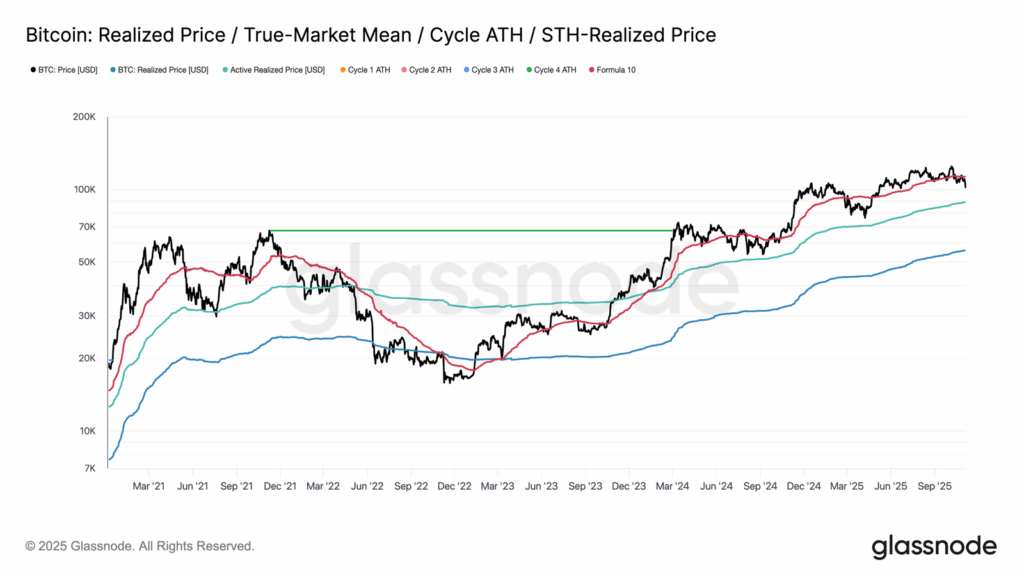
The digital asset has failed to recover above the short-term holder cost basis of $112,500, a level that historically signals renewed buying strength.
This breakdown marks a distinct move away from bullish market behavior. Since October 10, Bitcoin has lost about 11% of its value, testing investor patience as sentiment weakens. According to on-chain data, structural support now sits near the active investor realized price of $88,500, a zone often revisited during extended corrections.
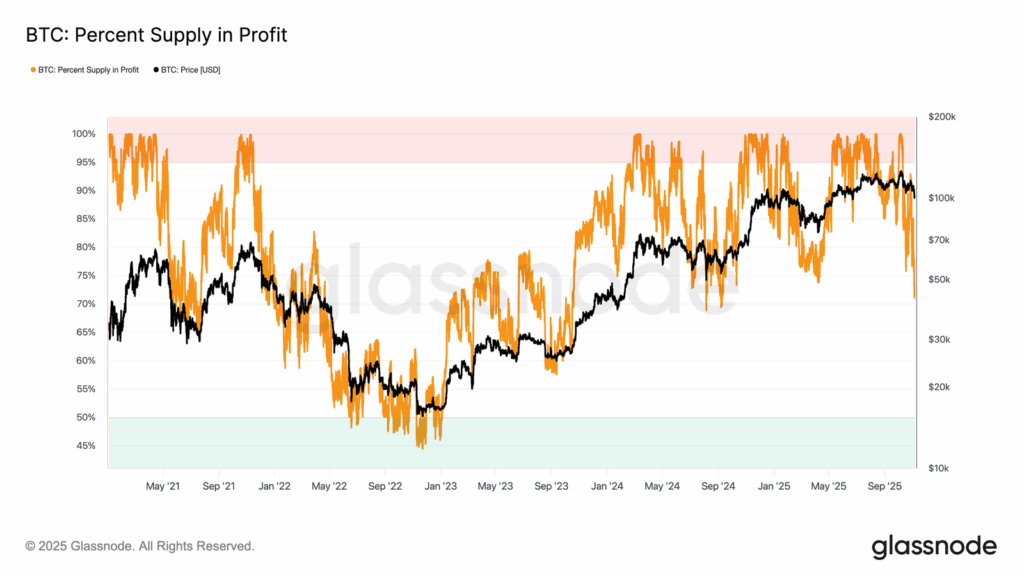
At present, roughly 71% of Bitcoin’s circulating supply remains in profit, hovering at the lower end of the equilibrium range observed during mid-cycle slowdowns.
In past cycles, similar patterns led to temporary relief rallies followed by periods of consolidation before recovery. But if more coins fall into loss territory, the market could slide deeper into a bearish phase, prompting longer re-accumulation periods.
Long-Term Supply Drops From 14.7M to 14.4M Bitcoin
Even as bitcoin has experienced a relatively low decrease of 21% from its all-time high price of $126,000, experienced holders have continued to sell their coins.
Since July 2025, experienced holders have collectively decreased their supply of coins by about 300,000 coins, down from 14.7 million coins to 14.4 million coins. Unlike previous phases, this time experienced holders continue to sell as prices fall, indicating that they have lost faith or conviction in their coins.
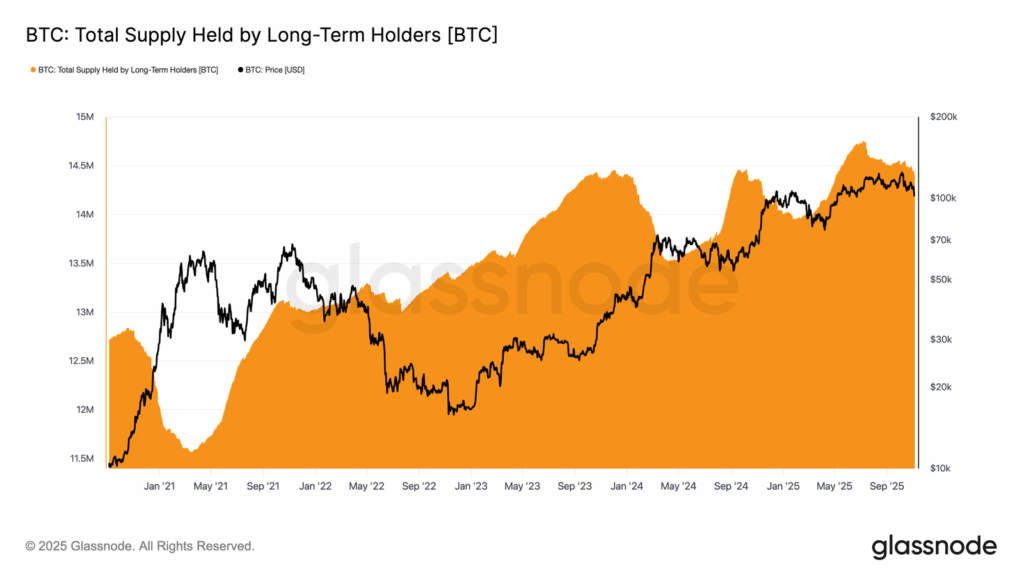
Such a steady distribution indicates that there is a balance between spending and maturing coins that have been allocated long-term status. Since mid-year, about 2.4 million coins have been spent by holders of longer-term coins, though this has been compensated for by maturing coins, translating into a net decrease of 300,000 coins in supply.
On-chain loss metrics continue to support this more conservative stance. The Relative Unrealized Loss value is currently close to 3.1% and not indicating market distress, as was observed during the bear market phase of 2022-2023. So long as this number is below 5%, one could say that this market is experiencing a planned correction, rather than a panic sale.

ETF Outflows Signal Waning Institutional Interest
There are signs of decreased market confidence through off-chain indicators as well. There have been daily flows of between 150 million and 700 million dollars leaving U.S. spot Bitcoin ETFs. This trend comes after a strong accumulation trend that had been pushing prices up during September and October.
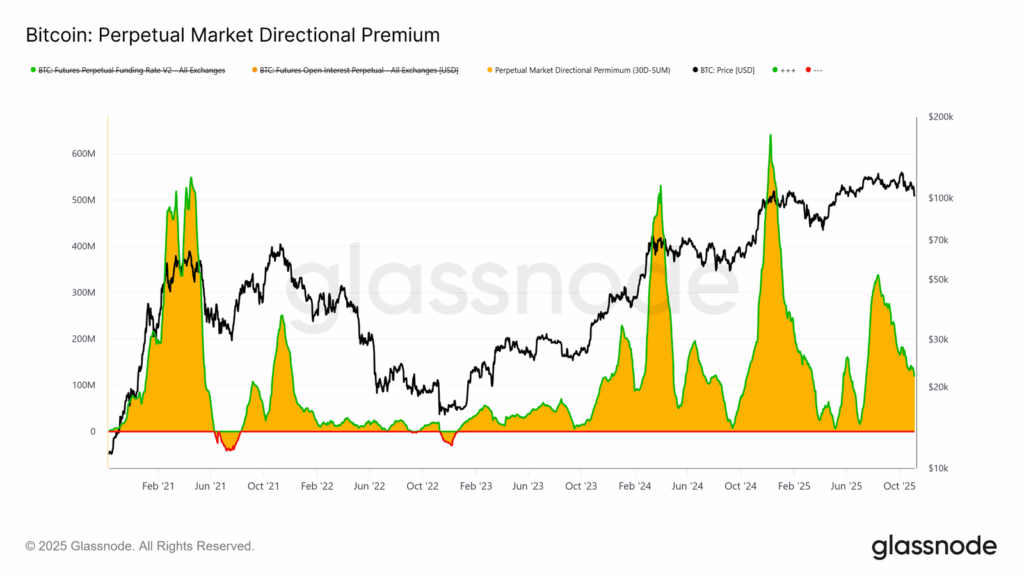
At the same time, perpetual futures market funding has decreased from $338 million monthly in April to approximately $118 million, indicating a step back from levered positions.
Market participants have shown favoritism towards neutral positions, and there is a strong skew towards downside protection within the options market. Volatility and put premiums NEAR $100K strike demonstrate market participants’ preference for hedging and protecting over accumulating positions.
