A stark FBI report reveals US cryptocurrency holders suffered a staggering $11.4 billion in losses during 2025, marking a 22% year-on-year surge in theft and exploits. The acceleration of attacks, which coincided with strong market performance, positions crypto scams as the second-largest category of cyber crime, trailing only phishing in total complaints.
US crypto holders made more complaints in 2025
US crypto holders increased their complaints by 21% year on year. Out of the total complaints logged, around 10% lost more than $100K.
The average loss was $62,604, revealing the significant engagement with crypto processes. The personalized attacks were varied, but overlapped with investment fraud. As of 2025, investment fraud was the leader in total amount stolen, with over $8.6B.
Crypto complaints logged by the FBI also targeted a specific age bracket.
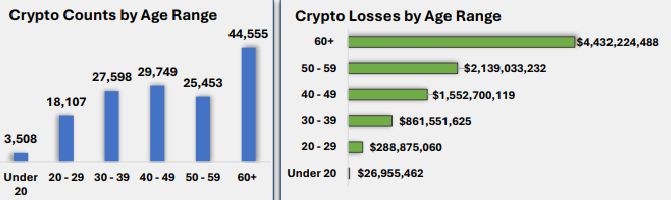
Crypto scams against individuals targeted the 60+ group more often, avoiding the younger cohorts, who were more aware of crypto pitfalls. | Source: FBI IC3 report
While crypto investors tend to be younger cohorts, the victims of fraud were, in most cases, aged 60 or over. That cohort lost over $4.4B in the past year and filed 44,555 complaints. That age group was mostly targeted by investment or confidence scams, often with little connection to crypto-native projects.
Investment scams were the leading cause of complaints and losses
The most common types of scams involve investment promises, fake kiosks or ATM, as well as recovery frauds with malicious links. Investment scams were the leader, with 61,559 complaints. Those scams rode on the rising popularity of BTC and crypto in 2025, a year marked by new all-time peaks for BTC.
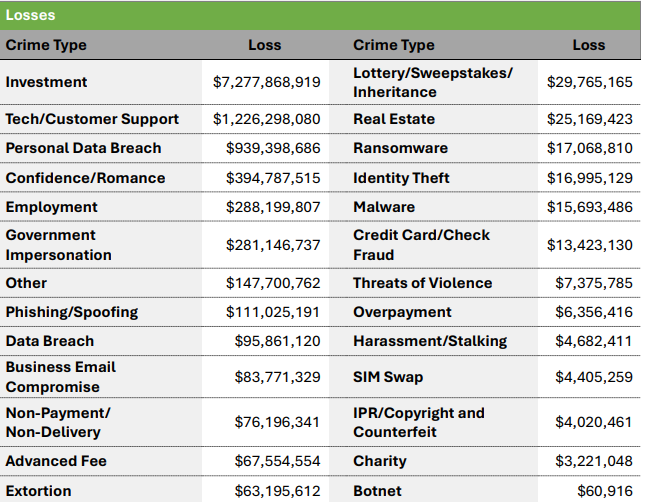
Investment with high return promises was the main vector of attack, with other crypto-adjacent scams also leading to significant losses. | Source: FBI IC3 report
California was the leader with 20,878 complaints and over $2B in losses. Outside investment fake promises, crypto crime included multiple categories related to payments or technical scams.
The FBI report counts personal scams and is not indicative of crypto-native attacks. Those often include other pathways and targets, especially smart contracts and protocols.
Crypto theft is also becoming more valuable, as stablecoins are becoming the main target of scams, as well as hackers. Unlike stealing tokens, withdrawing stablecoin liquidity retains its value and requires no additional trading.
While stablecoins can be frozen, in the case of real-life hacks like Drift Protocol, the reaction may arrive too slowly, when the funds are already laundered.
For personal scams in 2026, laundering may be more difficult after the crackdown against escrow services like Haoang Guarantee, Tudou, and Xinbi Guarantee.
The smartest crypto minds already read our newsletter. Want in? Join them.
Articles on this site are sourced from public networks or curated by AI for informational purposes only and do not represent BTCC’s views. Original rights belong to the respective authors. For copyright concerns, please contact
[email protected]. BTCC assumes no liability for the accuracy, timeliness, or completeness of this information, and disclaims all liability arising from reliance on such content. This content is for reference only and should not be taken as investment, legal, or commercial advice.



Log in to Reply
Log in to comment your thoughtsComments