A groundbreaking implementation of Quantum-Safe Bitcoin has been deployed without altering Bitcoin's core protocol, potentially neutralizing one of cryptocurrency's most existential threats. Researcher Avihu Levy published the working solution on April 9, 2026, operating entirely within Bitcoin's existing script constraints and available immediately to any user willing to absorb computational costs. This development bypasses Bitcoin's notoriously difficult governance process, where Levy's co-authored BIP-360 quantum-resistant address standard—merged into Bitcoin's official repository in February 2026—requires protocol-level consensus that could take years to achieve.


(@avihu28) April 9, 2026
Quantum Safe Bitcoin sidesteps that bottleneck entirely. It’s not a theoretical workaround; Levy shipped GPU-accelerated CUDA code, Python pipelines, and complete Bitcoin scripts alongside the academic paper.
How QSB Actually Works – Hash Puzzles, Not Elliptic Curves
Standard Bitcoin transactions rely on ECDSA signatures over the secp256k1 curve. Shor’s algorithm can compute discrete logarithms efficiently, meaning a sufficiently powerful quantum computer could forge those signatures and drain any wallet with an exposed public key.
Post-quantum cryptography addresses this – but every known implementation requires larger signatures and new opcodes, which means a soft fork.
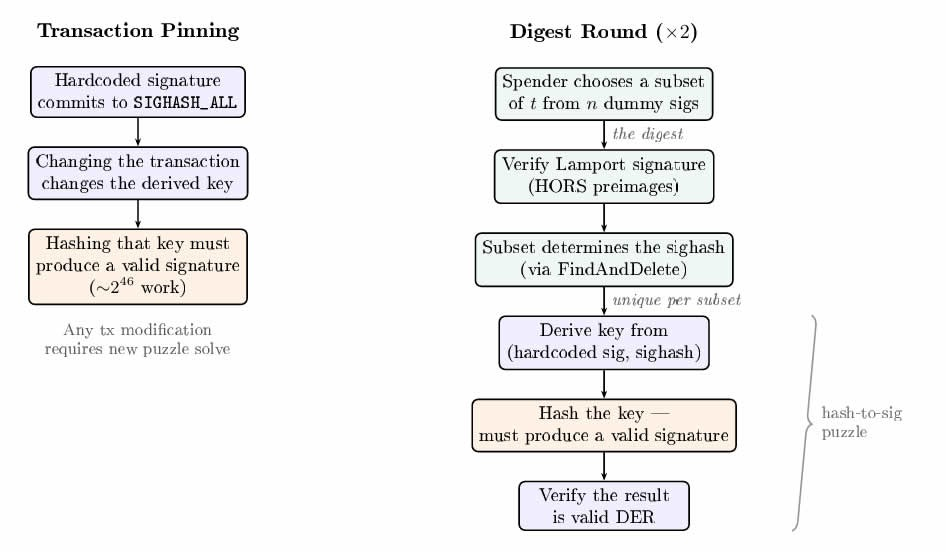
Levy’s approach cuts the elliptic curve dependency at the root. The scheme, built on Binohash (Robin Linus, 2026), replaces the standard signature verification with a hash-to-signature puzzle. The Bitcoin script hashes a transaction-bound public key via OP_RIPEMD160 and interprets the resulting 20-byte output as a DER-encoded ECDSA signature.
A random 20-byte string satisfies DER structural constraints with probability roughly 2−46 – that’s approximately one in 70 trillion attempts – which defines the proof-of-work target.
The critical distinction: this puzzle’s security rests entirely on RIPEMD-160’s preimage resistance, not on any elliptic curve assumption.
Source: GitHub
Shor’s algorithm attacks discrete logarithms. It does not break hash functions. That single architectural decision is what makesresistant to the quantum threat without touching the protocol.
The construction works in three phases. First, transaction pinning: the prover searches over (sequence, locktime) parameter pairs until the recovered public key’s RIPEMD-160 hash produces a valid DER signature – approximately 246 work.
Second, two digest rounds: for the pinned transaction, the prover searches over subsets of dummy signatures; each subset alters the scriptCode via FindAndDelete, producing a different sighash and a different recovered key.
Find a subset whose recovered key hashes to a valid DER signature (~246 candidates per round). The total computational cost is $75–$150 per transaction on cloud GPUs.
Zero-Knowledge Proofs and Dashlink enter the picture as an efficiency layer for proof verification. The QSB construction leverages post-quantum cryptography principles by anchoring security to hash-based assumptions – the same foundation underpinning ZK-friendly hash functions used in modern Zero-Knowledge Proofs.
Dashlink’s role is to compress the verification burden so that proof validation stays within Bitcoin’s existing 10,000-byte script limit and 201-opcode ceiling. No new opcodes. No consensus change. The scheme is consensus-valid under rules Bitcoin already enforces.
Bitcoin Hyper Targets Early Mover Upside

Bitcoin Hyper (HYPER) is currently in presale, targeting early-mover upside in the Bitcoin yield infrastructure layer – a sector drawing serious institutional attention as US spot Bitcoin ETFs pulled in $471.3 million in a single week.
The presale has raised $32 million to date, with the current token price at $0.0093 and staking APY running at 86% annualized for early participants.
The core technical differentiator: Bitcoin Hyper operates as a Bitcoin-native Layer 2 executing smart contracts with BTC as the settlement asset – bypassing the wrapped-token credit risk that plagues existing BTC DeFi infrastructure.
That’s a specific, verifiable architecture claim in a space full of vague interoperability promises.



Log in to Reply
Log in to comment your thoughtsComments