
Where and How to Buy Roaring Kitty (ROAR) in 2026
Roaring Kitty (ROAR) is more than simply a digital comm…
2026-04-03
BREAKING: Bitcoin's price correlation with global monetary policy has undergone a complete structural inversion, flipping from +0.21 before ETF approval to -0.778 in 2026—a shift nearly three times stronger in the opposite direction. According to a new Binance Research case study, Bitcoin has evolved from a macro lagging indicator to a leading pricer, now front-running Federal Reserve decisions and showing increasing indifference to ETF flow headlines that once moved markets within hours. This transformation threatens to dismantle the entire macro trading playbook active investors have relied on for the past decade, rendering traditional signals like CPI prints, FOMC language, and rate trajectory projections potentially obsolete.
The −0.778 correlation reading between Bitcoin price and the Global Easing Breadth Index is the headline number, but the mechanism behind it is what matters.
Before the January 2024 launch of spot Bitcoin ETFs in the United States, retail traders dominated BTC price discovery, reacting immediately to macro signals, selling on rate-hike language, and buying when easing breadth widened.
That reflex produced a mild positive correlation: more global central bank easing led to greater risk appetite, and BTC benefited.
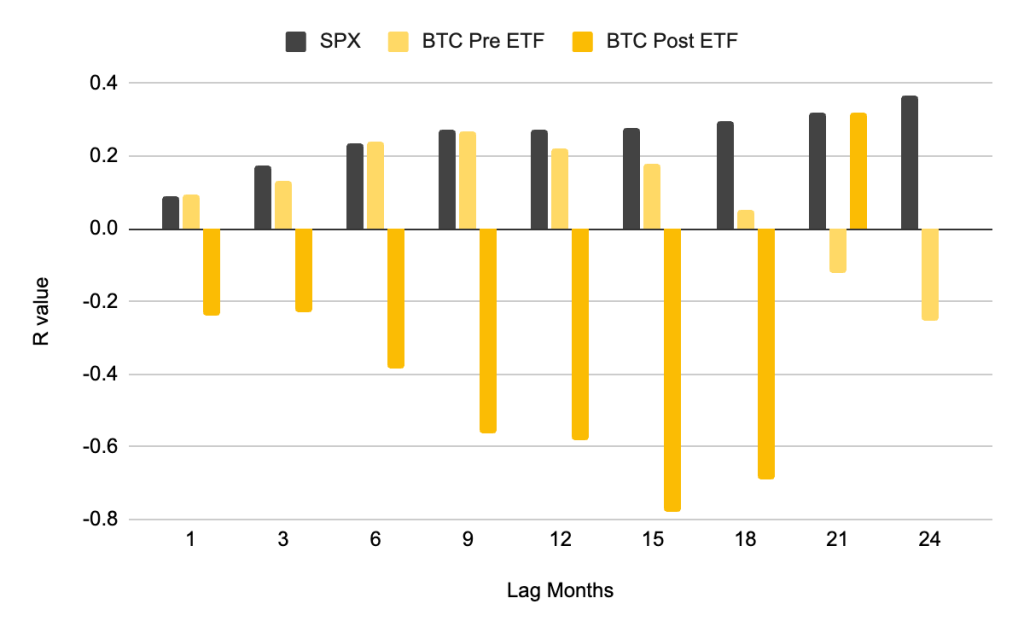
Institutional investors entering through ETF vehicles operate on a fundamentally different timeline. Binance Research documents that these players now build positions 6–12 months ahead of expected policy changes, effectively pricing in Fed decisions before official announcements arrive.
The result: when the Fed finally eases, BTC has already moved, and the correlation appears negative to any observer measuring it in real time.
On-chain data reinforces the structural argument. Long-term holder (LTH) supply has remained at historically elevated levels through Q1 2026 despite price volatility, consistent with accumulation rather than distribution.

Exchange reserve depletion continues-Bitcoin held on centralized exchanges has trended lower across the cycle, a signal that coins are moving into cold storage rather than toward sell-side liquidity.
The MVRV ratio, which compares market cap to realized cap, has held below 2.0 throughout early 2026, indicating the market remains well below the euphoria zone that has historically preceded major tops.
Together, these on-chain metrics describe a market structure where supply is contracting and patient capital is dominant-conditions that make BTC less reactive to short-term macro noise, not more.
The data makes the decoupling thesis concrete: Bitcoin isn’t ignoring the Fed because traders have become irrational. It’s ignoring the Fed because the marginal buyer has changed, and the new marginal buyer already knows what the Fed is going to do.
The practical consequence of the Binance thesis is a signal hierarchy reorder. Traders who treat CPI prints and FOMC meetings as tier-one BTC catalysts are using outdated inputs.
The new signal stack, as the data implies, runs: ETF weekly flow data first, LTH supply and exchange reserve metrics second, legislative and regulatory developments third, and Fed language a distant fourth.
The bull case requires three conditions to remain intact: ETF inflows sustain above $1 billion per month through Q2, exchange reserves continue declining (currently trending toward multi-year lows), and LTH supply holds above 14.5 million BTC without a significant distribution event.
If those three hold simultaneously, the supply-demand math supports a price structure where $90,000 functions as support rather than resistance, and the Bitwise supply-shock thesis moves from projection to observable market dynamic.
The bear case activates if institutional conviction breaks. A return to sustained ETF outflows, specifically two consecutive months above $2 billion net negative, would signal that the marginal buyer has stepped back, removing the demand anchor that has held the decoupling structure in place.
In that scenario, macro sensitivity could partially reassert, and the $70,000–$72,000 on-chain support band identified in current technical analysis becomes the first meaningful test level.
Binance Research put it plainly: a peak in global easing may already be old news for BTC. Watch monthly ETF flow totals and LTH supply in Q2; those two numbers will confirm or invalidate the decoupling thesis faster than any Fed statement will.



Log in to Reply
Log in to comment your thoughtsComments