VanEck’s $60K-$70K Macro Bottom Thesis: The Real Crypto Cycle Reset or Just Hopium?

Forget the panic. VanEck just drew a line in the sand.
The investment giant's latest thesis cuts through the noise, pinpointing a $60,000 to $70,000 range as the new macro floor for Bitcoin. It's not a prediction—it's a declaration of structural support, a level where institutional gravity kicks in and retail capitulation ends.
Anatomy of a Bottom
This isn't about short-term volatility. VanEck's model bypasses daily sentiment, focusing instead on on-chain metrics, miner economics, and ETF flow sustainability. The $60K-$70K zone represents more than a price—it's the cost basis for a new wave of capital, the level where long-term holders stop selling and start accumulating again.
The Institutional Pivot
Gone are the days of wild west speculation. The floor thesis hinges on regulated products and corporate treasury strategies entering the fray. When traditional finance finally gets a seat at the table, they don't just buy the dip—they redefine what a dip even means.
Cycle Reset or Wishful Thinking?
Skeptics will call it another narrative spun by suits trying to justify their own positions—because what's finance without a little self-serving prophecy? But the data doesn't lie: sustained accumulation at these levels would signal a market maturity we've never seen before.
One thing's clear: if VanEck is right, the rules of the game just changed. The question isn't whether Bitcoin finds a bottom, but what kind of market gets built on top of it.
The VanEck “Macro Bottom” Thesis: A Bullish Call in a Choppy Market
Jan van Eck isn’t looking at the 15-minute chart. Speaking to CNBC, the CEO laid out a thesis that frames the last two years not as a random walk, but as a textbook completion of Bitcoin’s historical capitulation phase.
According to van Eck, the brutal drawdown of 2022 and the consolidation of 2023 established a Bitcoin Macro Bottom that remains intact despite recent volatility.
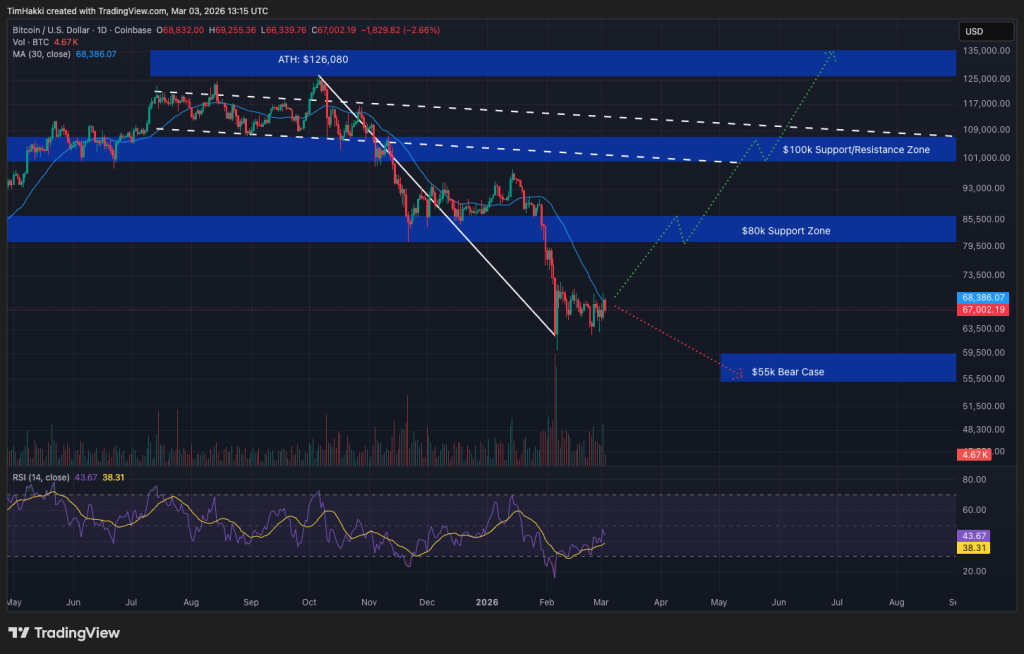
The argument is simple but contrarian. Most traders view the inability to break $73,000 as a failure. Van Eck views the resilience of the $60,000 level as proof of a new cycle floor, or “macro bottom”.
He notes that Bitcoin, often correlated with tech stocks, is behaving more like gold in its maturity phase. This isn’t just a risk-on asset anymore. It is a store of value being absorbed by the traditional financial plumbing.
"I think we're making a bottom." @JanvanEck3 pic.twitter.com/NdbHJqREui
— VanEck (@vaneck_us) March 3, 2026Data from CryptoQuant supports this structural view. Long-term holder supply has remained relatively static around the $60,000 mark, suggesting that while tourists are leaving, the entities van Eck represents, funds, wealth managers, and family offices, are not selling.
Now, fear just hit a level seen only twice before, often a counter-signal for a cycle reset. If the macro bottom thesis holds, any dip below $60,000 is a deviation, not a trend change.
The 4-Year Halving Cycle: Dead or Just Different?
For a decade, the 4-Year Cycle was the gospel. Halving cuts supply. Miners sell less. Price goes up. But the 2024 Halving Analysis has proven far more complex. Bitcoin hit an all-time high before the April halving, a historic anomaly that broke the standard model.
The culprit is the ETF. The launch of spot Bitcoin ETFs introduced what analysts call a “continuous demand shock.”
In previous cycles, price action was dictated by miner capitulation and eventual supply squeezing. Now, daily BTC ETF Inflows or outflows can dwarf the daily production of miners by a factor of ten. This creates a tug-of-war between the old cycle mechanics and new Wall Street liquidity.
VanEck’s analysts have noted this shift. In a recent Bitcoin report, they highlight that while miner revenue is down, leading to a hashrate drop of 4% in late 2024, the price has not collapsed.
This divergence matters. If the 4-year cycle were purely mechanical, the miner stress post-halving should have crushed the price to $40,000. It didn’t. The ETF bid provided a floor.
However, the cycle isn’t dead; it’s elongated. Now, the market is waiting for the traditional post-halving supply shock to actually register on exchange balances. Until exchange reserves hit critical lows, the tension between the 4-year pattern and institutional flows will keep volatility high.
Institutional Reality Check: ETF Flows vs. Miner Capitulation
Institutional behavior currently tells two different stories. On one hand, miners are under extreme pressure. Profitability has plummeted post-halving, forcing some operators to sell inventory to cover electricity costs. Typically, this miner capitulation suppresses price for months. This aligns with the bearish argument: the sellers are exhausted, but they are still selling.
On the other hand, the BTC ETF Inflows paint a picture of relentless absorption. BlackRock’s IBIT and Fidelity’s FBTC have continued to see net positive weeks even during price dips.
This is a divergence from retail sentiment. When retail sells in fear, ETFs are buying in size. $1 billion flooded back into crypto ETFs recently, signaling that smart money sees current prices as a discount, not a danger.
This accumulation signals that the “macro bottom” Van Eck describes is being enforced by capital allocators, not chart patterns.
If ETF buyers continue to absorb miner supply, the supply shock will eventually trigger a repricing. But if institutional flows dry up while miners are still capitulating, the floor at $60,000 becomes precarious.
