Vitalik Buterin Dumps 9,000 ETH - Is Ethereum Headed for $1,500?

Ethereum's co-founder just made a massive move. Vitalik Buterin sold 9,000 ETH, sending shockwaves through the crypto market and sparking fears of a major price correction.
The Whale's Exodus
When a founder sells, the market listens. This isn't just another wallet transfer; it's a strategic exit by one of the most influential figures in blockchain. The sheer volume—9,000 ETH—creates immediate sell-side pressure and raises the ultimate question of insider sentiment.
The $1,500 Question
Technical charts now paint a grim picture. Key support levels are crumbling, with analysts pointing to $1,500 as the next major downside target. This isn't mere FUD; it's a mathematical reality based on current order book liquidity and historical resistance flips.
Market Mechanics in Motion
Large sales don't just affect price—they alter market structure. Liquidity pools rebalance, automated strategies trigger stop-losses, and the entire derivatives market shifts its hedging posture. One wallet activity cascades into a systemic tremor.
The Founder's Gambit
Buterin's move follows a familiar playbook: founders monetize while retail holds the bag. It's the Silicon Valley exit strategy dressed in decentralized clothing—another reminder that in crypto, the 'early adopters' are often the first to adopt a profit-taking strategy.
Ethereum's resilience will face its ultimate stress test. Will the network's fundamentals outweigh a founder's fading conviction, or is this the signal that separates the true believers from the fair-weather fans? The market votes with every limit order.
Why Is Founder Selling Triggering Alarm?
The market’s sharp reaction stems from both the volume of the sale and historical precedent. Founder-led selling often acts as a bearish signal for retail traders, and previous sales by Buterin have preceded price declines of almost 23%.
With roughly 7,350 ETH still remaining in the wallet, traders fear a continued supply overhang could suppress price action throughout the week.
This localized selling pressure compounds macro headwinds. Broad market sentiment has already shifted due to nervousness surrounding tariffs, which recently caused a de-risking event across major altcoins.
While long-term institutional holders like Consensys maintain significant treasuries, the immediate liquidity shock from a founder sale creates a tangible drag on short-term momentum.
Technical Breakdown Points to $1,475 Bottom
The price action on the charts confirms the bearish narrative. ethereum has entered the “breakdown phase” of a prevailing bear pennant pattern.
Early on Monday UTC, ETH dropped approximately 5.60% in 24 hours to hover NEAR $1,850, slicing through the pennant’s lower trendline. Rising trading volumes accompanied the move, indicating strong conviction from sellers.
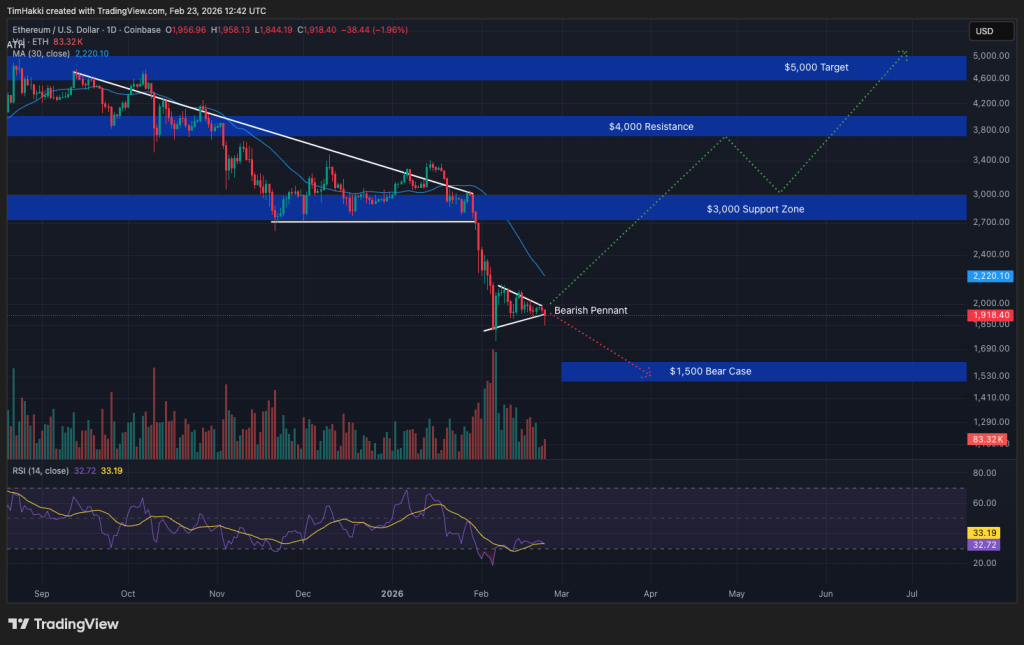
According to standard technical analysis principles, a bear pennant breakdown typically resolves when the price falls by a magnitude equal to the previous downtrend’s height.
Applying this to the current chart suggests a downside target of $1,475, precisely aligning with the psychological support zone of $1,500.
While Buterin continues to advocate for protocol improvements, recently backing censorship resistance upgrades, these long-term fundamentals are currently overshadowed by chart weakness.
Can Ethereum Hold Critical Support?
The path forward depends heavily on whether buyers can defend the sub-$1,800 region.
If the bearish momentum continues, a test of $1,475 appears inevitable by early March. Conversely, invalidating this outlook requires a swift reclaim of the pennant’s lower trendline and a sustained close above the $2,000 resistance level.
Despite the current gloom, some analysts, including those at Intellectia.ai, suggest that a 2026 return to $3,000 remains firmly feasible once this correction exhausts itself.
