Ether.fi Shifts Crypto Card to OP Mainnet, Drops Scroll in Strategic Pivot

Ether.fi just pulled its crypto card product from Scroll and redeployed it on OP Mainnet. It's a quiet but significant migration—one that speaks volumes about where the smart money is building.
The Layer-2 shuffle is on
Forget the hype cycles. Real adoption happens when infrastructure moves. Ether.fi's card—a bridge between DeFi liquidity and real-world spending—needs a chain that's fast, cheap, and, crucially, has a thriving ecosystem. OP Mainnet, with its growing Superchain vision, just checked more boxes than Scroll did. This isn't about one chain failing; it's about another proving it can scale utility right now.
Why this move matters for your wallet
It signals a consolidation phase. Projects are moving beyond multi-chain sprawl to strategic concentration. They're picking winners based on developer activity, transaction finality, and partnership potential—not just grant money. For users, it means fewer fragmented experiences and a more seamless path from yield farming to buying coffee. The card's functionality hinges on low fees and instant settlements—OP Mainnet's optimistic rollups deliver that promise today.
The cynical take from a finance veteran
Let's be real—this is also about survival and attention. In a market where traditional finance still views crypto cards as a novelty, aligning with a top-tier L2 like OP Mainnet isn't just technical; it's marketing. It's a signal to VCs and users that you're building on the rail with momentum. Sometimes, infrastructure choices are as much about narrative as they are about nanoseconds. After all, in crypto, perception often liquidity.
The bottom line? Ether.fi's pivot is a bullish case study in pragmatic evolution. It cuts through the multi-chain noise and commits to a stack that works. Watch where the serious builders migrate—that's usually where the next wave of real utility gets spent.
Key Takeaways
- Mass Migration: Approximately 70,000 active cards and 300,000 accounts are moving to Optimism.
- Volume Impact: Ether.fi Cash processes roughly $2 million in daily spend volume.
- Incentives: Gas fees for card transactions will be fully absorbed by Ether.fi during and after the transition.
Why Is Network Choice Critical?
Ether.fi initially built its reputation on asset restaking but successfully pivoted to consumer payments with Ether.fi Cash in 2024.
The product allows users to spend stablecoins or borrow against staked assets like EETH to fund real-world Visa purchases.
According to Paymentscan, these cards now facilitate nearly half of all crypto-native card transactions.
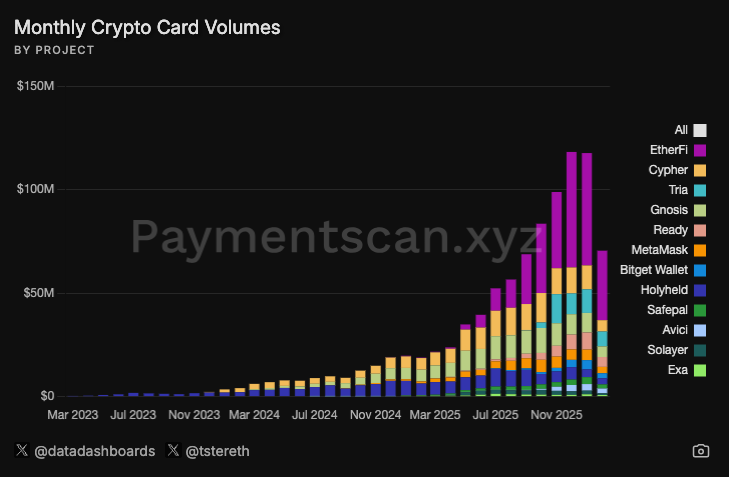
The choice of underlying network defines transaction speed and liquidity depth.
Operational stability is paramount for consumer products; just look at what happened to what happened to Moonwell this week.
Payment providers must mitigate infrastructure risks by selecting mature execution layers. Ether.fi’s MOVE signals that liquidity depth on OP Mainnet currently outweighs the ZK-rollup advantages offered by Scroll for this specific use case.
Breaking Down the Migration
The migration utilizes an OP Enterprise partnership, providing Ether.fi with dedicated support and shared codebase tooling.
Transaction costs for card usage will be absorbed by the protocol, ensuring users experience no friction during the switch. This is critical as Ether.fi Cash currently processes roughly 2,000 internal swaps and 28,000 spend transactions daily, metrics that have reportedly doubled every two months.
1/ Today, we announce our plan to move to @Optimism's OP Mainnet
70,000+ active cards, 300,000+ accounts, and $160M+ in TVL will migrate to the Superchain in the coming months, marking a long-term partnership to accelerate global onchain payments.
Learn more below ↓ pic.twitter.com/ayd11I4SAd
Capital efficiency is the Core technical driver here. Much like how new frameworks are introducing unified liquidity and staking solutions, Ether.fi expects deeper liquidity for swaps on OP Mainnet compared to its previous deployment.
Optimized liquidity pools mean lower slippage for users converting crypto to fiat at the point of sale.
The OP Stack itself processed a staggering 3.6 billion transactions in the second half of 2025, representing 13% of all crypto transactions in that period.
What Does This Mean for the L2 Landscape?
For Scroll, this represents a notable loss of volume. The ZK-powered chain had relied on Ether.fi as a significant driver of daily activity.
Conversely, Optimism reinforces its position as a dominant hub, securing a high-retention consumer product just as internal ecosystem dynamics shift, notably with Base signaling moves toward a bespoke chain platform.
This consolidation reflects a maturing ethereum ecosystem where projects prioritize battle-tested liquidity over novel tech stacks.
It aligns with broader institutional positioning, similar to how funds like Founders Fund have adjusted their ETH-related exposure to align with prevailing market realities.
For the end user, the backend plumbing changes, but the card in their digital wallet simply becomes more efficient.
