Canary and Grayscale Unleash Game-Changer: First-Ever Sui ETFs with Staking Rewards Hit US Markets

Two titans just rewired the ETF rulebook. Canary and Grayscale—names that move markets—have launched the first US-listed exchange-traded funds for the Sui blockchain, and they're packing a feature Wall Street hasn't seen before: built-in staking rewards.
The Passive-Income Pivot
Forget the old buy-and-hope model. These funds don't just track Sui's price; they actively stake the underlying assets. That means investors get exposure to the token's potential growth plus a yield stream—a dual-engine approach that turns a speculative asset into a potential cash-flow vehicle. It's a direct challenge to the stagnant, fee-heavy structures of traditional finance.
Why This Isn't Just Another Crypto Fund
Grayscale's brand brings institutional heft, while Canary's move signals aggressive product innovation. By bundling staking into the ETF wrapper, they solve a massive pain point: the technical complexity and security risks of DIY staking. Now, any investor with a brokerage account can tap into Sui's network rewards—no crypto wallet required. It democratizes a core Web3 function, potentially unlocking billions in sidelined capital.
The Regulatory Tightrope Walk
Getting this green-lit in the US is the real story. The SEC has historically blanched at crypto ETFs that do more than passively hold. By structuring the staking mechanism within the fund's operations—and presumably navigating a gauntlet of compliance checks—the issuers have set a precedent. Watch for a flood of 'staking-ETF' copycats if this gains traction.
A cynical take? It's a brilliant fee-justification strategy wrapped in innovation—finally giving fund managers something to 'actively' manage in the passive ETF space, and a fresh reason to clip that expense ratio.
This launch does more than add another ticker. It blurs the line between investing and participating. It's a bet that the next wave of adoption won't come from pure speculation, but from investors seeking utility and yield—even if they never know what a validator node is. The race to tokenize everything just found its new blueprint.
Why Sui Crypto ETFs With Staking Matter
While spot Bitcoin and ethereum ETFs have attracted over $140 billion in inflows, they notably lack staking mechanisms due to initial regulatory hurdles.
The new SUI ETFs from Canary and Grayscale actually can stake the tokens. They tap into Sui delegated proof of stake system and earn rewards. That yield can help offset the usual management fees.
For institutions, that is a big deal. They do not just want price exposure. They want income too.
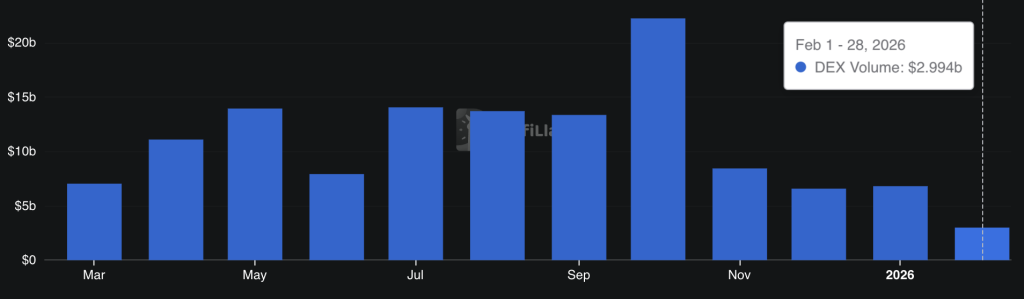
Demand for smarter products is rising rapidly. However, the SUI chain itself has been in decline over the past couple of months. We’re now in mid-January, and DEX volume is at $3B. It may outperform this January, but it is still lower than last year’s numbers.
Breaking Down the ETF Structure
Canary Capital’s ETF is live on Nasdaq under SUIS. It sits under the 1940 Act, which means tighter oversight.
That usually attracts the more cautious money. CEO Steven McClurg made it clear. Investors get direct access to net staking rewards.
Just had my first @SteaknShake burger to celebrate launch of $SUI etf.
Solid choice.
At the same time, Grayscale flipped its old Sui trust into an ETF called GSUI on the NYSE. The fee is 0.35%, waived for the first three months or until assets hit $1B.
And here is the kicker. 100% of the tokens were staked at launch. Classic Grayscale move. Turn legacy trusts into spot ETFs and scale fast.
