BlockFills Halts Withdrawals Amid Bitcoin Downturn - Counterparty Risk Fears Intensify

Another domino wobbles as BlockFills freezes customer withdrawals during Bitcoin's latest slide.
The move throws a harsh spotlight on counterparty risk—the silent killer in crypto's infrastructure layer.
When Trust Evaporates Overnight
Withdrawal freezes are never just operational hiccups. They're red alarms signaling potential liquidity mismatches or worse—insolvency. In a market where assets can plunge double-digits in hours, platforms face immense pressure. BlockFills' decision, while framed as protective, immediately shifts risk from their balance sheet to their users'.
The Counterparty Conundrum
This isn't about FUD—it's about fundamental finance. Every centralized platform you use is a counterparty. You're betting they're solvent, liquid, and honest. When Bitcoin drops, that bet gets stress-tested. BlockFills just failed its test, joining a notorious list of firms that paused withdrawals before vanishing entirely. Due diligence isn't optional; it's survival.
Decentralization's Persistent Promise
Each centralized failure fuels the argument for self-custody and DeFi. Why trust a middleman's opaque ledger when code can enforce solvency transparently? The technology exists. Adoption lags—often until it's too late. This episode is another costly reminder that in crypto, your keys are your coins; everything else is credit.
Market Mechanics Under Stress
Bitcoin's volatility isn't the disease—it's the symptom. The real illness is leverage and poor risk management hidden across the ecosystem. Platforms promise seamless trading but often rely on risky, rehypothecated assets. A price drop triggers margin calls, then liquidity crunches, then gates. It's a playbook written in 2022, yet here we are again in 2026. Some never learn—or worse, they learn and bet you won't notice.
The path forward demands more than hope. It requires verifiable reserves, real-time audits, and a cultural shift toward transparency. Until then, expect more freezes. And maybe—just maybe—keep most of your stack in a wallet you control. After all, the only counterparty risk you can truly eliminate is the one you never take. The old finance joke holds: How do you make a small fortune in crypto? Start with a large one and use a sketchy exchange.
Key Takeaways
- BlockFills has reportedly frozen client withdrawals and deposits without immediate explanation.
- The firm was averaging over $100 million in daily trading volume as of mid-2025.
- Founders include veterans from Deutsche Bank and Credit Suisse, highlighting risks even in “institutional-grade” platforms.
BlockFill’s Institutional Pedigree is Under Pressure
This isn’t some anonymous offshore exchange run by code hobbyists. BlockFills was purpose-built by heavyweights from the traditional finance (“TradFi”) world to bring adult supervision to crypto.
The leadership team includes former executives from Deutsche Bank and Citadel, who pivoted to crypto to bridge the gap between centralized TradFi structures and fragmented crypto liquidity. They pitched themselves as the safe, compliant option for proprietary trading firms.
But pedigree doesn’t immunize you from market mechanics. The halt coincides with a brutal rejection in price action.
As bitcoin slides following reports on US labor market revisions, liquidity providers are facing severe stress tests.
Traders rely on these platforms for 24/7 access to credit and collateral management. When that access cuts off suddenly, it implies the firm is trying to stop a run on assets or manage a credit blow-up internally.
Is the Fallen Price of Bitcoin Causing a Liquidity Crunch at BlockFill?
Why now? The market structure is thinning out. We are seeing significant capital flight, with Bitcoin ETF outflows hitting $410M as BTC slips below $66k.
When institutions pull back, ECNs (Electronic Communication Networks) like BlockFills often face imbalances. If their liquidity providers pull quotes (i.e. stop offering buy or sell prices), or margin calls start cascading, the safest MOVE for the venue is often to freeze the pipes. That protects the house, but it leaves clients exposed to the elements.
This follows a rough quarter for trading venues globally. Even giants are feeling the pinch, with Coinbase reporting a $667M loss amid the market downturn. However, there is a massive difference between reporting a loss and freezing client assets.
- The best new crypto to buy now.
- The best meme coins on the market today.
What Happens Next?
Silence is expensive in this industry. Traders are already drawing parallels to the 2022 credit contagion, where “temporary” halts often turned into permanent restructuring.
BlockFill users are now keeping vigil for an official statement regarding solvency. Is this a technical glitch, or a liquidity crisis? If the latter, it challenges the narrative that institutional infrastructure has solved crypto’s counterparty risk problem.
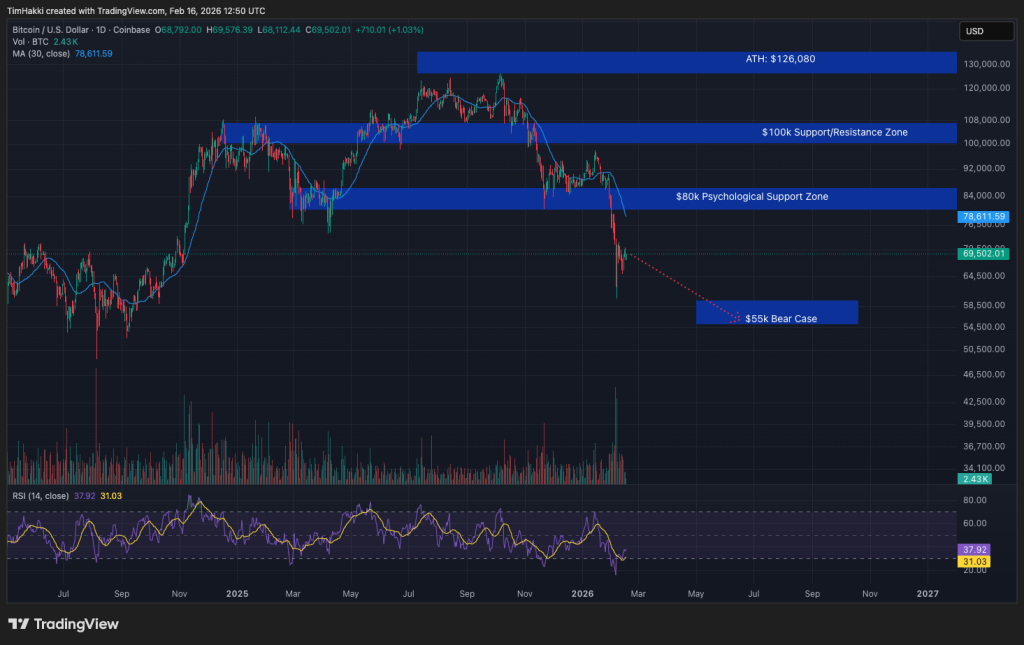
Analysts are watching support levels closely. While CryptoQuant suggests the ultimate Bitcoin bear market bottom could be $55,000, blocked funds can’t buy the dip.
Ultimately though, for BlockFills clients, the price of Bitcoin matters less right now than the status of their withdrawal button.
