Bitcoin Capitulation Mode: Why This ’Discipline-Over-Prediction’ Phase Is Your Ultimate Test

Bitcoin's latest plunge isn't just another dip—it's a full-blown capitulation event. The market's shedding weak hands, flushing out leverage, and entering a zone where emotional traders get wrecked. This is where narratives die and fundamentals get tested.
The Discipline Playbook
Forget price targets. Technical analysis looks like abstract art right now. The game has shifted from predicting the bottom to executing a plan. Dollar-cost averaging isn't sexy, but it works. Rebalancing a portfolio requires stomach, not genius. This phase rewards the robotic, not the prophetic.
Contrarian Signals Flash
While mainstream headlines scream panic, on-chain metrics tell a quieter story. Exchange reserves are draining. Long-term holders aren't budging. The noise is deafening, but the data suggests accumulation is happening under the surface—just like it always does when sentiment hits extremes.
Surviving the Washout
This isn't about timing the market; it's about time in the market. Liquidity crunches expose over-leveraged positions. Every major cycle has this purge. The key? Maintain exposure without gambling the farm. Manage risk like your survival depends on it—because it does.
Capitulation creates opportunity. It separates tourists from residents. While traditional finance panics over quarterly returns, crypto's brutal honesty forces a longer-term view. The market isn't broken; it's just working as designed—removing excess with ruthless efficiency. Stay disciplined, stay solvent, and remember: the best trades often feel the worst when you make them.
‘Bitcoin Capitulation’
Nic Puckrin, investment analyst and co-founder of, commented on BTC’s recent and major pullback, particularly its fall to the $70,000 level.
“As Bitcoin continues its slide toward the psychological barrier of $70,000, it’s clear the crypto market is now in full capitulation mode,” he said.
Per Puckrin, based on data provided by previous cycles, the current situation is “no longer a short-term correction, but rather a transition from distribution to reset.” These typically take months, not weeks, he warns.
The analyst now expects BTC to fight to defend the $70,000 threshold. If it breaks below, it could proceed lower towards its bear market low around the $55,700-$58,200 territory.
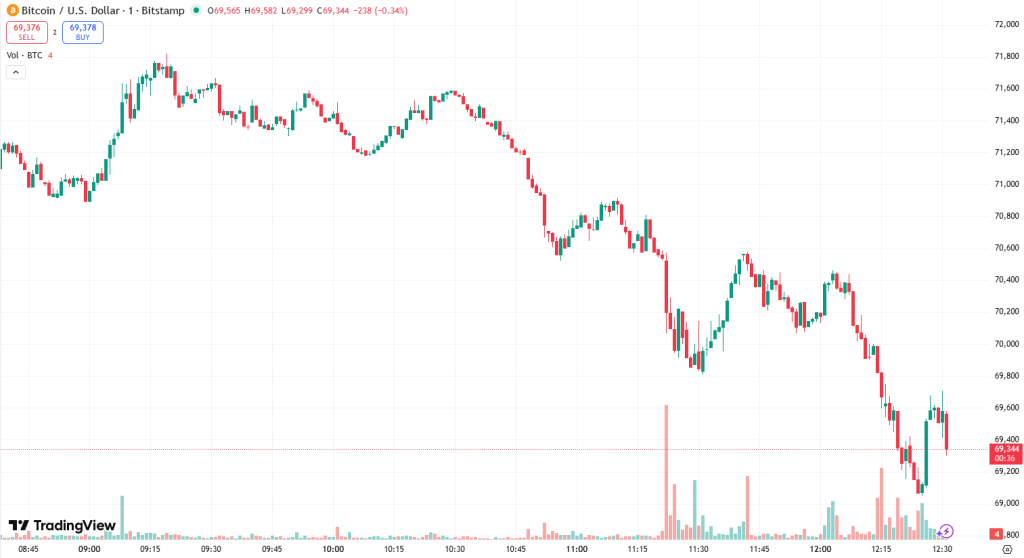
Meanwhile, Puckrin also noted that the market is slipping as Bitcoin whales are going for large-scale selling. At the same time, institutional outflows are increasing.
Yet, while Bitcoin exchange-traded funds (ETFs) are seeing negative flows, the majority of ETF holders are sitting on paper losses. It is Bitcoin OGs who are doing most of the selling, Puckrin says, citing Bloomberg data.
“This is Bitcoin’s institutionalisation in action,” the analyst concludes.
‘Discipline Over Prediction’
Nic Roberts-Huntley, CEO and co-founder of, argues that Bitcoin’s latest drop doesn’t suggest a fundamental breakdown in demand. Instead, it reflects a broader risk-off sentiment across markets.
The number one coin has struggled to hold key technical levels. Liquidity dried up and forced liquidations intensified, the CEO said.
Additionally, macro uncertainty and risk sentiment are currently driving flows, as evidenced by the demand for precious metals and other traditional hedges.
“That said, if macro clarity returns, liquidity improves, and key support holds, Bitcoin could stabilise and set the stage for a recovery rally later in the cycle,” Roberts-Huntley wrote.
“In the NEAR term, traders and investors should be watching whether BTC can defend the mid-$70,000s and reclaim the $78,000–$80,000 zone.” These are key levels to monitor.
A lot of stops were likely just taken, and a lot of people are now flipping bearish because of the lower low
IMO this *could* lead to a short-term bounce
I closed more shorts and will leave the rest — no new positions until more clarity and no hedge long yet either
Meanwhile, Tony Severino, market analyst at, wrote that the common theme across markets this week “is not direction, but compression.”
Bitcoin is “locked in one of the tightest volatility regimes in its history.” At the same time, currency volatility is rising even as the dollar softens, and metals are holding extreme levels without breaking.
“These conditions tend to frustrate short-term participants, but they also signal that markets are working off time rather than trend,” Severino wrote.
“For crypto investors, this is a phase that rewards discipline over prediction.”
He argued that macro forces are shifting, while technical structures across assets suggest that resolution is nearing. Timing, though, is still unclear.
“When volatility expands from these conditions, history suggests the MOVE is unlikely to be subtle. Until then, patience, positioning, and risk management remain the real edge,” the analyst concluded.
You may also like: Nic Roberts-Huntley on DeFi’s Next Frontier: Institutional Yield, Crypto Vaults, and the Maturation of Digital Assets | Ep. 509 In this wide-ranging interview, Nic Roberts-Huntley, CEO and co-founder of Blueprint Finance, shares a rare perspective shaped by an unconventional journey from elite surgical practice to institutional finance and, ultimately, decentralised finance (DeFi). Drawing on his experience at Oxford, Point72, and now the helm of a fast-growing DeFi infrastructure company, Roberts-Huntley explains why crypto is entering a more mature phase - one defined less by speculation and more by sustainable...‘Bitcoin Serves as a Barometer’
analysts identified renewed tensions in the Middle East, as well as the AI-sector-fuelled “repricing-driven selloff” in technology stocks, as major factors affecting markets.
When it comes to BTC specifically, it retraced 45% from last year’s high of $126,080. The overall market pullback suggests that “the excess risk premium accumulated earlier has been systematically squeezed out.” Subsequently, this has led to market sensitivity to liquidity conditions, as well as elevated uncertainty.
Additionally, “Bitcoin is increasingly viewed as a result indicator of whether markets are willing to reabsorb risk,” the analysts say. In other words, BTC “serves as a barometer of whether capital is willing to re-engage with higher-risk assets.”
If the cryptocurrency manages to reclaim $75,000 and remain structurally stable there amid mounting macro uncertainty, it WOULD imply that the market’s pricing of systemic liquidity risk remains restrained.
However, a sustained break below $75,000 would indicate that risk appetite has yet to recover.
 #Bitcoin now trades ~20% below its estimated $87K production cost as miner profitability hits a 14-month low. #Crypto $BTC #Mininghttps://t.co/kBh1sj8NDD
That said, “as long as global capital remains defensively positioned and structural deleveraging is incomplete, the crypto market is unlikely to decouple from macro-driven risk pricing,” the analysts argue.
Market participants should continue to monitor geopolitical tensions and assess the risk of escalation into conflict. Another factor is that the technology sector repricing could potentially trigger a broader balance-sheet contraction across asset classes.
You may also like: (LIVE) Crypto News Today: Latest Updates for February 5, 2026 The cryptocurrency market is facing intense selling pressure this Thursday, with Bitcoin (BTC) and Ethereum (ETH) leading a broad-based retreat that has sent total market capitalization sliding over 6%. Bitcoin recently dipped below the psychological $72,000 mark, falling nearly 5%, while Ethereum has struggled to maintain its footing above $2,100 following a 4.66% drop. The decline is most acute in the CeFi sector, which tumbled 6.05% behind heavy losses from Binance Coin and Nexo. Despite...