Tether’s $100M Bet on Anchorage Digital Signals Institutional Shift as HYPER Token Surges

The stablecoin giant just made a power move.
Tether—the controversial, ubiquitous, and wildly profitable issuer of USDT—has deployed a cool $100 million into Anchorage Digital. This isn't just an investment; it's a strategic alignment with the first federally chartered digital asset bank in the U.S. The message is clear: the old guard of crypto is building bridges to the regulated financial system, whether the purists like it or not.
Why Anchorage, and Why Now?
For Tether, parking capital with Anchorage isn't about charity. It's about infrastructure and legitimacy. Anchorage provides institutional-grade custody, prime brokerage, and trading services—precisely the plumbing needed for Wall Street's cautious entry into digital assets. This deal secures Tether a seat at that table, wrapping its massive liquidity in a layer of regulatory compliance. A smart play, or perhaps a necessary one for a company that's faced its share of regulatory scrutiny.
The HYPER Momentum Play
While the giants build foundations, the market chases momentum. Enter HYPER. The token is riding a wave of speculative fervor, its charts painting a familiar picture of rapid ascents and breathless social media hype. It's the other side of the crypto coin: as institutions methodically construct the future, retail traders are piling into the next big narrative, hoping to catch a rocket ship. Some will win; many won't—the oldest story in finance, now on a blockchain.
One cynical take? Tether's vault-like move into regulated banking looks almost prudent compared to the casino-like frenzy around newer tokens. It's the finance sector's classic tale: the house always builds for the long term, while the players bet on the next spin.
Bottom line: The landscape is bifurcating. On one side, deep-pocketed players are cementing alliances with regulated entities, betting on a future of digital asset banking. On the other, the hunt for the next 100x continues unabated. Both narratives are driving the market forward—for better or worse.
 Tether’s $100M investment in Anchorage Digital signals a major shift toward regulated, US-centric stablecoin infrastructure via the new $USAT token.
The deal highlights the institutional demand for compliant custody solutions, bridging the gap between traditional finance and the digital asset economy. Bitcoin Hyper is capitalizing on the demand for Bitcoin utility by integrating the Solana Virtual Machine (SVM) to bring high-speed smart contracts to the Bitcoin network.
Tether’s $100M investment in Anchorage Digital signals a major shift toward regulated, US-centric stablecoin infrastructure via the new $USAT token.
The deal highlights the institutional demand for compliant custody solutions, bridging the gap between traditional finance and the digital asset economy. Bitcoin Hyper is capitalizing on the demand for Bitcoin utility by integrating the Solana Virtual Machine (SVM) to bring high-speed smart contracts to the Bitcoin network.Stablecoin titan Tether has officially deployed $100M into Anchorage Digital, the San Francisco-based crypto custodian. It’s a strategic pivot.
Instead of just providing liquidity, the $USDT issuer is buying its way into the bedrock of regulated digital asset infrastructure. The capital is largely aimed at backing $USAT, a new stablecoin tailored for the US market, using Anchorage’s status as a federally chartered crypto bank as leverage.
Tether is effectively buying regulatory air cover and institutional rails. By partnering with Anchorage (which holds a charter from the Office of the Comptroller of the Currency), Tether is signaling a hard shift toward compliance-first expansion. It comes right as traditional finance firms are scrambling for ‘safe’ entry points into the digital asset economy.
But while institutions fortify the custody layers, the real infrastructure revolution is happening on the bitcoin network itself. As Tether locks down banking rails, smart money is rotating into execution layers designed to unlock Bitcoin’s dormant capital.
This search for yield has directed massive volume toward Bitcoin Hyper ($HYPER), a project fixing the ecosystem’s single biggest flaw: Bitcoin’s inability to scale for DeFi.
SVM Integration Answers The Bitcoin Scalability Trilemma
For years, the bottleneck preventing Bitcoin from moving beyond ‘digital gold’ was technical. The network is secure, sure, but it’s notoriously slow and can’t handle complex contracts.
Bitcoin Hyper ($HYPER) is dismantling that barrier by integrating the solana Virtual Machine (SVM) directly as a Layer 2 solution. It’s a massive architectural shift. By using the SVM, Bitcoin Hyper delivers sub-second finality and Solana-grade throughput, all while settling on the Bitcoin network.
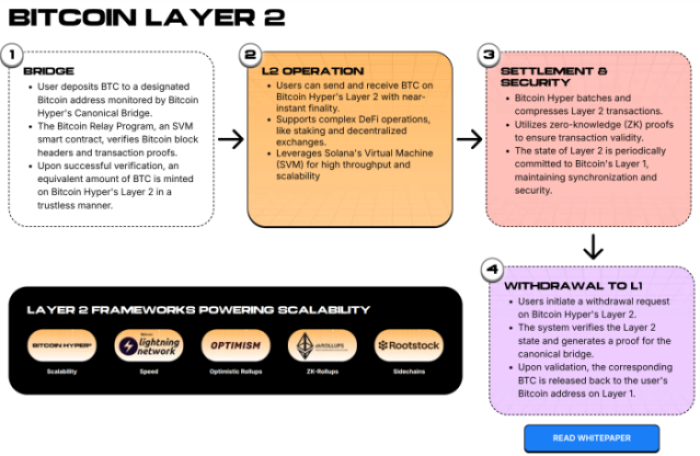
It’s the best of both worlds scenario that developers have chased for a decade. Previous Bitcoin L2 attempts usually suffered from high latency or centralization risks. By employing a decentralized canonical bridge and a modular structure, Bitcoin Hyper allows high-speed payments and complex apps, swaps, lending, and gaming to run on Bitcoin without clogging the main chain.
The implications are massive. If holders can deploy assets into high-yield DeFi protocols with Solana’s speed, trillions in dormant $BTC capital could be unlocked. The architecture mirrors the modular scaling thesis that dominated Ethereum’s roadmap, finally applying it effectively to the Bitcoin ecosystem.
EXPLORE THE $HYPER ECOSYSTEM
High Project Conviction Signal – Whales
The market’s appetite for this solution is visible in the on-chain data surrounding the $HYPER presale. According to live metrics, it has already raised over $31M, a figure that suggests validation from both retail and sophisticated investors.
With the token currently priced at $0.0136751, early positioning is aggressive before the protocol hits its Token Generation Event (TGE).
It’s also worth noting that a big signal of conviction in the project is bellowing – whales. Etherscan data reveals high-net-worth wallets have spent over $1M. The largest transaction was for $500K. That type of accumulation during a presale shows whales hedging against listing volatility by securing an entry price well below projected market value.
The $HYPER incentive structure is designed to lock in long-term liquidity. The protocol offers high APY staking immediately after TGE, with a modest 7-day vesting period for presale stakers. This reduces immediate sell pressure and aligns investor interests with the network’s stability.
As Tether creates a regulated environment for stablecoins, Bitcoin Hyper is building the high-velocity rails where those assets can actually be used.
BUY YOUR $HYPER ON THE OFFICIAL PRESALE PAGE
The information provided in this article is not financial advice. Cryptocurrency investments carry inherent risks, including high volatility and potential loss of capital. Always conduct your own research (DYOR) before making any investment decisions.
