Coinbase Insider Trading Lawsuit Advances Despite $2.9B Stock Sale Defense

Regulators just swatted away a $2.9 billion argument like a bothersome fly. The legal heat on Coinbase just got turned up.
The 'We Sold Stock, Not Secrets' Defense Fails to Land
Coinbase's legal team argued that a massive, pre-announcement stock sale by executives proved there was no insider intent. The court wasn't buying it. The lawsuit, alleging executives tipped off traders before negative news hit, charges ahead. That $2.9 billion figure wasn't a shield—it's now Exhibit A in the case for motive.
Why This Ruling Shakes the Crypto Landscape
This isn't just about one exchange. It sets a precedent. Regulators are signaling that traditional market rules apply, even when the assets are digital. The 'move fast and break things' ethos of tech crashes headfirst into the 'comply or get fined' reality of finance. Expect compliance costs to spike across the board as other exchanges scramble to review their internal controls.
A Cynical Take on High-Finance Maneuvers
Nothing says 'we have nothing to hide' quite like cashing out a few billion before bad news drops. It's the kind of coincidence that warms the cold, mechanical heart of every securities lawyer—and empties the pockets of shareholders.
The gavel has spoken. For Coinbase, the path forward is now a legal minefield, not a financial one. The industry watches, knowing the outcome will redefine the rules of the game for everyone.
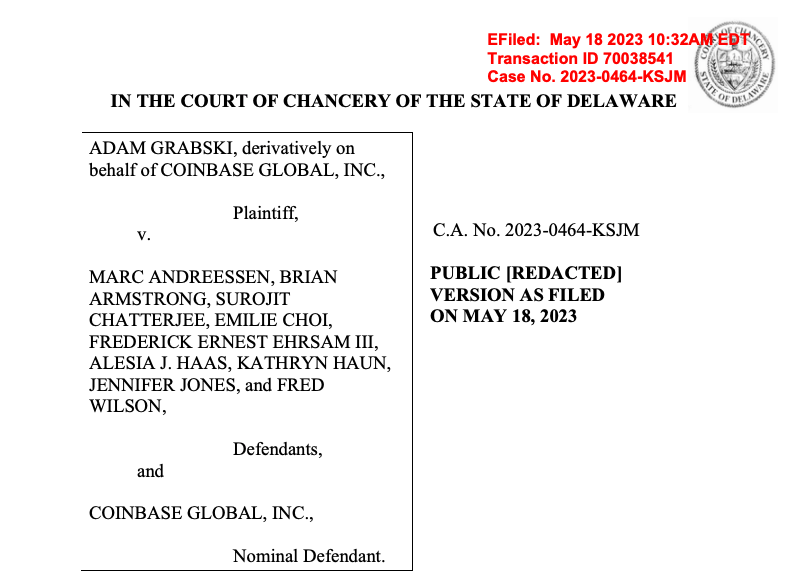 Source: Court Filing
Independence Concerns Undermine Internal Review
The special litigation committee comprised two Coinbase board members: Kelly Kramer, former chief financial officer of Cisco Systems, and Gokul Rajaram, a Silicon Valley angel investor.
Neither was named as a defendant nor sold shares in the direct listing. However, McCormick identified substantial business ties between Rajaram and Andreessen Horowitz as disqualifying conflicts of interest.
According to court filings, interactions included a 2007 investment by Andreessen in a startup co-founded by Rajaram, and at least 50 financing rounds in which Rajaram or his venture firm participated alongside Andreessen Horowitz since 2019.
“No one—not plaintiff and thus not the court—questions Rajaram’s good faith,” McCormick wrote. “But the thick ties between him and the subject of the SLC’s investigation are sufficient to raise material disputes regarding his independence.“
Attorneys for the committee argued that the business interactions were “,” given the 700 total investments, and noted that there was no evidence of coordination in financing rounds.
“These are not close personal ties. These are professional ones,” said Brad Sorrels, representing the committee, during an October hearing.
Direct Listing Structure Enabled Immediate Sales
The shareholder complaint centers on Coinbase’s unconventional path to public markets through a direct listing rather than a traditional IPO.

This structure allowed existing shareholders to sell immediately without the lockup periods typically imposed by underwriters to prevent insider trading on material nonpublic information.
Armstrong sold $291.8 million in shares, according to the complaint, while Andreessen Horowitz divested $118.7 million through the direct listing.
Other defendants included Chief Operating Officer Emilie Choi, who sold $224 million, and co-founder Fred Ehrsam, who sold $219.5 million.
The lawsuit alleges that directors knew the shares were overvalued, based on an internal Andersen Tax valuation that was substantially below market expectations when trading began at $381 per share.
Within five weeks of the April 14, 2021 listing, Coinbase shares declined by more than 37% as the company disclosed fee compression affecting retail revenues and announced a dilutive convertible note offering.
By May 18, 2021, the stock had wiped out just over $37 billion in value, according to the complaint.
Company Disputes Claims Amid Delaware Criticism
“We are disappointed by the court’s decision and remain committed to fighting these meritless claims in court,” Coinbase said in a statement.
The committee’s report concluded that the defendants didn’t rely on confidential information, noting that Coinbase stock is “highly correlated” with bitcoin prices, making it impossible to prove insider trading allegations.
The committee argued directors “” sold stock to provide sufficient supply for the direct listing, divesting only small portions of their holdings.
“The evidence roundly showed that defendants, including the two biggest stockholders, didn’t want to sell because they were bullish about the company,” Sorrels said during the October hearing.
Armstrong and Andreessen Horowitz “ultimately agreed to sell just over 1% of their respective shares only after the company and its banker pleaded with them to provide supply necessary for the direct listing to launch,” according to committee filings.
Andreessen Horowitz has publicly criticized Delaware’s business courts, announcing plans last July to reincorporate portfolio companies elsewhere due to perceived bias “against founders and their boards.“
Coinbase has announced plans to leave Delaware and reincorporate in Texas, a MOVE Chief Legal Officer Paul Grewal described as a strategic decision to align with the company’s long-term vision for new product development and regulatory efficiency.“Toda…https://t.co/aELNKkSwDu
— Cryptonews.com (@cryptonews) November 12, 2025Coinbase announced its own reincorporation plans on November 12, following similar moves by other major companies seeking to exit Delaware’s jurisdiction.
Beyond civil litigation, Coinbase faced a similar, but criminal insider trading case in 2023, when former product manager Ishan Wahi received a two-year prison sentence for sharing confidential listing information with family members who profited from the advanced knowledge.
