Ex-SEC Lawyer Endorses Ripple’s CLARITY Act Stance — Declares ’Speculation Isn’t Securities Law’ in Landmark Crypto Defense

Another legal heavyweight just threw their weight behind Ripple's regulatory crusade. A former SEC enforcement attorney has publicly backed the company's push for the CLARITY Act, delivering a scathing critique of how securities laws are being misapplied to digital assets.
The Core Argument: Function Over Frenzy
The lawyer's central thesis cuts through the regulatory fog: using a speculative trading market as the sole basis for labeling an asset a security is a fundamental legal error. It's a direct challenge to the SEC's oft-cited Howey Test application in crypto, arguing that secondary market frenzy doesn't magically transform a utility token into an investment contract. The stance gives Ripple's long-standing position a powerful, insider-validation boost as the CLARITY Act seeks to draw clear legislative lines where regulators have seen only blurred ones.
Why This Legal Salvo Matters Now
This isn't just academic squabbling. The endorsement lands as the industry grapples with a patchwork of contradictory court rulings and agency actions. It provides ammunition for other projects facing similar charges and pressures Congress to act. The ex-regulator essentially argues that the SEC's current approach punishes innovation for the crime of being popular with traders—a classic case of regulating the symptom instead of the underlying structure. It's a reminder that in traditional finance, a speculative fever around orange juice futures or Beanie Babies didn't trigger securities laws either.
The Ripple Effect on the Regulatory Battlefield
Expect this argument to echo in courtrooms and congressional hearings. It reframes the debate from "are crypto assets securities?" to "when does a crypto asset become a security?"—a subtle but monumental shift. The move isolates the SEC's reliance on market behavior as its primary evidence, potentially undermining a slew of pending enforcement cases. For the broader market, it's a bullish signal that credible legal frameworks are coalescing, moving beyond the 'wild west' narrative. After all, nothing attracts institutional capital like the sweet, sweet sound of regulatory predictability—even Wall Street occasionally appreciates a rulebook that isn't written in invisible ink.
Ripple Says Speculation Alone Shouldn’t Trigger Securities Rules
Guillén agreed with Ripple’s Core concern, stating that approaches relying on a “passive economic interest” risk confusing market speculation with legally enforceable investment rights.
In her letter, Guillén clarified that her own academic work on digital asset market structure had been cited by Ripple not as an endorsement of such conflation, but as part of a broader discussion on how economic factors should be assessed.
She emphasized that no single factor, including speculative intent, should be determinative when applying securities laws to digital assets.
Instead, she argued, those factors must be weighed on a sliding scale grounded in legal obligations and historical regulatory practice.
Ripple’s original submission to the SEC’s Crypto Task Force came as Congress considered the CLARITY Act.
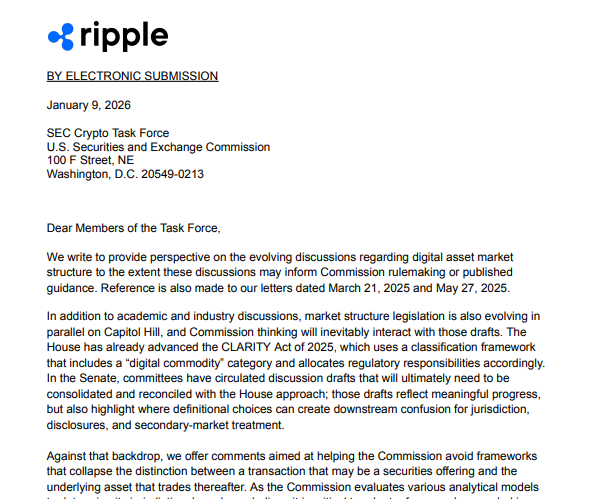
At the center of Ripple’s argument is the distinction between an asset and the transaction through which it may have been sold.
The company maintains that once an issuer’s enforceable promises have been fulfilled or expired, the asset itself should not remain subject to securities regulation indefinitely.
Treating it otherwise, the company argued, WOULD collapse the difference between a contract and a commodity-like asset, expanding regulatory authority beyond its intended limits.
Ripple also pushed back against regulatory approaches that rely heavily on the “efforts of others” prong of the Howey test.
The company said focusing solely on buyers’ expectations of others’ efforts overlooks key elements of an investment contract, including a common enterprise and enforceable profit rights.
It added that price speculation alone does not make an asset a security unless it involves a legal claim on an issuer.
Regulators Weigh New Asset Category as Crypto Policy Debate Widens
Guillén’s submission aligns with that view while stopping short of endorsing any single legislative proposal.
Separately, she released a discussion draft for a proposed Digital Markets Restructure Act of 2026, which has not been adopted by the SEC or the CFTC.
The draft outlines a new classification called “Digital Value Instruments” for assets that do not fit cleanly into existing securities or commodities frameworks and proposes a risk-based division of regulatory oversight between agencies.
The comments were part of a broader wave of submissions filed in late January, as industry participants, policy groups, and former regulators weighed in on market integrity, tokenization, and cross-border supervision.
Several contributors warned against broad exemptions for decentralized trading platforms.
Meanwhile, others urged Congress and regulators to preserve CORE investor protections without forcing digital assets into disclosure regimes designed for traditional equities.
The policy debate is unfolding as legislative momentum has slowed in the Senate.
This week, a winter storm in Washington delayed the Senate Agriculture Committee’s first markup vote on digital asset market structure legislation, further complicating an already uncertain timeline.
The Banking Committee’s parallel effort on the CLARITY Act has also been pushed back, leaving the Agriculture Committee’s bill as the most immediate vehicle for reform, despite visible partisan divisions.
