Chainalysis Exposes $16.1B Chinese-Language Crypto Money Laundering Networks

Crypto's shadow economy just got a price tag—and it's staggering.
The Scale of the Operation
Blockchain sleuths at Chainalysis have traced a river of dirty money flowing through digital wallets. Their latest report maps out sophisticated, Chinese-language networks that processed a jaw-dropping $16.1 billion in illicit cryptocurrency. This isn't petty cash; it's a parallel financial system operating in plain sight on the blockchain.
How the Networks Operate
The networks function like decentralized hawala systems. They slice, dice, and reroute funds through a maze of addresses and exchanges, obscuring the trail from scams, darknet markets, and stolen funds. Their methods are a masterclass in obfuscation, leveraging cross-chain bridges and peer-to-peer platforms to stay ahead of compliance teams. It's a cat-and-mouse game where the mice have built a billion-dollar maze.
The Regulatory Paradox
Here's the kicker for traditional finance: this laundering machine thrives partly because of crypto's inherent transparency. Every transaction leaves a permanent, public record. While banks might quietly settle for a fine when a suitcase of cash goes missing, the blockchain ledger never forgets—it just needs someone to connect the dots. The report underscores a brutal truth: for all the hand-wringing about crypto anonymity, old-fashioned, organized graft adapted to new tech is the real monster.
The takeaway? The tools for total financial surveillance exist. The will—and the cross-border cooperation—to use them effectively clearly doesn't. Meanwhile, the laundromat stays open for business, proving that some traditional finance services—like washing dirty money—will always have demand, no matter the currency.
Chinese-Language Networks Now Account for 20% of Known Laundering
Chainalysis found that Chinese-language money laundering networks (CMLNs) have increased their share of attributed illicit laundering activity to around 20% in 2025.
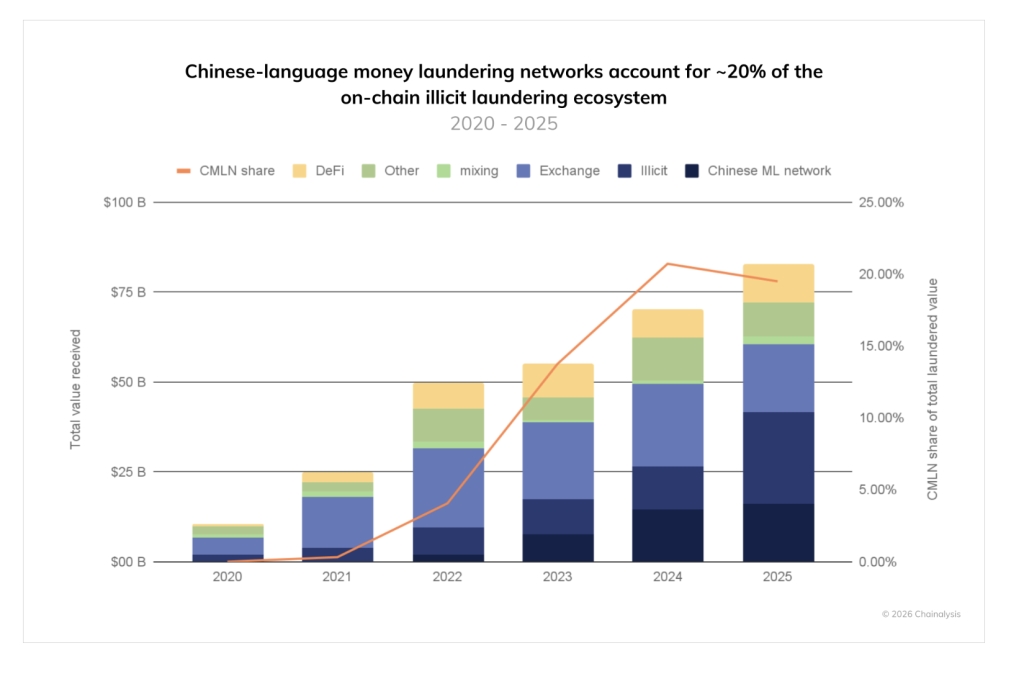
These networks have also become a key endpoint for scam proceeds. Chainalysis noted that CMLNs now consistently launder more than 10% of funds stolen in pig butchering scams, as criminals shift away from centralized exchanges, which can freeze assets.
Since 2020, inflows to identified CMLNs have grown 7,325 times faster than those to centralized exchanges, far outpacing growth in DeFi-related laundering and intra-illicit transfers.
Chainalysis said Telegram-based services operating in Chinese-language channels now account for a disproportionate share of the global laundering landscape.
CMLN Ecosystem Processed $16.1B Through 1,799 Wallets
Chainalysis identified six major service types within the CMLN ecosystem, which together processed $16.1 billion in inflows during 2025. The number of active entities has risen sharply reaching more than 1,799 active on-chain wallets last year.
The report highlights the speed at which these operations scale. “Black U” services reached $1 billion in processing volume in just 236 days, while other typologies such as OTC desks and money mule networks scaled over longer periods.
Chainalysis estimates the ecosystem is processing nearly $44 million per day showing the industrial capacity of these networks.
Guarantee Platforms Anchor a Sophisticated Underground Market
At the center of the ecosystem are “guarantee platforms,” which function as marketing and escrow hubs connecting laundering vendors with buyers. Chainalysis said services such as Huione and Xinbi have dominated this market, even as enforcement actions disrupt individual accounts.
Vendors offer a wide range of laundering techniques, including running point brokers, money mule “motorcades,” informal OTC services, Black U discounted illicit crypto sales, gambling-linked laundering, and mixing and swapping-as-a-service.
Chainalysis noted that these networks demonstrate resilience, often migrating across platforms when challenged, while maintaining operational continuity.
Enforcement Actions Highlight Growing National Security Threat
Recent sanctions and advisories have drawn attention to the national security risks posed by laundering facilitation networks. Chainalysis pointed to actions including OFAC’s designation of the Prince Group, FinCEN’s rule targeting Huione Group, and advisories on Chinese money laundering networks.
Experts cited in the report warned that crypto has allowed rapid cross-border movement of illicit funds. Chainalysis concluded that disrupting these networks will require coordinated public-private collaboration, combining blockchain analytics, intelligence sharing, and proactive targeting of underlying operators rather than individual platforms alone.
Chainalysis emphasized that on-chain transparency offers unprecedented visibility—but only if matched with global enforcement capacity and systemic cooperation.
