Ledger’s $4B Wall Street Debut: Can the Crypto Wallet Titan Conquer Traditional Finance?

Hardware giant Ledger is gunning for a $4 billion public offering—a move that could bridge the chasm between crypto's cypherpunk roots and Wall Street's marble halls.
From Cold Storage to Hot Market
Ledger isn't just selling wallets; it's pitching a fortress. While exchanges get hacked, their devices keep keys offline. That value proposition—security as a sellable product—now faces its ultimate stress test: the public markets.
The Wall Street Gauntlet
Can a company built on distrust of centralized finance thrive under the microscope of quarterly earnings calls and activist investors? The IPO isn't just a fundraising round—it's a cultural experiment. Analysts will dissect growth metrics while crypto natives watch for any dilution of the original mission.
One veteran trader quipped, 'They'll need to explain 'seed phrases' to a room full of people who think 'blockchain' is a consulting buzzword.' The real challenge? Making cold, hard security as sexy as the next speculative token.
If Ledger pulls this off, it won't just cash out—it will legitimize an entire infrastructure layer. If it stumbles, Wall Street's old guard will nod and say they saw it coming. The ultimate irony? Using traditional finance's biggest stage to prove decentralization's worth.
 @Ledger eyes U.S. IPO at a $4B+ valuation: @FT
Hardware #wallet maker #Ledger is preparing for a potential U.S. #IPO, reportedly working with Goldman Sachs, Jefferies, and Barclays on the deal, which could take place as early as this year pic.twitter.com/hjJQcnXxfh — Charged Ventures (@ChargedVentures) January 23, 2026
Wall Street Banks Line Up for Ledger’s IPO Push
Ledger’s IPO ambitions reflect a belief that it has reached sufficient scale to withstand public-market scrutiny from Wall Street.
In an earlier interview, CEO Pascal Gauthier said the company had grown to a point where a listing was realistic, adding that the U.S. stood out as the natural venue.
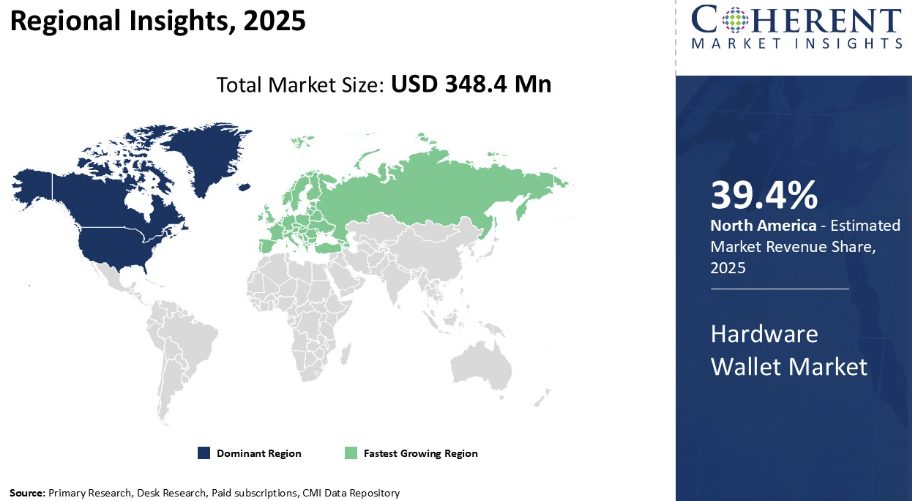
Roughly 40% of Ledger’s business now comes from North America, a figure that has shaped both its listing strategy and operational expansion in New York.
Gauthier has also said the firm is weighing a U.S. IPO alongside a potential private funding round, keeping multiple capital-raising paths open.
“Money is in New York today for crypto, it’s nowhere else in the world, certainly not in Europe,” Gauthier told the Financial Times.
He reiterated that view in November 2025 when the company first flagged the IPO plans, emphasizing that his increased time in New York was driven by where crypto financing is now concentrated.
From Nano Wallets to Triple-Digit Millions in Revenue
Founded in 2014 by Éric Larchevêque, Joël Pobeda, and Thomas France, Ledger built its reputation on hardware wallets designed to keep private keys offline.
Its early success came from the Ledger Nano series, which gained traction as hacks and exchange failures highlighted the risks of custodial storage.
The company has since broadened its product lineup, launching the Ledger Stax, a touchscreen device aimed at long-term holders and institutional users.
It has also rolled out an iOS app for enterprise clients and recently completed a major rebranding alongside the release of the Ledger Nano Gen5.
Ledger said its revenues reached triple-digit millions in 2025, marking its strongest performance to date, with further growth expected this year.
Over the past decade, the firm estimates it has sold more than seven million devices globally and now safeguards around 20% of global crypto assets, including over $100 billion worth of bitcoin.
Potential Ledger IPO closing market cap?
– raised $3m in 2019, $380m in 2021, $109m at $1.4b in Mar 2023
– seeking $4b valuation in IPO (~3x valuation from last raise)
currently the liquidity for this market on @Polymarket is limited, though interesting to see how high it goes… https://t.co/Pmv5JIR4XA pic.twitter.com/k5G6UGHf9E
The company was last valued at $1.5 billion in 2023 after raising a $108 million extension to its Series C round, bringing total funding in that round close to $500 million.
While Ledger has since said its valuation has increased, it has not disclosed an updated figure ahead of the reported IPO preparations.
Fees, Data Exposure, and the Self-Custody Debate
As Ledger expands beyond pure hardware, it has reframed its devices as “Ledger signers,” positioning them as tools for securing digital assets and online identities in an AI-driven environment.
That shift has not been without controversy, particularly around new monetization features.
Last October, Ledger revealed that its Multisig app WOULD charge a flat $10 fee per transaction, excluding token transfers, which would instead incur a 0.05% variable fee.
 @Ledger’s new Multisig app sparked backlash for adding a $10 flat fee per transaction and a 0.05% token transfer fee, on top of gas costs.#Ledger #Cryptohttps://t.co/b72bb5ZwXw
The charges are applied on top of standard blockchain gas fees, prompting backlash from users who argue that self-custody should not come with recurring platform costs.
Security concerns have also resurfaced following a recent data exposure incident involving a third-party provider.
On January 5, 2026, blockchain researcher ZachXBT said personal information of Ledger customers was accessed in a hack on Global-e, a payment processor used by the company.
While no funds were compromised, researchers warned that the exposure heightens the risk of phishing and social engineering attacks.
