Vitalik Buterin’s Ethereum Staking Fix: Eliminating Single-Node Risk Forever

Ethereum's co-founder just dropped a protocol bombshell—one that could reshape the entire staking landscape.
For years, the specter of single-node failure has haunted institutional validators. One hardware glitch, one network hiccup, and suddenly your multi-million dollar stake faces slashing penalties. It's been the dirty little secret of proof-of-stake: decentralization preached, but central points of failure tolerated.
The Architecture Shift
Buterin's proposal doesn't just tweak the system—it re-architects the validator-client relationship. Imagine distributing a single validator's responsibilities across multiple, independent nodes. No single machine holds all the keys or signs all the blocks.
The technical magic? A clever use of threshold signatures and distributed key generation. Each participating node gets a shard of the signing power. Only when a quorum agrees does a signature become valid on-chain. It's staking-as-a-service, but without the 'single point of failure' service part.
Why This Changes Everything
Risk management departments at crypto funds just got a new spreadsheet column. The old calculus—weighing slashing risk against hardware costs—gets thrown out. Suddenly, you can achieve redundancy without multiplying your ETH commitment.
Smaller stakers benefit too. Pool operators can now design truly resilient networks, not just clusters of nodes waiting to fail in unison. The protocol itself enforces what best practices could only suggest.
And yes, it makes Ethereum's staking yield look slightly less like a high-wire act and slightly more like, well, actual infrastructure. The kind that might not give traditional finance executives an immediate migraine—though they'll still complain about the volatility, because what else would they do with their lunch breaks?
The Ripple Effects
Watch for liquidity shifts. Staking providers with robust distributed systems will suddenly look like Swiss banks, while those running monolithic setups will seem like mattresses stuffed with cash. The market has a funny way of pricing risk once it actually understands the mechanics.
This isn't just a technical patch. It's a philosophical statement: that security shouldn't be optional, that resilience must be baked into the protocol layer. In a world where financial products often obscure risk in fine print, Ethereum moves to make its risks not just transparent, but structurally mitigated.
The upgrade path remains to be mapped, the governance debates will be fierce, but the direction is clear. The future of staking isn't about running more nodes—it's about running smarter ones. And Wall Street's legacy systems, with their single points of failure dressed up as 'proven infrastructure,' might want to take notes before the next outage makes the front page.
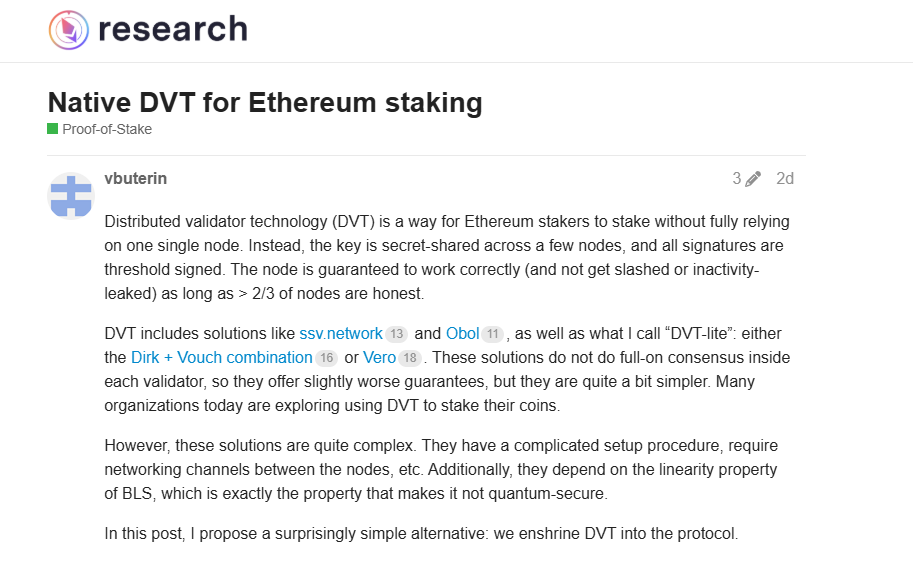 Source: ethresear.ch
The idea WOULD allow stakers to split validator responsibilities across multiple nodes directly at the protocol level rather than relying on complex external setups.
Ethereum’s Staking Boom Brings New Security Questions
The proposal comes as Ethereum staking reaches record scale with more than 36 million ETH now staked across nearly one million validators, with the total value of staked assets exceeding $118 billion.

While this growth has reinforced Ethereum’s security, it has also amplified long-standing concerns around centralization, operational risk, and the technical barriers faced by solo stakers.
For much of Ethereum’s proof-of-stake history, running a validator meant placing 32 ETH behind a single machine and a single private key.
Any failure, from a power outage to a software bug or security breach, could result in inactivity penalties or slashing.
These risks pushed many users toward large staking providers and liquid staking platforms, concentrating control of consensus among a relatively small group of operators and cloud providers.
Buterin’s proposal directly targets that single-node risk, as under the proposed native DVT, a validator with a larger balance would be allowed to register multiple keys, up to a maximum of 16, and define a threshold for signing duties.
Validator actions, such as block proposals or attestations, would only be considered valid if a minimum number of those keys signed off together.
As long as more than two-thirds of the nodes behave honestly, the validator would continue operating normally without penalties.
Buterin’s Native DVT Idea Targets Easier, Safer ETH Staking
Unlike existing DVT solutions such as Obol or ssv.network, which rely on external tooling, networking layers, and the linear properties of BLS signatures, Buterin’s design would be embedded directly into Ethereum’s consensus rules.
He argued this would dramatically simplify staking operations, reduce setup complexity, and remove dependencies that may not be compatible with future cryptographic upgrades.
 @VitalikButerin unveils "The Splurge," a bold plan to prepare Ethereum for a quantum future!#Ethereum #QuantumComputinghttps://t.co/vvRijeahpS
From a user perspective, Buterin described the experience as running multiple standard validator nodes with minimal configuration changes.
Most of the added complexity would be limited to block production, where one node would act as a temporary leader and others would co-sign its output.
The proposal is explicitly aimed at medium- to large-sized ETH holders, including institutions and individual “whales,” who currently face a choice between running fragile single-node setups or outsourcing control to staking providers.
By making multi-node staking simpler, Buterin said native DVT could increase client diversity, improve measurable decentralization metrics, and encourage more self-custodial staking.
Ethereum Developers Debate Practical Challenges of the DVT model
The discussion quickly drew technical feedback from the community.
Ethereum developer Alonmuroch raised questions around coordination during block production, the possibility of multiple proposers racing to collect signatures, and the need for protocol-level key rotation to handle compromised keys without forcing validators to exit and re-stake.
Buterin largely agreed, noting that instant key changes should be feasible and that reducing operational headaches is central to the proposal’s motivation.
The proposal also fits into a broader shift in Buterin’s recent public messaging.
Earlier this month, he declared 2026 the year Ethereum would reclaim lost ground on self-sovereignty and trustlessness, calling for fewer compromises in favor of convenience.
Days later, he warned that Ethereum risks becoming an “unwieldy mess” if developers continue layering complexity onto the protocol without deliberate simplification.
