SEC Crypto Task Force Faces Pressure Over Self-Custody Rights and DeFi ’Dealer’ Rules in New Legal Filings

Regulators just got served—and crypto's legal battle just got real.
The SEC's crypto enforcement squad faces fresh pressure as new filings challenge two core regulatory fronts: your right to hold your own assets, and whether DeFi protocols can be branded as 'dealers.'
Self-Custody Under Siege
The argument is simple: if you hold your own keys, you're not a customer of an exchange. New legal briefs hammer this point, pushing back against regulatory overreach that could criminalize basic wallet ownership. It's a fight for the foundational principle of 'not your keys, not your coins.'
The DeFi 'Dealer' Dilemma
Meanwhile, the SEC's attempt to label decentralized protocols as securities dealers faces stiff opposition. Critics call the move a square-peg-round-hole strategy—applying legacy market-maker rules to code that executes autonomously. The filings argue it's like regulating the wind for moving leaves.
These aren't abstract debates. The outcomes will dictate whether innovation lives in regulatory purgatory or gets clarity to build. One filing even quipped that the SEC's approach treats every crypto transaction like a potential crime—a surefire way to stifle the very competition traditional finance claims to welcome. The irony, of course, is that Wall Street's own rulebooks created the opacity that made crypto appealing in the first place.
SEC Filings Spotlight Self-Custody Protections and DeFi Market Structure
One submission, filed by an individual identified as DK Willard, centers on the experience of retail crypto users in Louisiana and ties state-level protections directly to the federal debate now unfolding in Washington.
Willard points to Louisiana legislation such as House Bill 488, which explicitly affirms residents’ right to self-custody digital assets, arguing that these protections should not be diluted by federal market structure proposals.
The filing shows that Congress is considering frameworks that include registration, transparency, and anti-fraud standards, but certain exemptions risk allowing developers or platforms to sidestep CORE investor protections.
In Willard’s view, weakening self-custody protections could expose consumers to fraud and financial crime rather than supporting responsible innovation.
At the same time, a more technical submission from the Blockchain Association’s Trading Firm Working Group focuses on how proprietary trading firms should be treated when providing liquidity in tokenized equity markets that operate on DeFi infrastructure.
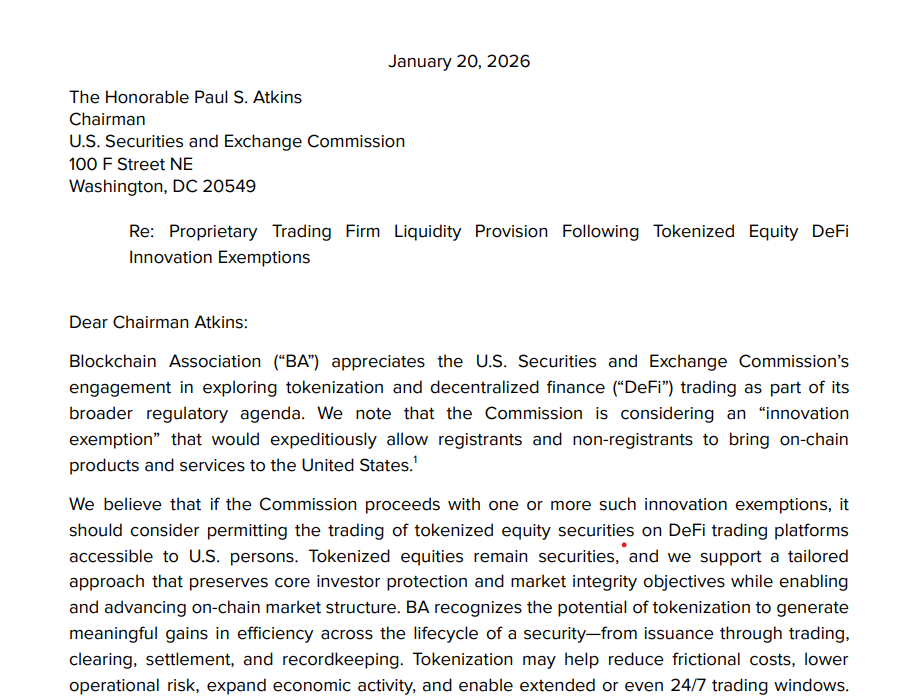
The group argues that long-standing distinctions in securities law between dealers and traders should continue to apply on-chain.
Trading for one’s own account, without customer solicitation, custody, or agency execution, should not trigger dealer registration under the Exchange Act, the filing says, even when that trading occurs through smart contracts and decentralized venues.
The association frames this issue as central to whether tokenized equity markets can function at all during any SEC-approved innovation exemption or sandbox.
Without legal certainty, proprietary trading firms may avoid on-chain markets altogether, leaving tokenized equities without reliable liquidity, price discovery, or arbitrage.
The group stresses that existing broker-dealer rules, including those governing clearing, custody, reporting, and capital, were designed for intermediated markets and will take time to adapt to atomic settlement and smart contract execution.
Allowing proprietary firms to participate immediately, they argue, WOULD give regulators space to modernize those frameworks without freezing market activity in the interim.
SEC’s New Crypto Approach Takes Shape After 2025 Restructuring
These submissions land within a broader shift at the SEC that began after the agency’s restructuring in early 2025.
Under Commissioner Hester Peirce, the Crypto Task Force has moved away from what industry participants long criticized as regulation by enforcement and toward formal rulemaking and guidance.
Over the past year, that approach has included dismissing the SEC’s lawsuit against Coinbase, pausing enforcement actions against Binance, and closing investigations into other major platforms.
 The @SECGov plans to drop its enforcement case against @coinbase, with CEO @brian_armstrong calling a "huge day" for crypto. #Coinbase #SEChttps://t.co/8Q5mkqG1J8
The agency has also rescinded restrictive custody guidance and clarified that certain crypto activities do not constitute securities transactions.
The latest filings also intersect with an increasingly complex legislative backdrop.
Negotiations over the CLARITY Act, which aims to establish a comprehensive federal market structure for digital assets, remain unsettled.
 Coinbase says crypto market structure bill more complex than stablecoin framework but global competition will force congressional action this year.#Coinbase #ClarityActhttps://t.co/PEuIKIZkwu
A scheduled markup in the Senate Banking Committee was postponed following industry opposition, while the Senate Agriculture Committee is still expected to review the bill later this month.
Other recent submissions to the Crypto Task Force highlight how contested the custody question remains.
Industry groups, including SIFMA, have cautioned against granting broad exemptions to wallet providers that perform broker-dealer functions, while policy groups tied to the solana ecosystem are calling for clearer distinctions between non-custodial software and regulated intermediaries.
