Coinbase CEO Targets 4 Billion "Unbrokered" People - And He’s Coming For Your Wallet

Brian Armstrong sees a planet-sized opportunity where Wall Street sees risk. The Coinbase CEO is on a mission to bank the unbanked—all 4 billion of them.
The Unbrokered Majority
Forget the 1%. Armstrong's focus is the global population currently locked out of traditional finance. No broker accounts, no wealth managers, just a smartphone and potential. His pitch? Crypto bypasses the gatekeepers.
Decentralization as Disruption
This isn't just about adding users—it's about rewriting the rules. Coinbase's global push cuts out middlemen, slashes transfer fees, and offers financial tools without a legacy bank's permission. It turns every internet connection into a potential branch office.
The Scale of Ambition
Four billion represents more than half the world's population. It's a number that makes hedge fund targets look quaint. The playbook: leverage blockchain's borderless nature to onboard users traditional finance systematically ignored—or exploited with predatory fees.
The Finance Jab
Wall Street spent decades building moats; crypto builds bridges. While traditional brokers debate basis points, Armstrong's chasing the people who've never seen a basis point in their lives. The ultimate irony? The industry that perfected exclusion is now getting excluded from history's largest wealth-creation event.
The race isn't for the richest portfolios anymore—it's for the next 4 billion wallets. And the starting gun just fired.
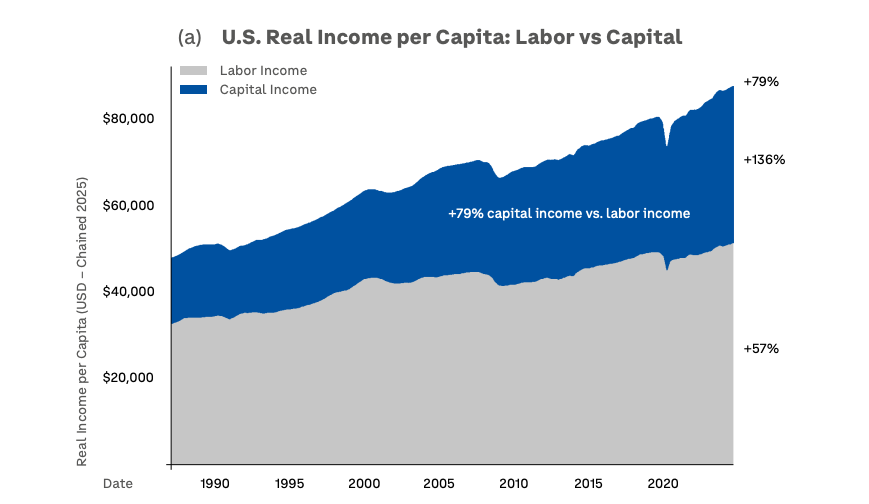 Source: Coinbase
Capital Chasm Widens Across Geographic Lines
The paper identifies participation in capital markets as fundamentally determined by wealth and geography rather than merit or savings discipline.
Roughly 4 billion adults do not participate in equity and bond markets, with engagement rates ranging from 55-60% in the United States to below 10% in China and India.

“I think about a talented worker in Lagos or Jakarta who has the drive and ability to build a better life for themselves and their family—but who faces near-total exclusion from the same capital markets available to a wealthy investor in New York,” Armstrong wrote, emphasizing that geography rather than ability determines who gets access.
Beyond national participation rates, the research highlights severe home bias among existing investors.
Data shows domestic equity holdings far exceeding countries’ share of global market capitalization, with investors in Indonesia, Russia, and Turkey allocating over 95% of portfolios to local markets despite representing fractions of global equity value.
Tokenization as an Infrastructure Solution
The policy blueprint positions blockchain-based tokenization as the primary mechanism to collapse legacy cost structures that price out small savers.
Traditional financial infrastructure operates on fixed compliance costs, custody fees, settlement delays, and minimum account thresholds that RENDER participation uneconomic for anyone below certain wealth levels.
According to the paper, recent studies estimate that tokenized equity trading could reduce investor transaction costs by more than 30%, with efficiency gains expanding over time as atomic settlement eliminates multi-day reconciliation cycles.
“Permissioned systems inevitably replicate existing power dynamics, allowing infrastructure owners to limit competition,” Armstrong wrote, comparing blockchain protocols to TCP/IP internet infrastructure that enables open innovation without gatekeeping.
Policy Roadmap Targets Regulatory Coordination
Coinbase outlined five policy pillars necessary to realize tokenized capital markets at scale.
The recommendations particularly prioritize base-layer neutrality, treating blockchain protocols as impartial infrastructure where compliance is concentrated at the application layers rather than at the protocol level.
The five policy pillars include:
- Uphold base-layer neutrality with compliance at application layers
- Create clear pathways for tokenizing traditional assets
- Foster integration with traditional finance institutions
- Recognize self-custody rights with blockchain transparency oversight
- Modernize safeguards through exchange controls rather than wallet bans
Modern blockchain analytics tools enable the detection and tracing of suspicious patterns with unprecedented precision, challenging historical assumptions that bearer instruments inherently facilitate illicit finance.
Everything Exchange Strategy Takes Shape
Armstrong defines success as a small saver anywhere on earth being able to convert spare earnings into fractional ownership of productive global assets as easily as sending a text message.
“When a farmer in a country without a functional stock exchange can own shares in the same companies as a hedge fund manager in New York, both on the same neutral infrastructure at basis-point costs, then the capital chasm will have truly narrowed,” he wrote.
The policy release comes as Coinbase began rolling out traditional stock trading to select users, positioning the exchange to compete directly with Robinhood, Charles Schwab, and Fidelity.
 Coinbase rolls out stock trading to select users as CEO Brian Armstrong pursues "everything exchange" vision combining crypto and traditional equities.#Coinbase #Stockhttps://t.co/hTsBWCELvu
Earlier this month, Armstrong outlined three 2026 priorities, including building an “” globally across crypto, equities, prediction markets, and commodities, scaling stablecoins and payments, and bringing users on-chain through the Base blockchain.
“Goal is to make Coinbase the #1 financial app in the world,” he posted. The exchange currently offers stocks through conventional methods using Apex Fintech Solutions, with plans to expand access to all customers within weeks.
David Duong, Coinbase’s head of investment research, also said regulatory clarity improvements and deepening institutional participation create favorable conditions ahead.
“We expect these forces to compound in 2026 as ETF approval timelines compress, stablecoins take a larger role in delivery-vs-payment structures, and tokenized collateral is recognized more broadly,” Duong wrote, as Armstrong projected up to 10% of global GDP could run on crypto rails by decade’s end.
