86% Chance Trump Blinks on Tariffs, But Bitcoin Will Tell You First

Markets whisper secrets before headlines scream them. Forget the political pundits—the real signal on whether Trump folds on tariffs is flashing in the crypto charts.
The Ultimate Leading Indicator
Bitcoin doesn't wait for press conferences or policy papers. It's a global, 24/7 sentiment machine, digesting geopolitical risk in real-time. A sudden surge in BTC or a flight to stablecoins can telegraph a policy shift hours—sometimes days—before the official announcement hits the wires. It's the purest form of collective intelligence, completely bypassing the spin cycle.
Follow the Digital Money
When traditional finance scrambles to price in uncertainty, crypto moves first. Watch for unusual volume patterns, derivatives positioning, and capital flows between major digital assets. These aren't just trades; they're votes of no confidence in the old system's ability to process information efficiently. It's like having a direct feed to the smartest—and most cynical—money on the planet.
Why This Time Is Different
The last tariff war played out before digital assets sat at the adult's table. Now, with institutional capital deeply embedded, crypto's reaction function is more pronounced and predictive. A tariff standoff isn't just about trade deficits anymore; it's a stress test for dollar dominance and a catalyst for alternative value networks. The market's pricing that in—one satoshi at a time.
The bottom line? If you want to know whether protectionist rhetoric turns into real policy, skip the cable news circus. Watch the blockchain. The money always talks first—it just used to do it in a language only Wall Street could understand. Now, it's on a public ledger for anyone to read, if they know where to look. Just remember, in finance, a 'strong signal' is often just someone else's panic, neatly packaged.
 Trump's Europe tariff threats erase $875 million in crypto positions as bitcoin falls 3% to $92,000 amid geopolitical market shock.#Trump #Europe #Tariffs #Bitcoinhttps://t.co/heRs8hxlkV
— Cryptonews.com (@cryptonews) January 19, 2026
Trump's Europe tariff threats erase $875 million in crypto positions as bitcoin falls 3% to $92,000 amid geopolitical market shock.#Trump #Europe #Tariffs #Bitcoinhttps://t.co/heRs8hxlkV
— Cryptonews.com (@cryptonews) January 19, 2026
The Pattern Behind the Probability
ChatGPT’s analysis of historical deadline-tariff episodes where Trump issued specific start dates for major trade actions reveals distinct reversal patterns.
When outcomes are grouped into,, orcategories, 86% of cases show some FORM of off-ramp materialized, either,,, or.
Breaking down the timeline further, there’s a 58% chance the off-ramp occurs before February 1 itself, combining a 29% probability of a full reversal before the start date with another 29% chance of softening measures such as delays or exemptions.
“The fact that this threat was on social media instead of distilled into an executive order and it has a delayed implementation means a lot of investors might just decide to wait things out before overreacting,” Brian Jacobsen, chief economic strategist at Annex Wealth Management, told Bloomberg.
The October 10 liquidation event preceding offers instructive parallels.
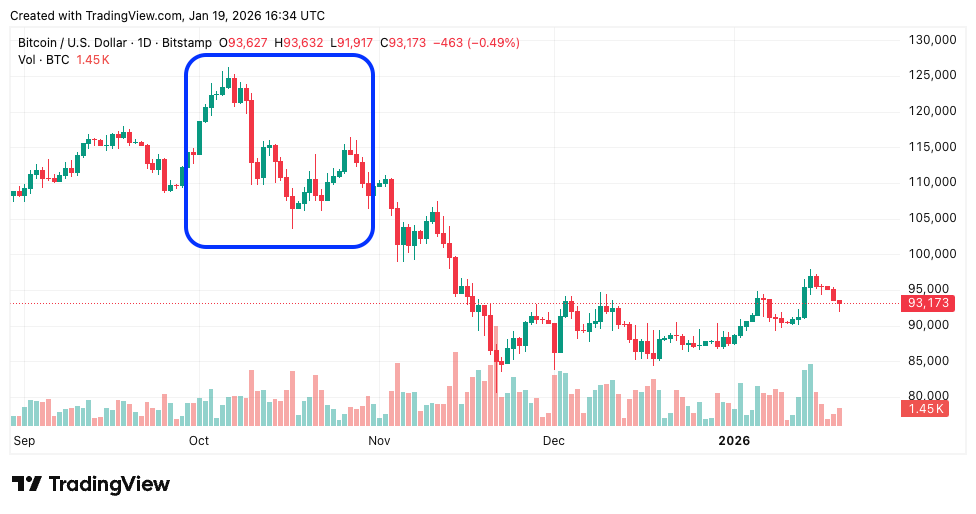
That episode saw brutal liquidations cascade through crypto markets during the pre-announcement phase as positioning built up, followed by sharp volatility swings between the announcement and implementation as traders attempted to front-run policy shifts.
After implementation, markets eventually stabilized once the actual tariff structure became clear, but not before major capital destruction during the uncertainty window.
Bitcoin’s 24/7 Lie Detector Function
While equities close overnight and on holidays, Bitcoin continues to print fear or relief in real time.
This 24/7 liquidity makes crypto markets the first responder to headline shifts, particularly during the key January 29–February 1 window, where any language pivot toward “,” “,” “,” “,” “,” or “” could ignite a violent relief rally with altcoins reacting even harder than Bitcoin.
In fact, speaking with Cryptonews, Farzam Ehsani, CEO of crypto exchange VALR, explains that growing fears of a U.S.-EU tariff standoff, combined with Trump’s aggressive trade rhetoric, pushed markets into renewed de-risking mode during thin weekend liquidity.
“Thin weekend liquidity and leverage fumes amplified the decline’s impact, turning the pullback into a flash drop of nearly $4,000 in less than two hours and a cascade of liquidated positions worth over $780 million,” Ehsani said.
“As capital rotated into established SAFE havens like gold, digital assets continued to trade as high-beta risk assets.“
The weakness extends beyond tariff fears into broader cryptocurrency-specific vulnerabilities.
While other risk assets, like the KOSPI, traded flat or higher amid US-EU trade-war concerns, cryptocurrencies continued to underperform, with only privacy coins standing out.
The 72-Hour Signal Window
The final stretch before February 1 represents maximum drama for traders positioned either for a reversal or further downside.
If no off-ramp language emerges within the final 48-72 hours, markets may begin treating the threat as real, with Bitcoin pricing fear ahead of traditional assets.
European leaders are already unified in defiant opposition, which suggests a greater likelihood of a blink before the said date.
According to the BBC, UK Prime Minister Keir Starmer told Trump in a phone call that “applying tariffs on allies for pursuing the collective security of Nato allies is wrong,” while Swedish Prime Minister Ulf Kristersson stated, “We will not let ourselves be blackmailed.”
As Prime Minister, I will always act in the United Kingdom’s national interest. pic.twitter.com/ZkveFmD1R1
— Keir Starmer (@Keir_Starmer) January 19, 2026French President Emmanuel Macron also called for activating the EU’s “trade bazooka,” an anti-coercion instrument designed to block US market access and impose sweeping restrictions on American goods.
Additionally, Germany’s Bundeswehr completed a reconnaissance mission in Greenland as part of NATO’s “” operation intended to strengthen the alliance’s footprint in the region.
Trump interpreted European military movements as hostile, writing that these countries “” and placed ““
Despite Bitcoin’s attempts to approach $100,000, monetary policy expectations offer little relief.
According to CME FedWatch tools, investors are pricing the first key rate cut only for June 2026, meaning tight financial conditions will persist.

“Clear signs of a reversal toward sustained growth are still lacking,” Ehsani said, adding that consolidation remains the baseline scenario for Bitcoin and most altcoins without new liquidity drivers.
For now, the trading playbook for the next 72 hours is binary.
Should the final two days before February 1 pass without conciliatory language from Washington, Bitcoin will likely lead the capitulation as markets price tariffs as credible rather than rhetorical.
Conversely, any headline indicating diplomatic retreat will trigger immediate repricing across crypto markets, with altcoins amplifying Bitcoin’s relief rally as Leveraged positions scramble to reverse defensive positioning built during the selloff.
