Bitcoin Price Eyes ’the Next Leg Up’—But Brace for Pain First, Warns Expert

Bitcoin's gearing up for another surge—but it's not going to be a smooth ride.
The Setup Before the Storm
Markets are consolidating, building energy like a coiled spring. Every major rally needs this phase—the painful grind that shakes out weak hands and resets expectations. It’s the financial equivalent of taking a deep breath before the sprint.
Why the Pain is Necessary
Liquidity needs to rotate. Over-leveraged positions must get flushed. The charts are hinting at a classic pattern: a final shakeout to trap the impatient before the real move begins. This isn't a bug; it's a feature of Bitcoin's volatile DNA.
The Path to the Next Leg Up
Once this corrective phase completes, the infrastructure for a sustained advance clicks into place. Key resistance levels turn into support, setting the stage. The expert view remains bullish on the macro trajectory, treating this potential dip not as a threat, but as the last buying opportunity before momentum kicks in again.
The Final Word
So, the thesis holds: higher highs are coming. But getting there will require stomaching some short-term turbulence—a concept traditional finance still struggles with, preferring the illusion of steady, predictable gains. Bitcoin doesn't do illusions. It does reality, raw and volatile. The next leg up is in sight, but the path runs straight through the pain cave.
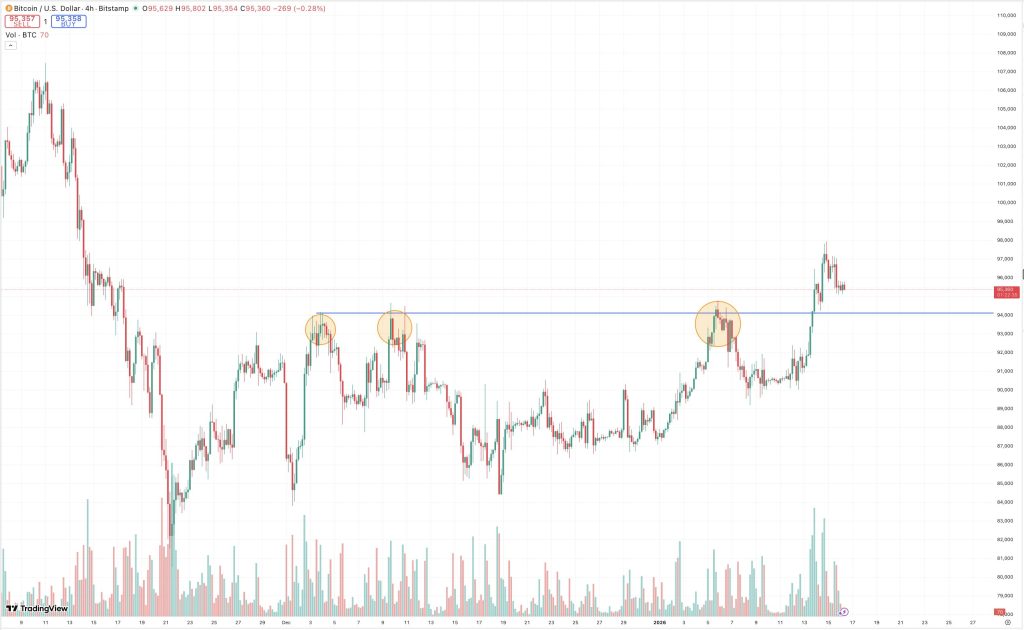 Source: TradingView
If Bitcoin continues to fall in Q1 and sets new lows, this could be a bearish signal for investors. Historically, Bitcoin has recovered after corrections, but this cycle looks different. Expectations are far less clear.
Institutional Flows Alone May Not Be Enough
, told Cryptonews that capital flows have shifted. According to him, gold is now attracting more attention as a traditional SAFE asset. Central banks, he says, are parking liquidity there for now:
The knock-on effect on the markets is a MOVE away from traditional safe assets like US treasuries and a shift towards gold, the oldest store of value in the world. This is where central banks will be parking their liquidity for now.
Thomas believes that for bitcoin price to regain positive momentum, dollar liquidity needs to expand:
For the right conditions to emerge for a return to BTC accumulation, the dollar liquidity needs to expand on the back of FED’s RMP and commercial banks lending to strategic industries.
These points highlight how dependent Bitcoin has become on institutional dynamics. That dependence increased sharply in 2025.
Macroeconomic data also continues to play a major role, Thomas added:
If we look at macroeconomic conditions, they drive the key scenarios and continue to be very uncertain.
Bitcoin ETF flows also paint a mixed picture. On the one hand, inflows are still present. On the other hand, they are often followed by outflows. This pattern keeps repeating. There are no clear signs of capitulation. At the same time, there is little evidence of aggressive institutional buying.

Bitcoin Price: Reset or the Start of a New Phase?
The broader market is still trying to recover from the Oct. 11 sell-off. The process has been slow. But the shock at the time was severe, and the market needs time to absorb it.
At this stage, it remains unclear whether the recovery will lead to another leg higher or a renewed decline. Uncertainty remains high, and both scenarios are still on the table.
Many market participants believe Bitcoin is currently in a redistribution phase. Historically, redistribution is often followed by accumulation, and then by a larger move, either up or down.
,, told Cryptonews that he sees the situation differently:
What some people call ‘distribution’ looks to me more like a handover from short-term, Leveraged traders to long-term investors who now treat Bitcoin as a real asset.
Knorr said downside moves remain possible, but they do not change Bitcoin’s broader setup:
If there’s an impulse move, the downside case WOULD come from a sudden liquidity shock, forced deleveraging, or a major regulatory hit. Something that could push prices lower in the short term without breaking the core thesis.
Even if the local trend turns bearish, Knorr believes it looks more like a reset than the end of the cycle:
The upside, however, is structurally stronger: growing institutional and ETF demand, increasing acceptance of Bitcoin as an investable asset, and continued money printing that erodes fiat value. Even if we dip to lower levels, I see that as a reset before the next leg up, not the end of the cycle. Bitcoin’s use case as a hedge against monetary mismanagement keeps the long-term direction firmly higher.
