Jefferies’ Wood Ditches Bitcoin: Quantum Computing Threat Looms Over Crypto’s Foundation

Another high-profile exit shakes crypto's top tier. Christopher Wood, global head of equity strategy at Jefferies, cuts Bitcoin from his long-term portfolio—citing a silent, gathering storm on the tech horizon.
The Quantum Countdown Begins
Wood's warning isn't about regulation or market cycles. It's about physics. He flags quantum computing's potential to crack the cryptographic algorithms that secure Bitcoin and the entire digital asset ecosystem. The move signals a rare, fundamentals-based fear from within finance: that the very bedrock of blockchain could face an existential tech bypass.
Security in the Crosshairs
The concern centers on public-key cryptography. Today's machines would need millennia to break it. Future quantum machines? Possibly minutes. While a large-scale, fault-tolerant quantum computer remains years away, the race for 'quantum-resistant' cryptography is on. Wood's pivot suggests some institutional players aren't waiting to see who wins.
A Calculated Retreat or Premature Flight?
Skeptics call it an overreaction—a classic case of finance folks getting spooked by sci-fi. Proponents see prudent risk management. After all, Wall Street's playbook is to sell the rumor, even if the reality is a decade out. It’s the ultimate hedge: dumping an asset because a technology that could destroy it might eventually exist. Only in modern finance can a theoretical future threat trigger a very real present-day sell signal.
The takeaway? The crypto narrative is evolving. The debate is no longer just about store of value or digital gold. It's about technological longevity. Wood's exit is a stark reminder that in the digital age, the greatest threats often come from the next generation of tech, not the last generation of regulators.
Quantum Threat Splits Bitcoin Community
The debate over quantum risk has intensified sharply in recent months, dividing prominent figures across the cryptocurrency ecosystem.
Nic Carter, a partner at Castle Island Ventures, accused influential Bitcoin developers of being “” about quantum computing threats, citing hundreds of millions of dollars in capital flowing into quantum computing development and U.S. government plans to deprecate classical cryptography by 2030.
Blockstream CEO Adam Back pushed back against Carter’s warnings, arguing that developers are quietly preparing quantum defenses without creating market panic.
“You make uninformed noise and try to MOVE the market or something. You’re not helping,” Back wrote in a December post criticizing Carter’s public statements.
 @Blockstream CEO @adam3us has publicly pushed back against claims that Bitcoin faces an imminent threat from quantum computing.#Bitcoin #Quantumhttps://t.co/8Xsi3zt95n
Despite the disagreement, Carter maintained his concerns are justified, noting that “companies are raising $100s of m to build QCs that can crack ECC” while “bitcoins mere existence is accelerating QC development.“
Solana co-founder Anatoly Yakovenko added urgency to the discussion at the All-In Summit 2025, warning there’s a 50% chance of a quantum breakthrough within five years.
“Bitcoin should migrate to quantum-resistant signature schemes as AI acceleration makes the timeline from research to implementation astounding,” Yakovenko stated.
One-Third of Bitcoin Supply Potentially Vulnerable
Security researchers estimate that approximately 30% of Bitcoin’s circulating supply is subject to quantum exposure under certain conditions.
David Duong, Global Head of Investment Research at Coinbase, calculated that roughly 6.51 million BTC sits in address types more vulnerable to long-range quantum attacks, including legacy Pay-to-Public-Key outputs and some Taproot constructions where public keys are already visible on-chain.
In an interview with Cryptonews last year, David Carvalho, CEO of Naoris Protocol and a former ethical hacker, warned that “any Bitcoin in lost wallets, including Satoshi (if not alive), will be hacked and put back in circulation” once sufficiently powerful quantum computers emerge.
Carvalho described “Q-Day” as arriving within three to five years, cautioning that “about 30% of all the BTC in circulation is sitting in addresses that contain public keys directly. The moment a powerful quantum rig is running, those coins are fair game.“
Major institutions have begun acknowledging the threat, with BlackRock flagging quantum risks in its iShares Bitcoin Trust ETF prospectus and Tether CEO Paolo Ardoino warning about exposure to inactive wallets.
 @Tether_to CEO @paoloardoino has warned that quantum computing could eventually pose a threat to inactive Bitcoin wallets.#Bitcoin #Quantumhttps://t.co/u8DCYrTjYw
While Ardoino reassured that “quantum computing is still very far from any meaningful risk of breaking Bitcoin cryptography,” he acknowledged that active wallet holders will need to migrate funds to quantum-resistant addresses once such protections become available.
Price Resilience Tested Amid Growing Technical Concerns
Bitcoin continues trading NEAR $97,000 despite debates over quantum security, supported by renewed ETF inflows and broader macro optimism.
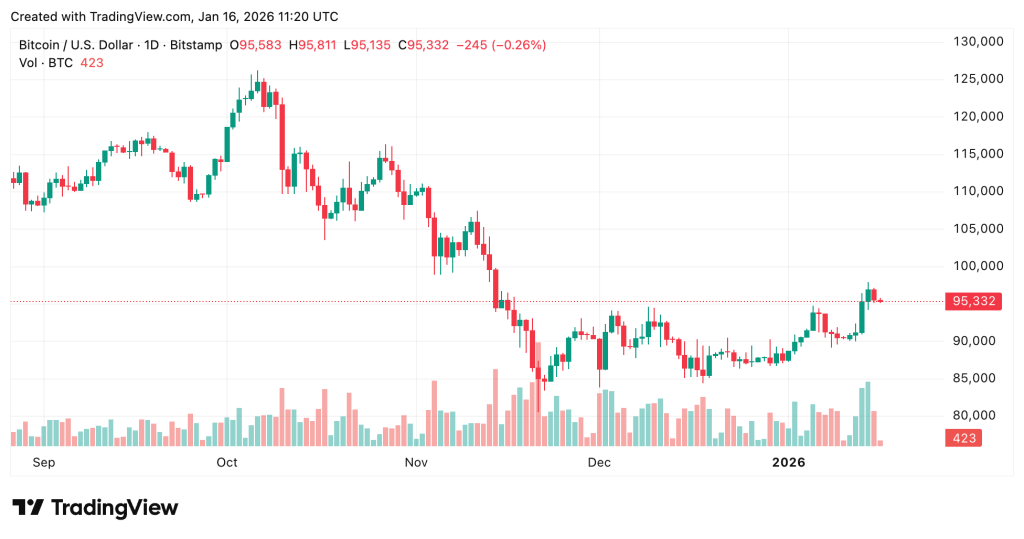
Speaking with Cryptonews, Timot Lamarre, Director of Market Research at Bitcoin financial services firm Unchained, which secures over $10 billion in BTC, believes ETF holder behavior will signal whether the rally sustains under growing technical scrutiny.
“The market value to realized value (MVRV) for bitcoin ETF holders has held strong above 1.0. Falling below 1.0 could scare off some investors,” Lamarre stated.
He noted ETF holders demonstrated resilience throughout 2024 despite extended periods of negative returns, adding that “it is expected that rates will likely have to come down, benefitting bitcoin, given the fact that $9+ Trillion worth of debt from the pandemic era is rolling over in 2026 and the interest expense paid is projected to be over $1T as well.“
Wood’s shift back toafter abandoning Bitcoin reflects his conviction that debates over quantum computing create conditions favoring traditional precious metals as “a historically tested hedge in an increasingly uncertain geopolitical world.“
