Elizabeth Warren Demands Regulator Freeze World Liberty Bank Bid Until Trump Cuts Crypto Ties

Warren's crypto crackdown targets Trump's financial backers—and could reshape banking's digital future.
The Regulatory Hammer Drops
Senator Elizabeth Warren just threw a regulatory grenade into the banking sector's crypto ambitions. Her demand? Freeze World Liberty Bank's acquisition bid until former President Donald Trump severs all cryptocurrency connections. This isn't just political theater—it's a direct assault on the intersection of traditional finance and digital assets.
Banking's Crypto Conundrum
World Liberty Bank's bid represents more than a simple acquisition. It's a potential gateway for crypto integration into mainstream banking infrastructure. Warren's intervention signals that regulators won't let financial institutions wade into digital assets without scrutinizing every political and financial tie. The message to banks: clean house before touching crypto.
The Trump Factor
Trump's crypto affiliations have become collateral damage in Washington's war on digital assets. Whether through campaign donations, NFT ventures, or public statements, his connections provide ammunition for politicians seeking to slow crypto's institutional adoption. The banking sector now faces an uncomfortable reality: political baggage can derail billion-dollar deals.
Regulatory Chess Match
Warren's move demonstrates how regulators can weaponize approval processes to enforce political agendas. By linking bank acquisitions to personal financial disclosures, she's created a new hurdle for crypto-friendly institutions. Expect other politicians to follow suit—using regulatory leverage as their preferred blunt instrument against digital asset expansion.
Banking's Digital Future on Ice
The freeze threatens more than one deal. It signals to every financial institution that crypto integration comes with political risk assessment. Banks must now weigh whether digital asset strategies are worth navigating Washington's minefield. Some will retreat; others will find creative workarounds—because where there's financial innovation, there's always a loophole waiting to be exploited.
Warren's gambit exposes Washington's growing willingness to use banking regulation as crypto policy—proving once again that in finance, the most dangerous risks often wear suits and work in government buildings.
Stablecoin Charter Puts OCC in Political Crosshairs, Warren Says
In a letter sent Tuesday to Jonathan Gould, the Comptroller of the Currency, Warren urged the Office of the Comptroller of the Currency to delay consideration of World Liberty Financial’s bid until Trump divests from the company and removes what she described as “real and serious” financial conflicts involving himself and his family.
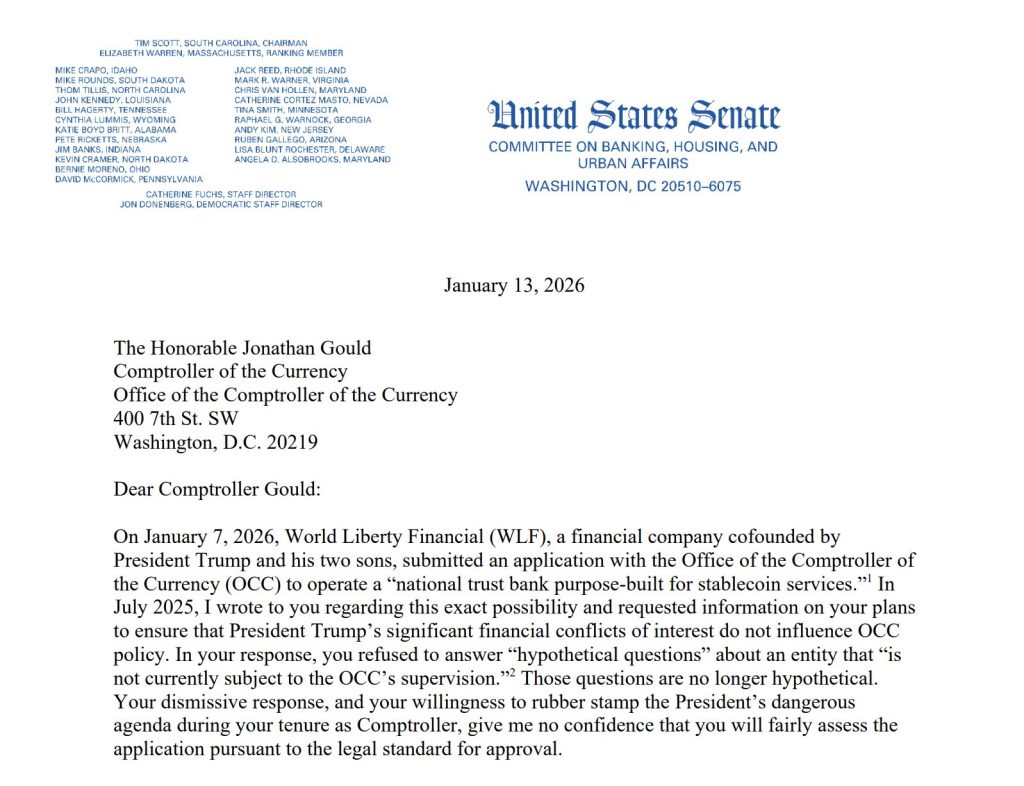
Warren, the ranking Democrat on the Senate Banking Committee, said the situation was no longer hypothetical after a World Liberty subsidiary formally applied on January 7, 2026, to operate a national trust bank designed to support stablecoin services.
World Liberty Financial was launched in 2024 and lists Trump and his sons Barron, Eric, and Donald Trump Jr. as co-founders.
 Trump-backed World Liberty Financial has launched World Liberty Markets, a new crypto lending platform tied to its #USD1 stablecoin.#Stablecoins #DeFi #USD1 #CryptoNewshttps://t.co/vginSli5es
The platform has grown quickly, raising more than $550 million through token sales and launching a dollar-backed stablecoin, USD1, in March 2025.
USD1 has since expanded to an estimated $3.4 billion in market value and has been used in high-profile transactions, including a $2 billion Binance investment by a third-party firm using the token.
A World Liberty subsidiary, WLTC Holdings, filed for the charter that WOULD allow it to issue, custody, and convert USD1 directly under federal supervision.
 World Liberty Financial filed for a US national banking charter, seeking OCC oversight to bring its dollar-backed stablecoin USD1 fully inside the regulatory perimeter. @worldlibertyfi#WLFI #OCC https://t.co/kDgbVB1c25
Warren argued that the application places the OCC in an unprecedented position.
Under the National Innovation for US Stablecoins Act, or GENIUS Act, signed into law by Trump in July 2025, the OCC became the primary regulator for federally licensed stablecoin issuers.
That role includes approving charters, writing rules, supervising issuers, and enforcing violations.
Warren said that approving World Liberty’s application would effectively make the president responsible for overseeing a financial company from which he and his family benefit, while the regulator itself serves at the president’s pleasure.
Crypto Policy Debate Intensifies as Trump Family Ventures Expand
In a public report cited in Warren’s letter, Trump and his family have earned more than $1 billion from World Liberty Financial and other crypto ventures.
Beyond World Liberty, the Trump family controls entities tied to an official Trump-branded meme coin launched on Solana in early 2025, several NFT collections that have generated millions in licensing revenue, and a bitcoin mining company established by Trump’s sons last year.
These ventures mark a sharp shift from Trump’s earlier skepticism of digital assets and have been accompanied by a policy agenda that has rolled back enforcement actions and positioned the US as a global crypto hub.
The charter filing comes as regulators have shown greater willingness to bring crypto firms under bank-style oversight.
In December, the OCC approved national trust bank charters for several digital asset companies, including BitGo, Circle, Paxos, Ripple, and others.
 The OCC has conditionally approved five crypto firms, including @Circle and @Ripple, to launch national trust banks.#Ripple #Circlehttps://t.co/wCeTNrhOQZ
Trust banks cannot take deposits or make loans, but they can provide custody and settlement services, making them an attractive structure for stablecoin issuers seeking tighter integration with the traditional financial system.
Warren’s push also lands amid broader legislative friction. There are many efforts going on in Congress, including the Stop TRUMP in Crypto Act and the End Crypto Corruption Act, that aim to restrict elected officials and their families from owning or profiting from digital assets, but none have advanced into law.
