Uganda’s Election Internet Blackout Sparks Bitchat Download Frenzy

When governments pull the plug, citizens find new sockets. Uganda's looming election-period internet shutdown has triggered a massive surge in downloads for decentralized messaging app Bitchat—a textbook case of demand meeting censorship.
The Run on Digital Refuge
Downloads aren't just ticking up; they're spiking. As authorities prepare to flick the switch, Ugandans are racing to install software that operates off-grid. Bitchat, which routes messages through peer-to-peer networks instead of centralized servers, represents more than an app—it's a digital lifeline. This isn't about convenience; it's about maintaining the basic human function of communication when the main roads are deliberately blocked.
Protocols Over Politics
The tech works by bypassing traditional internet service providers entirely. Phones connect directly to each other via Bluetooth or local Wi-Fi meshes, creating an ad-hoc network that government firewalls can't touch. It's a silent, distributed protest written in code—one that turns every smartphone into a potential relay station. The architecture itself is the argument against control.
A Cynical Finance Footnote
Meanwhile, traditional markets will likely shrug at this humanitarian tech story—after all, there's no clear ticker symbol for 'preserving democracy during an internet blackout.' The real value, apparently, remains in assets you can easily tax and regulate.
The takeaway? When access becomes a political tool, decentralized tools become political acts. Uganda's download spike isn't a trend—it's a signal. The next frontier for freedom might not be in the streets, but in the app store.
Internet Blackout Mirrors 2021 Election Crackdown
According to Vanguard, the Uganda Communications Commission justified the suspension as necessary to prevent “” that could undermine national security during the election period.
The directive applies to all access technologies, including mobile broadband, fiber-optic services, and satellite internet, with violators facing fines and possible license suspensions.
NetBlocks confirmed “nation-scale disruption to internet connectivity” shortly after the 3 p.m. GMT implementation deadline.
 Confirmed: Live network data show a nation-scale disruption to internet connectivity in #Uganda; the measure comes days ahead of general elections and corresponds to a shutdown notice from the Uganda Communications Commission "to mitigate the rapid spread of misinformation"
 pic.twitter.com/01ZGYVRSuG
Voice calls and basic SMS services remained operational, while essential state services received exemptions through secure whitelisted systems restricted to authorized personnel.
The government had repeatedly promised internet access WOULD remain available, stating on January 5 that “claims suggesting otherwise are false, misleading, and intended to cause unnecessary fear and tension among the public.“
Uganda previously cut internet access during its 2021 election, which international observers described as marred by widespread allegations of rigging and state violence against opposition supporters.
Opposition Faces Intensified Repression Ahead of Vote
United Nations Human Rights Office reported that police and military forces used live ammunition to disperse peaceful rallies, conducted arbitrary detentions, and abducted opposition supporters in the election run-up.
Security forces detained hundreds of opposition supporters while repeatedly firing tear gas at campaign events supporting Bobi Wine, whose real name is Robert Kyagulanyi.
The government on Tuesday ordered two local rights groups (Chapter Four Uganda and Human Rights Network for Journalists-Uganda) to immediately cease operations.
The state-run National Bureau for NGOs accused the organizations of activities “” to Uganda’s security.
Both groups had documented alleged arbitrary detention and torture of opposition supporters and journalists covering the election campaign.
Another opposition figure, Kizza Besigye, who challenged Museveni in four previous elections, remains jailed on treason charges after being kidnapped in Kenya in 2024 and returned to Uganda for military trial.
Decentralized App Provides Communication Alternative
Bitchat entered beta testing in July and requires no accounts, phone numbers, or central infrastructure.
The app fragments messages into 500-byte chunks that hop between devices within 30 meters, with up to 7 relay points enabling transmission during connectivity blackouts.
Store-and-forward systems cache messages for offline users up to 12 hours, ensuring delivery when direct connections are unavailable.
Wine encouraged supporters to download the application during his final Monday rally, where heavy security deployment established a perimeter that deterred attendance.
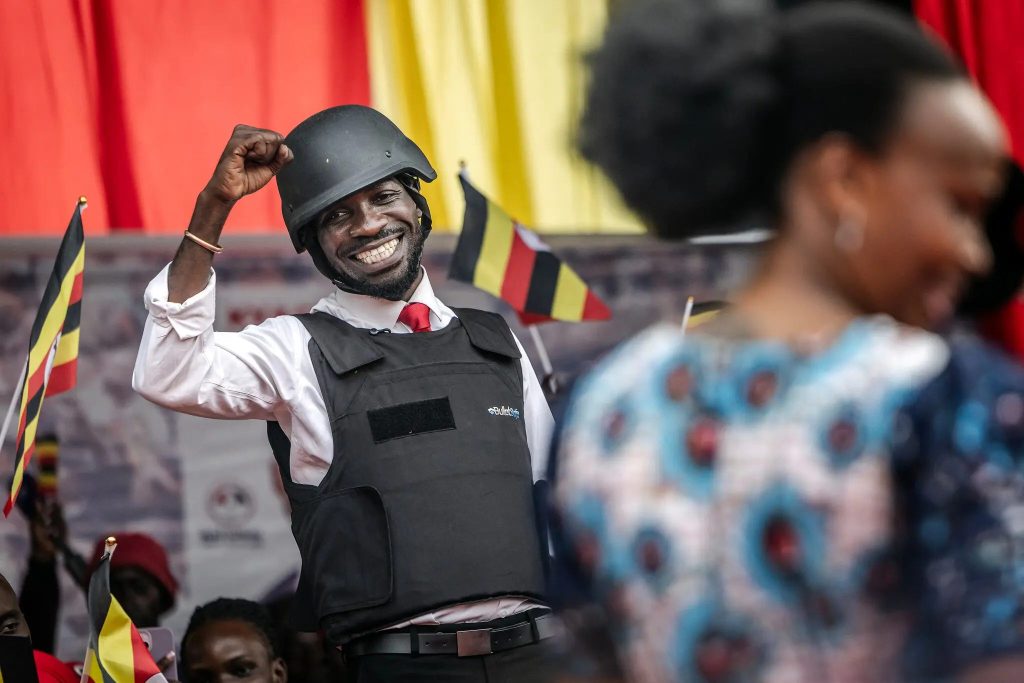
Soldiers chased down and beat at least one person for waving Uganda’s national flag, a symbol of Wine’s campaign that authorities have banned.
Uganda Communications Commission executive director Nyombi Thembo warned regulators could disable Bitchat if needed, stating, “Don’t be excited by Bitchat, it’s a small thing.“
Calle rejected that assessment, citing internal data showing over 400,000 Ugandan downloads while declaring, “You can’t stop Bitchat. You can’t stop us.“
Museveni came to power in 1986 after leading a five-year rebellion and is Africa’s third-longest serving head of state. He has changed the constitution twice to remove age and term limits.
His campaign slogan “” contrasts sharply with Wine’s “” message, emphasizing generational change for Uganda’s population, where more than one in four citizens are between 18 and 30 years old.
Notably, Uganda’s adoption follows similar patterns during recent civil unrest across multiple countries.
 Dorsey's Bitchat explodes in Madagascar as protesters adopt censorship-resistant messaging during violent protests over infrastructure failures.#BitChat #Madagascarhttps://t.co/oZS9WNukd2
Nepal recorded 48,781 downloads in September during youth-led protests against government corruption that left 22 dead and forced Prime Minister KP Sharma Oli’s resignation, while Madagascar saw searches spike from zero to 100 during violent demonstrations over water and electricity shortages that prompted government curfews across the capital.
