Institutions Now Control 11% of All Ethereum as Exchange Reserves Plummet to Historic Lows

The smart money is moving—and it's not heading to the exits. A seismic shift in Ethereum's supply landscape is unfolding, with institutional players quietly accumulating while retail-facing exchanges bleed reserves.
The Great ETH Migration
Forget the daily price noise. The real story is in the wallets. Exchange balances, the traditional barometer of sell-side pressure, have evaporated to levels never seen before. That means less ETH is sitting on the sidelines, ready to be dumped at a moment's notice. The liquidity squeeze is real.
Wall Street's Crypto Vault
While exchanges run dry, institutional coffers are filling. A full 11% of Ethereum's entire circulating supply is now held in custody by funds, corporations, and regulated entities. That's not speculative trading capital—it's strategic, long-term positioning. They're not buying to flip; they're buying to hold, staking their claim on the future of decentralized finance and digital infrastructure. It's the ultimate vote of confidence, wrapped in a cold storage key.
The New Supply Shock Calculus
This creates a powerful, two-pronged dynamic. Shrinking exchange supply limits immediate selling, acting as a natural price floor. Meanwhile, institutional accumulation locks away tokens for years, not days. The result? A fundamentally tighter market where new demand meets a supply that's increasingly hard to find—unless you're willing to pay a premium, of course. The old traders' lament of 'it's all on exchanges' simply doesn't apply anymore.
The game has changed. The narrative of crypto as a purely retail-driven casino is crumbling under the weight of billion-dollar balance sheets. The institutions aren't just dipping a toe in; they're building an ark. And as any good financier knows, the real money isn't made in the frenzy of the trade—it's made in the quiet patience of the vault, waiting for everyone else to realize what you bought years ago.
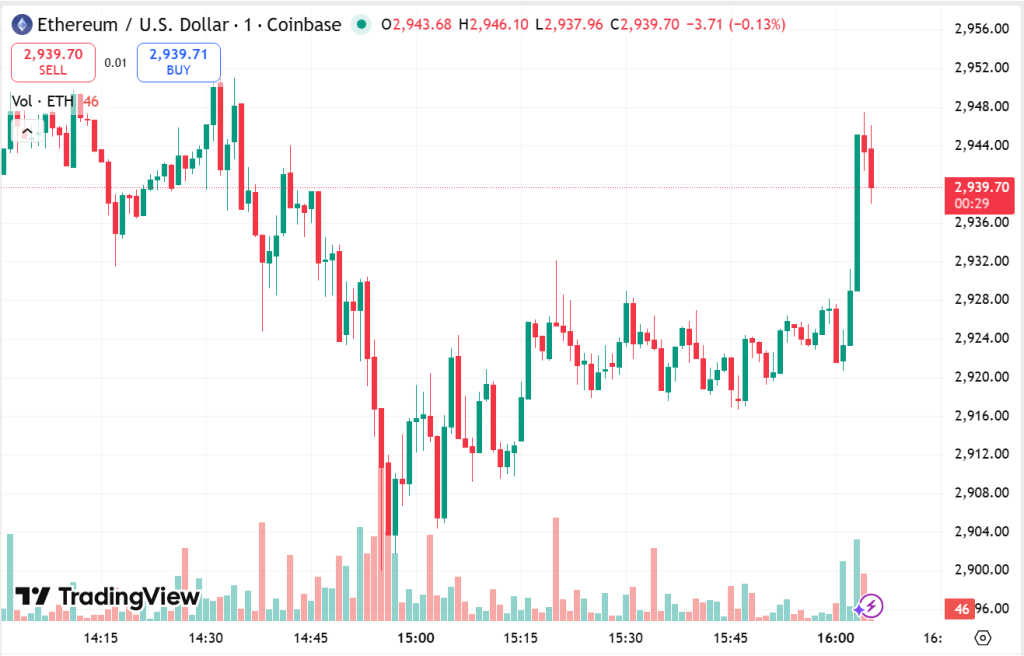 Source: TradingView
The Supply Squeeze
The liquidity drain is quite noticeable as ethereum reserves on centralized exchanges have plummeted to, a record low and a 43% drop since July.
Unlike previous accumulations, this capital isn’t just sitting in whale wallets idly. It’s being locked into staking contracts and treasury vaults.
- The Buyer: U.S. spot Ethereum ETFs have netted approximately $12.4 billion in year-to-date inflows, with BlackRock’s iShares Ethereum Trust (ETHA) leading the charge.
- The Catalyst: BlackRock filed for a staking-enabled ETH trust earlier this month, indicating intent to capture the network’s native yield, effectively treating ETH as a digital bond.
BREAKING: Blackrock’s iShares just filed for a staked Ethereum ETF.
Bullish for $ETH pic.twitter.com/7DHuXANW4R
Infrastructure, Not Speculation
The value proposition has shifted from “ultrasound money” to settlement plumbing.
“Current prices remain above Citi’s activity-based estimates, likely reflecting ‘buying pressure and exuberance around new use cases such as tokenization and stablecoins,'” according to Citi analyst Alex Saunders in a note seen by Reuters.
Data from RWA.xyz confirms this thesis: Ethereum now securesin tokenized real-world assets (RWAs). Simultaneously, the network settlesin monthly stablecoin volume, cementing its role as the financial LAYER for digitized dollars.
The Outlook and Institutional Take
The disconnect between price action and on-chain metrics is stark. While NFT sales are down 87% from 2021 highs, the structural absorption of ETH continues.
A Binance Square post argued that ETH’s valuation could shift from a deflation narrative toward an ecosystem/infrastructure narrative as stablecoin and L2 usage grow. Separately, Binance Research has pointed out that rising staking participation reduces liquid ETH supply, which can amplify price sensitivity during demand spikes.
Forget the chart for a moment. The real story is the reclassification of ETH in institutional portfolios. It’s no longer a high-beta tech play; it’s being structured as a yield-bearing instrument (approx. 3-4% APR).
The BlackRock staking filing is the “green light” for risk-averse allocators to capture that yield. Expect liquidity to remain thin on exchanges as custodians MOVE assets into cold storage staking solutions, making a “supply shock” squeeze a mathematical inevitability if flows accelerate.
