125 Crypto Groups Warn Congress: Stablecoin Yield Ban Hands Power to Big Banks

Washington's latest regulatory push just sparked a crypto rebellion.
A coalition of 125 industry groups fired a shot across the bow of Congress this week. Their message? A proposed ban on stablecoin yields isn't about protecting consumers—it's about protecting legacy financial giants from competition.
The Real Stakes: Innovation vs. Incumbency
The draft legislation, circulating quietly in committee rooms, aims to outlaw the generation of returns on digital dollar-pegged tokens. Proponents frame it as a necessary guardrail. The crypto alliance calls it a blatant power grab.
They argue the rule would functionally outlaw decentralized finance (DeFi) protocols that allow users to earn yield on stablecoins through lending, staking, or liquidity provision. Traditional banks, meanwhile, face no such restrictions on the interest they can pay—or charge.
A System Designed for the Few
This isn't just about a niche financial product. It's about who gets to build the next layer of the financial system. The ban, critics say, would cement the current hierarchy: banks at the top, everyone else asking for permission.
It creates a regulatory moat around old business models. Innovation gets sidelined while the usual suspects count their blessings—and their fees. After all, why compete on a level playing field when you can just write the rules?
The clash exposes a fundamental tension. Lawmakers see risk in the unknown. The crypto industry sees a deliberate move to stifle a challenge to the status quo. One thing's clear: the fight over who controls digital money is just heating up.

 pic.twitter.com/nxZcNaJBTI
— Blockchain Association (@BlockchainAssn) December 18, 2025
pic.twitter.com/nxZcNaJBTI
— Blockchain Association (@BlockchainAssn) December 18, 2025
Banks Push Asymmetric Restrictions on Digital Payments
The dispute centers on whether platforms like Coinbase and PayPal can offer rewards to stablecoin users through loyalty programs and third-party incentives.
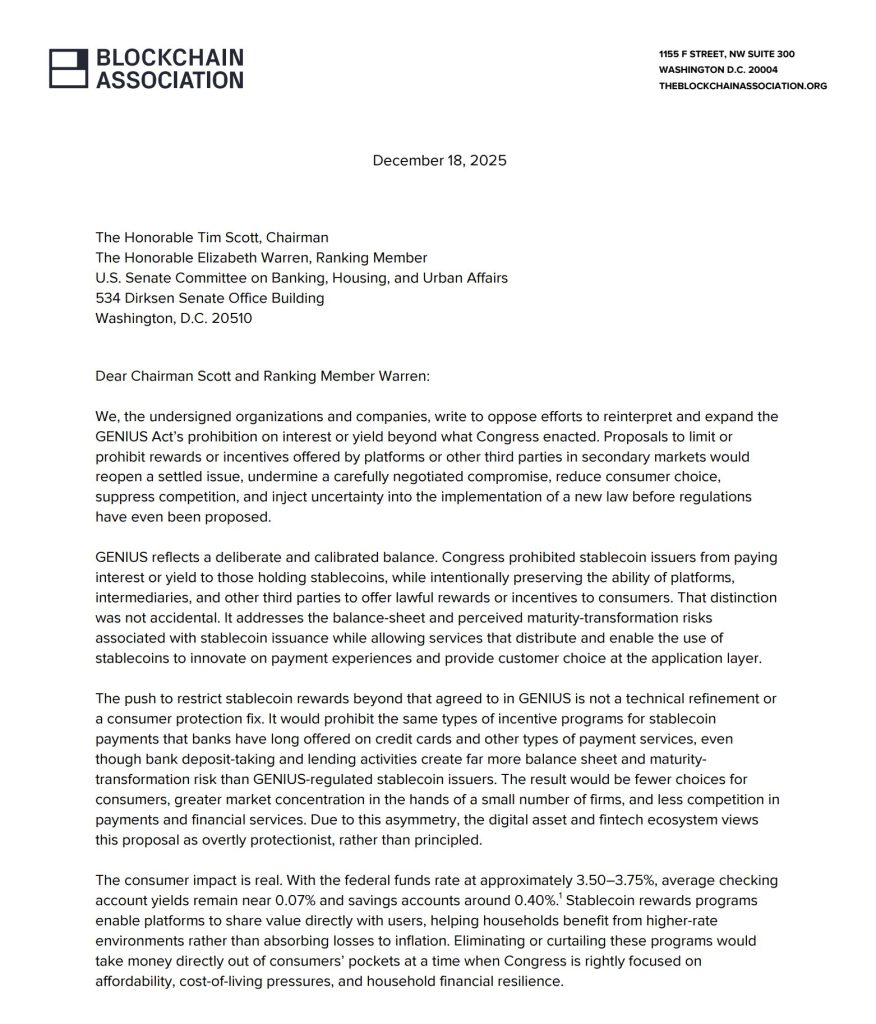
While the GENIUS Act explicitly prohibits stablecoin issuers from paying interest directly to holders, the coalition maintains that Congress deliberately preserved intermediaries’ ability to offer lawful rewards at the application layer.
Banking groups led by the American Bankers Association have urged Treasury to interpret “” broadly enough to capture any economic benefit, including merchant discounts and platform rewards.
The coalition called this expansion “” noting that banks face no similar restrictions on credit card rewards despite engaging in riskier balance-sheet activities than GENIUS-regulated stablecoin issuers.
“With the federal funds rate at approximately 3.50–3.75%, average checking account yields remain NEAR 0.07% and savings accounts around 0.40%,” the letter noted.
“Stablecoin rewards programs enable platforms to share value directly with users, helping households benefit from higher-rate environments rather than absorbing losses to inflation.“
Coalition Disputes Bank Deposit Flight Claims
Banking associations have warned that stablecoin yields could trigger deposit outflows resembling the 1980s money market fund crisis, when withdrawals drained $32 billion from banks between 1981 and 1982.
Treasury estimates suggested yield-bearing stablecoins could result in up to $6.6 trillion in deposit flight.
The coalition firmly rejected these projections, citing Charles River Associates’ analysis, which found no evidence of disproportionate deposit outflows from community banks between 2019 and 2025.
The letter questioned how banks can claim deposit constraints while holding roughly $2.9 trillion in reserve balances, earning interest at the Federal Reserve rather than deploying them into loans.
“Opposition to stablecoin rewards reflects protection of incumbent revenue models, not safety-and-soundness concerns,” the coalition wrote, arguing that restricting third-party incentives would prevent stablecoins from competing on a level playing field with legacy payment systems.
 Citi executive warns stablecoin interest payments could drain bank deposits like the 1980s crisis amid GENIUS Act loophole concerns.#Stablecoin #Bankshttps://t.co/aaHxz9bXHM
Regulatory Certainty and Market Competition at Stake
Beyond consumer choice, the coalition warned that reopening the yield issue before GENIUS implementation begins would undermine the regulatory certainty that defines Congressional frameworks.
“It would signal that even recently enacted compromises remain subject to almost immediate renegotiation, undermining the predictability that markets, consumers, and innovators rely on,” the letter stated.
The groups emphasized that rewards and incentives are standard competitive tools in markets with high network effects and switching costs, including the current payments market.
offer faster settlement, lower transaction costs, and greater transparency compared to traditional rails, but adoption requires incentives to overcome entrenched user habits.
The signatories include industry leaders such as Coinbase, PayPal, Stripe, Ripple, and Kraken, as well as Stand With Crypto chapters across 20 states and investment firms such as Andreessen Horowitz and Paradigm.
“Preserving the balance Congress struck is essential to protecting consumers, fostering competition, and ensuring that market structure legislation can advance on a bipartisan and durable basis,” the coalition concluded, urging lawmakers to reject any effort to expand the yield prohibition beyond issuer payments.
The dispute comes as stablecoin adoption accelerates, with a circulation of $310 billion.

The market could triple to $1 trillion by 2026 as institutions integrate blockchain payments into financial infrastructure.
