Bitcoin Could Hit $140,000 in Next 180 Days, Expert Predicts — Here’s Why

Forget the noise. One bold forecast cuts through the chatter: Bitcoin's price could surge to $140,000 within six months.
The Six-Month Sprint
That 180-day window isn't just a random timeframe—it's a countdown to a potential paradigm shift. The prediction hinges on converging catalysts, from institutional adoption waves to macroeconomic tremors that traditionally send investors scrambling for hard assets.
The $140,000 Target: More Than a Number
Hitting that figure wouldn't just be a new all-time high; it would represent a fundamental re-rating of Bitcoin's role in global finance. It bypasses traditional valuation models, pointing instead to a liquidity rush and a crisis of confidence in legacy systems. After all, what's a central bank meeting compared to a verifiably scarce digital ledger?
The path won't be a straight line—volatility never is. But the thesis argues the momentum is building, fueled by forces more powerful than any single regulatory frown or skeptical headline. It’s a bet on the network effect hitting escape velocity.
So, mark the calendar. In roughly half a year, we could be looking at a radically different financial landscape. Or, we'll be listening to the same experts explain why their model was 'right, just early'—the favorite hedge of every Wall Street prognosticator who missed the call.
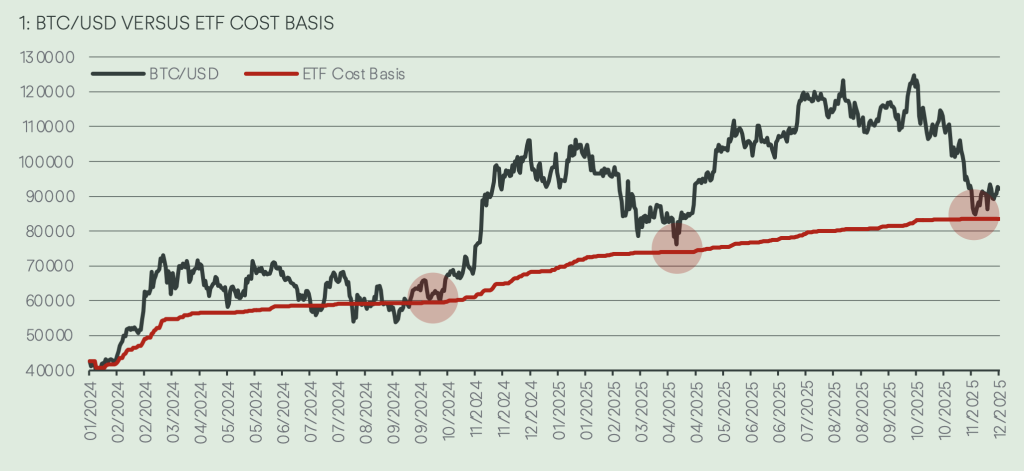 Image: Copper
Copper also claims this has exposed a significant divide between crypto-focused traders and institutional investors, with some bitcoin commentators claiming it is “the worst bull market ever.”
So… what exactly causes these sharp corrections once BTC enters price discovery mode? Well, its analysis suggests that institutions rebalancing their portfolios is primarily to blame — an activity that “transforms Bitcoin’s volatility into realized returns.”
“Institutions are not ‘staking sats’ — in fact, most do not care about sats at all now that Bitcoin is accessible through equities-style ETF shares. They care about risk-adjusted contribution to a portfolio.”
Generally speaking, it’s been recommended that institutions allocate somewhere between 2% and 5% into Bitcoin — but a sudden surge in price can have a huge impact.
“Without rebalancing, a modest 2% Bitcoin allocation drifts to 6.2% in less than 180 days during these cycles. A 5% allocation drifts dangerously close to double-digit.”

Copper’s head of research Fadi Aboualfa told Cryptonews that Bitcoin is now at a critical juncture.
“With BTC now trading NEAR its $84,000 cost basis, that pattern points to a move north of $140,000 in the next 180 days. If cost basis rises 10% to 15% as in prior cycles, the resulting premium seen at past peaks produces a target range of $138,000 to $148,000.”
The prospect of a return to all-time highs within the next six months WOULD provide a much-needed dose of “hopium” for traders. However, other analysts have warned there are few catalysts that can drive BTC forwards at the moment. The Federal Reserve’s recent 0.25 percentage point interest rate reduction was largely priced in, with policymakers suggesting there may only be one cut in 2026.
A big test will concern what happens if Bitcoin’s value falls below its cost basis for ETF investors — and whether sell-offs would intensify if institutions spent a prolonged period in the red.
Bitcoin (BTC)24h7d30d1yAll timeData from SoSoValue shows inflows into spot Bitcoin ETFs on Wall Street have fallen substantially so far in December, and have failed to compensate for eye-wateringly high levels of outflows last month.
Products from the likes of BlackRock and Fidelity now hold 6.57% of Bitcoin’s total market cap, meaning sustained outflows could put the digital asset’s valuation under a lot of pressure.
Further price declines would also create headaches for Strategy, which has now amassed a warchest of 660,625 BTC — well over 3% of BTC’s supply. These acquisitions have largely been funded by debt, with the company admitting it may be forced to begin selling if its mNAV, which compares Strategy’s market value to its BTC holdings, falls below 1.
Strategy’s concerted push to continue buying Bitcoin throughout the bull run means that the average price paid per coin has surged over the past year, giving it less headroom in the event of a bear market. We’ve also been the buffer between Bitcoin’s price and the ETF cost basis erode. Amberdata research suggests “the margin of safety has compressed to levels not seen since early 2024.”
“The early money is patient. DEEP profits create holders who can weather drawdowns without stress. The late money is nervous. They have investment committees asking questions and redemption pressure from clients who bought at $100,000.”
Amberdata argues that a fall below $80,000 could prove hugely consequential — and cause a huge change in psychology among investors, as well as a barrage of negative headlines.
A bigger question that might need to be asked is this: should institutions back out of Bitcoin ETFs, will they ever return?
