Harvard Bets Big on Bitcoin With $443M Stake, Outpacing Gold 2-to-1

Ivy League Endowment Makes Crypto Play of the Decade
Forget tweed jackets and dusty libraries—Harvard's investment arm just placed a $443 million bet that digital gold beats the real thing. The move allocates twice as much capital to Bitcoin as it does to traditional gold holdings, signaling a tectonic shift in how elite institutions view store-of-value assets.
The Numbers Don't Lie
The $443 million figure isn't just a rounding error in a multi-billion dollar portfolio. It's a conviction trade, one that publicly sidelines a 5,000-year-old asset class in favor of its 15-year-old digital competitor. The 2-to-1 ratio speaks louder than any investment thesis white paper ever could.
Why This Cuts Through the Noise
Harvard's endorsement bypasses the usual crypto hype cycle. This isn't a speculative hedge fund or a tech VC fund—it's one of the world's most conservative, long-term capital allocators. Their move legitimizes Bitcoin's narrative as a monetary asset in a way that retail FOMO rallies never could. It forces every other endowment and pension fund manager to re-run their models.
A New Playbook for Institutional Capital
The investment shatters the old guard's argument that crypto lacks 'institutional adoption.' When an institution that predates the United States starts reallocating from ancient stores of value to digital ones, the game has changed. It provides a blueprint for other fiduciaries to follow, offering cover for the inevitable 'me-too' allocations that will follow.
The Ironic Twist
There's a delicious irony in watching an institution funded by centuries of traditional wealth preservation—land grants, blue-chip stocks, and yes, gold—now bank on a decentralized network created in response to the very financial system it inhabits. It's the ultimate pragmatic pivot, proving that even hallowed halls can recognize a paradigm shift when it stares at them from a blockchain ledger.
What This Means for the Rest of Us
For the average investor, it's a stark signal. When Harvard's money managers—who usually move with the speed of continental drift—make a decisive leap into a volatile asset, it underscores a fundamental reassessment of risk and future value. It suggests the 'digital asset' thesis has moved from the fringe to the core of future-facing portfolio construction.
The bottom line? The smart money is no longer just watching from the sidelines. It's building a position—and leaving the old guards of finance, who are still debating 'intrinsic value,' to play catch-up. After all, nothing validates an asset class faster than seeing a billionaire's university endowment outmaneuver Wall Street's gold bugs.
Timing Proves Problematic as Bitcoin Tumbles
Harvard’s aggressive Bitcoin accumulation came right before a sharp market correction that has erased substantial value from its cryptocurrency holdings.
Bitcoin has dropped more than 20% since the third quarter ended, falling from $114,000 to around $92,000.
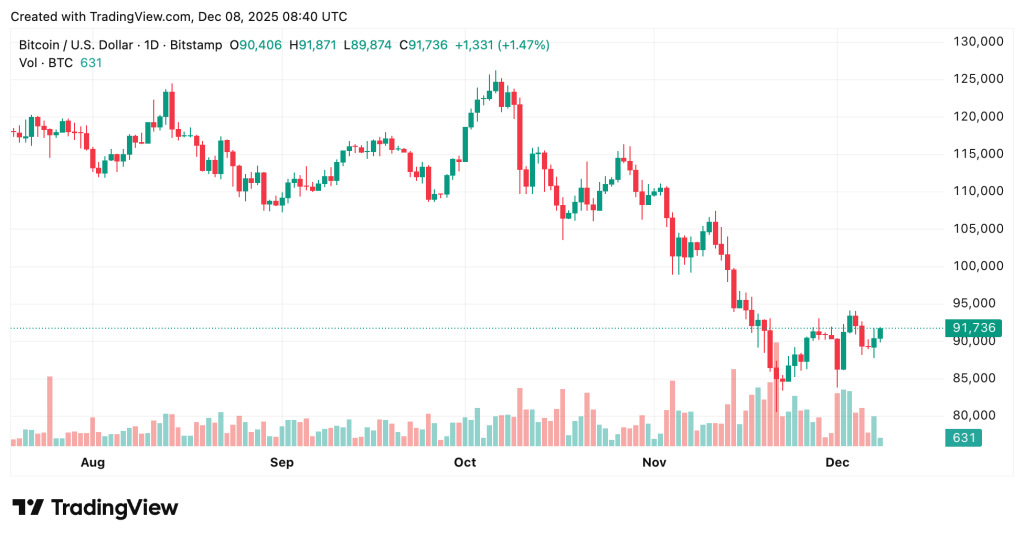
The timing suggests Harvard could face a 14% loss on its third-quarter purchases in the best-case scenario, assuming shares were bought at July’s low point, which represents an $89 million paper loss on the recent position alone.
While the losses remain a fraction of Harvard’s massive endowment, the university’s annualized returns have lagged behind some Ivy League peers over the past decade, according to WSJ.
Harvard posted an 8.2% return ranking ninth out of 10 elite schools in a Markov Processes International comparison. For the year ending June 30, Harvard reported an 11.9% gain but trailed MIT’s 14.8% and Stanford’s 14.3%.
Stanford finance professor Joshua Rauh explained in an interview with The Harvard Crimson that “investors often seem to view both bitcoin and gold as hedges against a collapse of the international monetary system in general, and against a loss of the US dollar in particular.”
However, he cautioned that “the extent to which either actually protects investors from these forces is uncertain and scenario-dependent.“
Academic Skepticism Meets Institutional Validation
Harvard’s substantial Bitcoin allocation stands in stark contrast to earlier predictions from its own economics faculty.
Kenneth Rogoff, a Harvard professor and former IMF chief economist, stated in 2018 that Bitcoin WOULD more likely trade at $100 than $100,000 within a decade.
“I think bitcoin will be worth a tiny fraction of what it is now if we’re headed out 10 years from now,” Rogoff told CNBC, arguing that removing money laundering and tax evasion would leave Bitcoin with “” transaction uses.
Rogoff recently acknowledged his misjudgment in his new book “Our Dollar, Your Problem,” writing, “I was far too optimistic about the US coming to its senses about sensible cryptocurrency regulation.”
 Harvard economist @krogoff admits his $100 Bitcoin crash prediction was wrong as $BTC trades above $115,000.#Bitcoin #Harvardhttps://t.co/AX8l7Aitxz
He added that he “did not anticipate a situation where regulators, and especially the regulator in chief, would be able to brazenly hold hundreds of millions (if not billions) of dollars in cryptocurrencies seemingly without consequence given the blatant conflict of interest.“
Despite growing institutional adoption, criticism of Harvard’s Bitcoin investment has intensified.
MarketWatch columnist BRETT Arends called the investment an “” noting that Bitcoin’s global computing network uses more energy than Thailand or Poland annually.
Meanwhile, Stanford professor Darrell Duffie also expressed surprise at the investment, stating, “Bitcoin does not pay dividends and has limited uses as a payment instrument.“
Bitcoin’s Path Forward Remains Uncertain
Bitcoin is struggling to find direction amid ETF outflows and weakening market sentiment, creating uncertainty about whether it can reclaim the $100,000 threshold.
More than $2.7 billion has left Bitcoin ETF products over the past five weeks.
Speaking with Cryptonews, Arthur Azizov, Founder and Investor at B2 Ventures, described the current situation as “a market that has lost its anchor at the exact moment it needed stability.“
He noted a disconnect with traditional markets, pointing out that “the S&P 500 is up more than 16% this year, while Bitcoin is down about 3%.“
Azizov identified key resistance levels ahead, explaining that “a large share of Bitcoin is currently held at a loss, so each MOVE toward $96,000–$100,000 meets selling from holders who want to exit at break-even.”
He added that approximately $3.35 billion in Bitcoin options expire around a $91,000 area of interest, making traders cautious.
“Only a strong move above $100,000 could flip the script, restore confidence, and open the way toward $120,000+ level,” Azizov stated.
“If that fails, a deeper pullback to the broad $82,000–$88,000 zone may be needed to attempt to break the $100k ceiling once again.“
