Whale Alert: How ’Ramarxyz’ Allegedly Sniped 70% of $WET Presale Using 1,000+ Wallets – Then Demanded a Refund

A single entity, operating under the alias 'Ramarxyz,' stands accused of orchestrating a massive presale sniping operation. The alleged scheme involved deploying over 1,000 distinct wallets to capture a staggering 70% of the total $WET token allocation before launch.
The Mechanics of a Presale Snipe
Presale sniping isn't new, but the scale here is audacious. By fragmenting capital across a vast network of wallets, an actor can bypass per-wallet investment caps. This tactic effectively corners the market on a new asset before it even hits decentralized exchanges, setting the stage for a potential pump-and-dump.
The Refund Demand That Raised Eyebrows
The plot thickened post-sniping. After securing the lion's share of the tokens, 'Ramarxyz' reportedly turned around and demanded a full refund from the project team. The move reads like a cynical hedge—a play to either secure risk-free capital or apply pressure for undisclosed concessions, a maneuver that would make a traditional finance shark blush.
This incident cuts to the core of decentralized finance's growing pains. It exposes the razor-thin line between aggressive participation and market manipulation, all playing out in a space where pseudonymity is a shield. For retail participants, it's another stark reminder: the 'wild west' era isn't over—it's just evolved with smarter scripts.
 ↓ pic.twitter.com/YhWnOrZRNZ
— Bubblemaps (@bubblemaps) December 5, 2025
↓ pic.twitter.com/YhWnOrZRNZ
— Bubblemaps (@bubblemaps) December 5, 2025
The sale, which took place through Jupiter’s Decentralized Token Formation (DTF) launchpad, sold out in just two seconds before most retail participants could interact.
HumidiFi Confirms Bot Attack as Blockchain Data Traces Sale to One Actor
HumidiFi later confirmed that a large bot farm had overwhelmed the public sale. Bubblemaps found that at least 1,100 of the 1,530 participating addresses were controlled by the same actor.
The wallets followed a repetitive funding pattern, with each receiving exactly 1,000 USDC from centralized exchanges shortly before the sale.
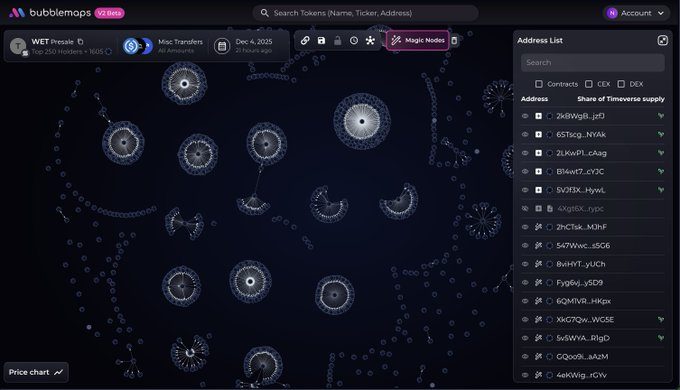
One wallet allegedly broke the pattern by receiving funds from a private address that could be traced to the Twitter handle @ramarxyz through previous public blockchain activity.
Rather than acknowledging the activity, the individual later publicly suggested that HumidiFi should refund the sniper’s allocation, despite being linked to the exploit.
Shortly afterward, HumidiFi confirmed that all suspected bot allocations had been canceled and that legitimate presale participants WOULD instead receive a prorated airdrop.
A separate on-chain analysis by trader Gautam Mgg showed that 4% of the public allocation went to just 10 wallets, with four wallets alone committing 40% of the entire public sale supply using bots.
 $WET @humidifi : 4% Public Sale Supply went to just 10 wallets
Presale was completely botted, basically rugged And yes, @JupiterExchange is also at fault.
Here’s the proof: These 4 wallets alone committed 40% of the 4% public sale allocation using bots (finding more… pic.twitter.com/5dGz3bHwjZ

The wallets were publicly listed using solana explorers. Gautam also blamed Jupiter Exchange for failing to introduce basic bot protection measures, such as CAPTCHA or last-minute address rotation.
Jupiter had earlier announced that the $WET token sale was fully completed, raising $5.57 million across its Wetlist, JUP stakers, and public sale phases.
It’s official: Public sale phase for $WET has SOLD OUT!
The Decentralized Token Formation for @HumidiFi is now officially concluded, raising a grand total of $5.57m across the Wetlist, JUP stakers and public sale phases.$WET token for successful contributors will be claimable… pic.twitter.com/o5Hleg91z1


The public phase offered 30 million tokens at $0.069 per token, capped at $1,000 USDC per wallet. The token is scheduled to become claimable on December 9 alongside the launch of liquidity pools.
HumidiFi to Reissue Token After Aborting Disrupted $WET Launch
Following the incident, HumidiFi announced it would abandon the compromised launch and create a new token instead.
The protocol said all legitimate Wetlist and JUP staker participants would receive a pro-rata airdrop under a newly deployed contract that has been audited. A new public sale is now scheduled.
Some real dry shit happened today.
Humidifi started 6 months ago from nothing, straight from the trenches of DeFi 1.0.
In those 6 months, for SOL-USD, we started quoting tighter and doing more volume than Binance. We did not kiss any ass or bend the knee to anyone. We started…
HumidiFi launched in mid-2025 and has grown into one of Solana’s most active decentralized exchanges, processing over $1 billion in daily trading volume and often accounting for more than one-third of all spot trading on the network.
According to DefiLlama, its Dex volume currently sits close to $30 billion over 30 days, while its cumulative volume sits at over $122 billion.

The $WET token was introduced as the protocol’s staking and fee-rebate asset and was promoted as a community-driven distribution using Jupiter’s DTF platform.
The incident has revived broader concerns over token distribution fairness across launchpads.
In September, Bubblemaps also flagged a separate Sybil attack linked to the MYX token airdrop, where roughly 100 newly created wallets claimed nearly $170 million in tokens after being funded simultaneously from OKX.
That case similarly raised questions about identity controls and launch design weaknesses.
Jupiter DTF was introduced as a transparent, trust-minimized alternative to traditional token launches, combining curation and on-chain verification. The $WET sale was its first live deployment, making the failure a major test for the model.
Neither Jupiter Exchange nor the individuals accused have issued a detailed technical breakdown of what failed at the infrastructure level.
