Fusaka Upgrade: Will It Propel Ethereum to $3,800? Experts Break Down the Bull Case

Ethereum's next big network overhaul, Fusaka, is on the horizon—and the market is already buzzing with a single, tantalizing price target.
The $3,800 Question
Can a technical upgrade really move the needle that far? Analysts point to Fusaka's core promise: slashing transaction fees and turbo-charging network speed. It's not just a patch; it's a fundamental overhaul designed to make Ethereum leaner, meaner, and more attractive to the institutional capital currently sitting on the sidelines. Lower costs and faster settlements could finally unlock the floodgates for real-world, high-volume applications—the kind that generate sustained demand for ETH, not just speculative froth.
Beyond the Hype Cycle
Past upgrades have catalyzed rallies, but Fusaka aims deeper. It tackles Ethereum's perennial pain points head-on, potentially solving the scalability trilemma that's haunted developers for years. If it delivers, the network doesn't just get a temporary boost; it gets a durable competitive edge. Skeptics, of course, warn that crypto markets have a PhD in pricing in hype long before the code is live—and an even stronger degree in punishing unmet expectations. (After all, on Wall Street, they'd call buying the rumor and selling the news a 'time-tested strategy.' In crypto, we just call it Tuesday.)
The Verdict: A Catalyst, Not a Guarantee
Fusaka sets the stage. It provides the technical foundation for the next growth phase. But hitting that magic number? That depends on a messy cocktail of adoption, broader market sentiment, and whether traders get distracted by the next shiny thing. The upgrade is the spark. Whether it ignites a run to $3,800 depends on what's left to burn.
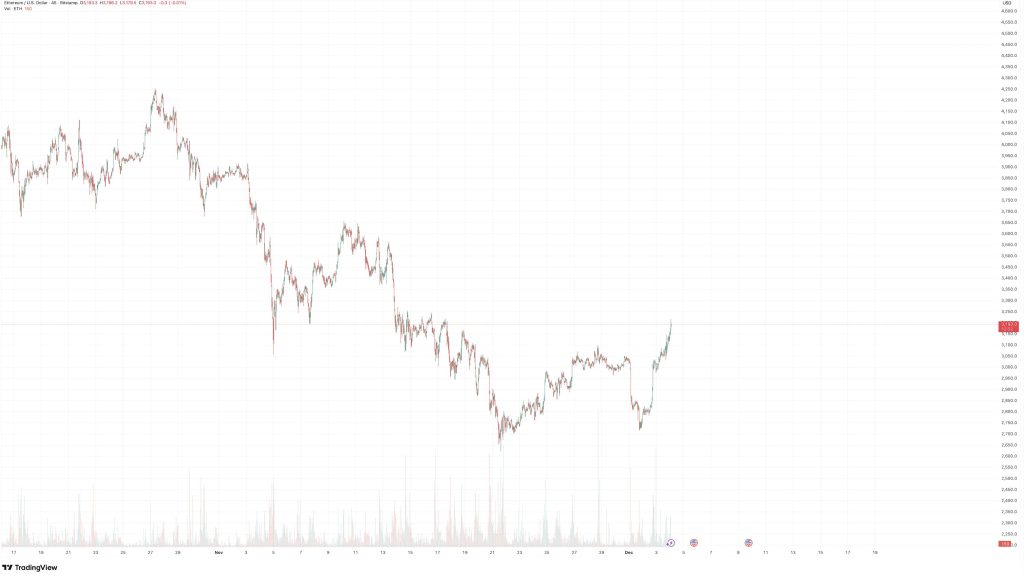 Source: TradingView
Is Fusaka Really That Important for Ethereum?
One of the Core goals of the hard fork is to reduce fees for Layer-2 networks. This will happen through PeerDAS, a new selective data availability system. It allows nodes to store only small fragments of L2 data (blobs) while still verifying network integrity. This reduces load on nodes, lowers the cost of running infrastructure, and makes data publication for L2s cheaper. In turn, users should see lower transaction fees over time.
called Fusaka “significant because it literally is sharding.” At the same time, he said that the upgrade does not solve everything. L2 scaling is already becoming more efficient, but for L1 transactions to benefit similarly, Ethereum still needs “mature ZK-EVMs.”

High L2 fees are a long-standing problem. Fusaka is not the first attempt to address them, and early results have been mixed.,, pointed out that immediately after Fusaka went live, gas temporarily doubled:
I’ll wait a bit for the waters to calm down and try again.
Will Ethereum Price Continue to Rise from Here?
Market conditions remain challenging. Fusaka gave traders a reason to be optimistic, and the price reaction shows that buyers were ready to step in. Bitcoin also moved higher on expectations of softer monetary policy, which added momentum.
Still, the broader crypto market faces the possibility of retesting new lows. Ethereum is not immune to that pressure. The move back above $3,000 is encouraging, but it does not guarantee a sustained uptrend. The true impact of Fusaka will only become clear over time. It will likely take at least a month to evaluate whether gas fees actually fell and whether L2 ecosystems are benefiting as intended.
For now, the key question is whether ETH can defend $3,000. Bitcoin’s ability to hold $90,000 will also play a role, since BTC is currently steering overall market direction.
,told Cryptonews that Ethereum can maintain its support as long as macro conditions improve. He noted that ETH stands a better chance if the Federal Reserve signals a softer stance heading into Q1, liquidity expectations pick up, and ETF inflows stabilize. If those conditions align, ETH could quickly rebuild upward pressure:
Under that scenario, ETH can build pressure into the $3,300–$3,800 range quickly because the structural flows are still intact, long-term holders haven’t moved, staking activity remains healthy, and institutions continue to add exposure quietly.
