Bitcoin’s $1.44B Bear Market Buffer: A Strategic Bet on Crypto’s Future

A major player just parked a billion-dollar cushion against Bitcoin's next downturn. CryptoQuant data reveals a $1.44 billion strategic reserve—a move that screams long-term conviction more than short-term fear.
The Contrarian Playbook
While retail traders chase pumps, institutional strategies are building moats. This isn't about timing the market's bottom; it's about having dry powder ready when panic sells. The buffer acts as a shock absorber, designed to deploy capital when weaker hands capitulate.
Reading Between the Blockchain Lines
A reserve of this size signals a fundamental belief in Bitcoin's resilience. It's a hedge against volatility, sure, but also a calculated bet on the asset's inevitable recovery—a classic 'be greedy when others are fearful' setup, just with more zeros.
The Bigger Picture: From Speculation to Strategy
Forget moonboys. This is cold, hard risk management entering the crypto arena. It mirrors traditional finance's playbook, albeit applied to a market that still gives Wall Street veterans night sweats—probably because their spreadsheets can't model 'vibes' as a variable.
So, while the headline screams 'bear market risk,' the subtext whispers something else: preparation for the next cycle. Because in crypto, the only thing more predictable than a crash is the rebuild that follows.
Strategy Pivots to Dual-Reserve Treasury as Bitcoin Buying Slows
CryptoQuant described the move as a structural change from Strategy’s long-standing playbook of issuing equity and convertibles primarily to buy more Bitcoin.
Instead, the company is now operating a dual-reserve treasury model that pairs long-term Bitcoin exposure with short-term dollar liquidity aimed at reducing the risk of forced BTC sales during market stress.
The shift comes as Strategy’s pace of Bitcoin accumulation has slowed sharply through 2025. Monthly purchases fell from 134,000 BTC at the 2024 peak to 9,100 BTC in November 2025, with just 135 BTC added so far this month, according to CryptoQuant.
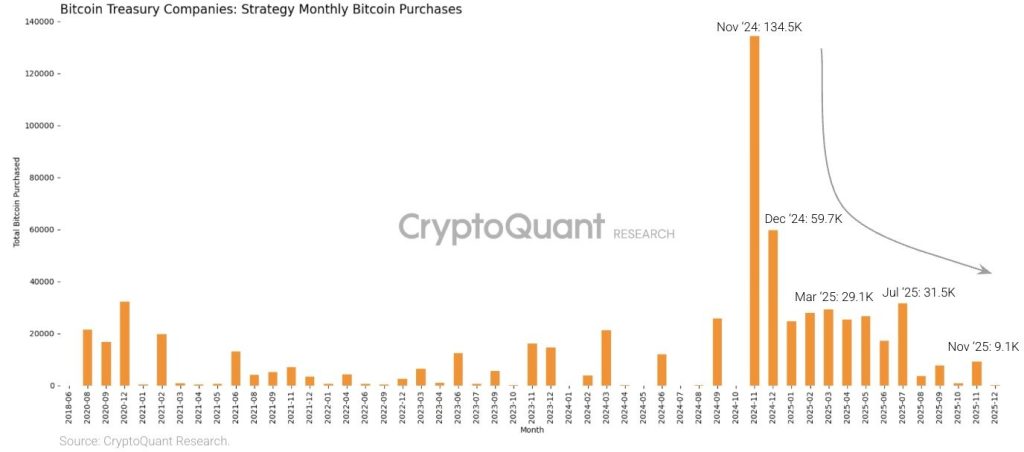
The analytics firm said the scale and timing of the dollar buffer signal preparation for a sustained bear market.
Despite the slowdown, Strategy remains deeply exposed to Bitcoin. On Nov. 17, the firm bought 8,178 BTC for roughly $835.5 million in its largest purchase since July, bringing total holdings to about 650,000 BTC.
Strategy’s stock trades under the ticker MSTR, with a basic market capitalization of about $54 billion and an enterprise value NEAR $69 billion.

Market net asset value metrics show the stock trading close to the value of its Bitcoin holdings. Basic mNAV stands at 0.892, diluted mNAV at 0.994, and enterprise-value mNAV at 1.136, reflecting the effect of debt and preferred obligations.
Falling Shares Put Strategy’s Bitcoin Treasury Model Under the Microscope
CEO Phong Le has said the company WOULD only consider selling Bitcoin if its shares fall below net asset value and access to new financing dries up.
He described such sales as a last resort to protect what he calls “Bitcoin yield per share,” stressing that selling would occur only if issuing new equity became more dilutive than reducing holdings.
Strategy’s annual fixed obligations tied to preferred shares are estimated at $750 million to $800 million. Le said the new dollar reserve currently covers about 21 months of dividends.
Founder and Executive Chairman Michael Saylor described the reserve as the next stage in Strategy’s evolution as a Bitcoin-focused treasury company, positioning it to navigate market volatility while maintaining its long-term digital-asset strategy.
To reassure investors, the company recently launched a “BTC Credit” dashboard, stating that it has sufficient dividend coverage even if Bitcoin prices remain flat for extended periods.
Strategy also said its debt remains well-covered if Bitcoin falls to its average cost of roughly $74,000 and remains manageable even at $25,000.
The reserve strategy has drawn mixed reactions from the market. Bitcoin critic Peter Schiff argued that the shift shows the company is being forced to sell stock to buy dollars rather than Bitcoin in order to meet its obligations.
Today is the beginning of the end of $MSTR. Saylor was forced to sell stock not to buy Bitcoin, but to buy U.S. dollars merely to fund MSTR's interest and dividend obligations. The stock is broken. The business model is a fraud, and @Saylor is the biggest con man on Wall Street.
— Peter Schiff (@PeterSchiff) December 1, 2025Strategy’s share price has fallen more than 60% from recent highs even as Bitcoin has traded between $95,000 and $110,000 in late 2025, adding to investor scrutiny of the model.
Strategy’s stance is also being watched by index providers. MSCI is currently reviewing how companies with large digital-asset treasuries should be treated in major equity indexes.
Any change in classification could force benchmark-tracking funds to rebalance, adding another LAYER of volatility to a stock that already trades with a high Bitcoin beta.
