Binance’s Junior Wallet: Crypto’s Family-Friendly Revolution Hits Mainstream

Binance just made crypto a family affair. The world's largest exchange launched its 'Junior Wallet,' a supervised account feature designed to onboard the next generation of digital asset users—with parental controls firmly in place.
Grooming the Next Wave
Forget piggy banks; think digital wallets. The move strategically positions Binance at the center of household finance, capturing users early. It's a long-game play for brand loyalty in a market where today's teen trader is tomorrow's high-net-worth client. The feature includes spending limits, transaction approvals, and educational resources—wrapped in a package that makes managing an allowance look archaic.
Regulatory Chess, Not Checkers
This isn't just product development; it's a masterclass in regulatory narrative. By baking in supervision and education, Binance builds a compelling case for responsible innovation. It's a preemptive strike against critics who paint crypto as the wild west, offering a controlled, compliant gateway instead. Suddenly, the conversation shifts from speculative risk to financial literacy—a much harder angle for regulators to attack.
The Ripple Effect
Expect competitors to scramble. This sets a new standard for user onboarding and could pressure the entire sector to develop similar family-centric tools. It also opens a fresh battleground: whose ecosystem can best serve multi-generational wealth? The feature subtly encourages asset retention within the Binance ecosystem, from savings to spending—locking in families for the long haul.
A cynical observer might note it's a brilliant way to create future customers for products that haven't even been invented yet—because what better way to secure a slice of future wealth than by handing a child their first wallet? In finance, they say the best time to plant a tree was 20 years ago. In crypto, the best time to onboard a user appears to be about 12.
 https://t.co/q4Y50PvApy pic.twitter.com/O1R2yZ4vVE
— Binance (@binance) December 3, 2025
https://t.co/q4Y50PvApy pic.twitter.com/O1R2yZ4vVE
— Binance (@binance) December 3, 2025
The app allows adults with a Binance account to deposit crypto into a savings account for kids and teenagers between the ages of 6 to 17. The tool also allows parents to set spending and transfer limits, while enabling earn products for kids dependent on local regulations.
The Importance of Crypto Adoption at Young Ages
Binance’s newly appointed co-founder Yi He explained the importance behind Binance Junior at Binance Blockchain Week.
“We not only nurture children in their early development, but also with long-term growth, responsibility and wisdom,” the executive stated. “Helping children face real life challenges independently means that financial health and literacy are key to preparing them for the future, especially as money is evolving.”
While the notion of educating children on the importance of cryptocurrency may be controversial, findings from a recent survey conducted by Gemini show that more than half (51%) of global Gen Z respondents currently own cryptocurrency or have owned it in the past. The report also notes that over half of Gen Z respondents located in the US owned or had owned cryptocurrency (51%), compared to 49% of Millennials (people born 1981-1994).
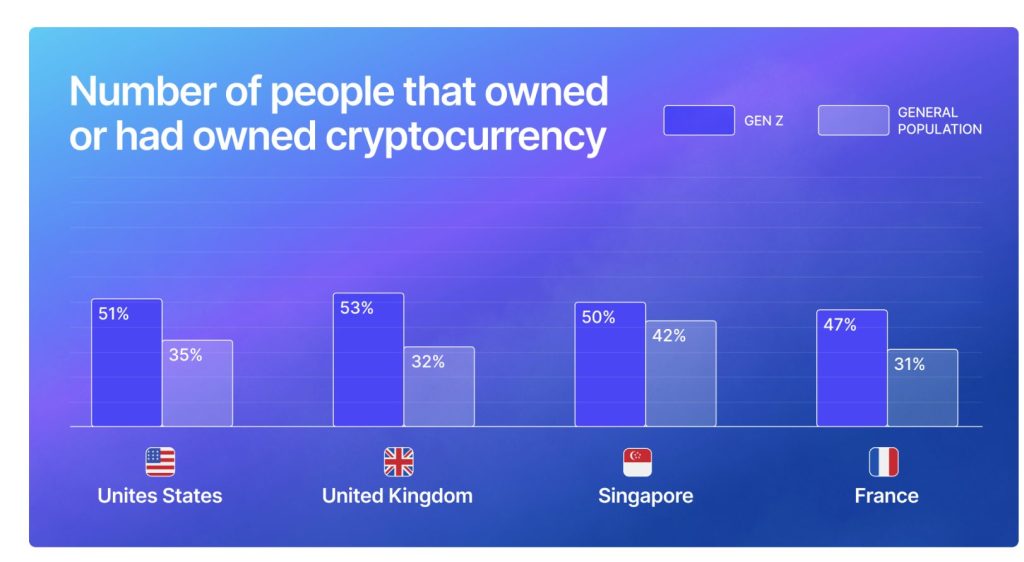
This demonstrates the growing appeal for crypto adoption amongst younger generations. Binance Junior aims to further facilitate this by allowing children 13 years and up to initiate transfers independently within the app, as long as local regulations are met and daily limits are applied.
Teaching Children About Crypto: Beneficial or Concerning?
While some users on the social media platform X expressed concerns around Binance Junior, the new app aims to align with a growing trend of teaching children about the importance of cryptocurrency at early ages.
Henri Arslanian, co-founder of Nine Blocks Capital and a best-selling author, told Cryptonews that it shouldn’t come as a surprise that Binance has launched Binance Junior.
“Children used to have penny banks to keep fiat in, but now we have hard assets like Bitcoin and there is a huge learning element there that becomes critical,” he said.
Arslanian added that Binance Junior aligns with children’s books and toys centered around cryptocurrency. In September last year, Arslanian published Decoding Crypto, a best-selling children’s book that explains digital assets in simple terms.
Here’s why you should check out my latest kids book, Decoding Crypto, for your kids.
Grab your copy of Amazon’s number 1 new release kids book, Decoding Crypto with @henriandhodler https://t.co/n2hYqlc7bW pic.twitter.com/W7CSmvIsOP
Other books including B is for bitcoin by Graeme Moore – which is an A-to-Z style alphabet book where each letter links to a crypto term – also aim to make crypto learning fun for children. Goodnight Crypto by Scott Blair is a book that is even suitable for toddlers. Included in the story are 42 collectible non-fungible tokens (NFTs) that can be minted and added to a crypto wallet.
In addition, Binance released a self-published book entitled ABC’s of Crypto that breaks down fundamental terms including security and blockchain technology, to different types of crypto coins.
Cautiously Preparing the Next Generation for Crypto Adoption
While it’s notable that initiatives are being taken to teach young children about digital assets, caution should be exercised.
Parents and teachers explaining cryptocurrency to younger generations may wish to point out the volatile nature of digital assets. Focusing on concepts like savings, diversification, long-term thinking, and risk versus reward rather than price speculation may also be helpful.
