Will Bitcoin Price Get a Christmas Rally? Experts Bet on Early 2026

Bitcoin's holiday cheer might be delayed until 2026, according to market analysts. The anticipated year-end surge—a seasonal pattern some traders bank on—could be a no-show this December.
The Waiting Game
Instead of a Santa Claus rally, experts point to early 2026 as the next major catalyst window. The reasoning hinges on macroeconomic cycles and institutional adoption timelines, not festive sentiment.
Patience Over Presents
For investors hoping for a quick gift, the message is clear: temper short-term expectations. The market's current consolidation phase suggests a bigger move is brewing, but it's taking its sweet time—much like the approval process for a traditional finance ETF.
So, while the charts won't be wrapped with a bow this Christmas, the setup for 2026 looks promising. Sometimes, the best gains come to those who wait, not those who chase seasonal myths.
‘Weak Hands Shaken Out’: Bitcoin Price Closed November in the Red
,, told Cryptonews that December and January could become decisive months for the crypto market:
The next two months are critical for a potential breakout into a ‘super cycle.’
As mentioned earlier, November 2025 echoed November 2024 for Bitcoin, only with the opposite scenario. The monthly close highlights this shift and remains one of the most important indicators on the market. Last November closed with a strong green candle that led to a correction and then a new all-time high. This November finished with a noticeable red candle, shifting sentiment to the downside. Yet the price stopping almost precisely at $90,000 still gives bulls something to hold on to.
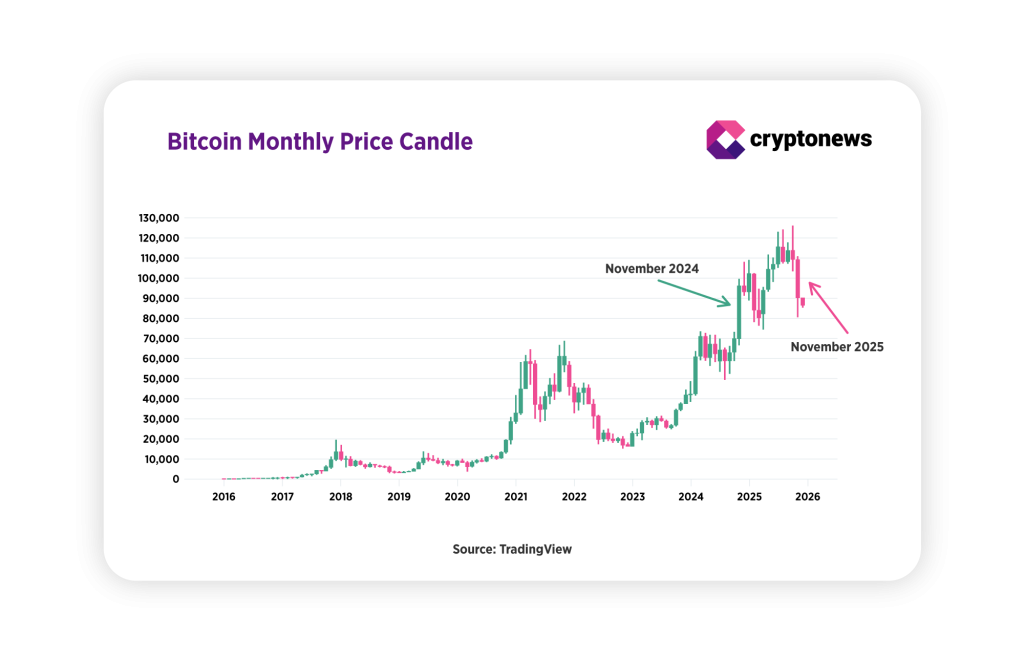
,, told Cryptonews that he does not see the current cycle ending and that there is still room for Bitcoin to rise. At the same time, the market does not have a clear leader, and both sides continue to build their cases:
The current move looks like a mid-cycle flush rather than the end of the bull market, with bitcoin roughly 31% off its $126,000 peak, weak hands shaken out, but ETF demand and institutional flows keeping the bullish structure intact even as the Fed stays slow on cuts and equities soften.
The launch of Bitcoin ETFs was met with enthusiasm, bringing a wave of institutional money into the market. These inflows supported Bitcoin’s rise. Now, retail investors play a much smaller role. The market is shaped mostly by large capital and ETFs. This has created a double-sided dynamic. According to some analysts, institutions may be reallocating capital, which helps explain why liquidity has remained thin for the second month in a row. Retail investors do not see this backstage process. They only see the losses.
Another concern for retail traders is the idea of crypto cycles. According to this framework, Bitcoin was expected to rally in November. This did not happen. Instead, the price dropped by more than 30%. It raises the question of whether these cycles have stopped working or whether a new market structure has formed because of institutional participation.
Lord adds another view:
The four-year halving still frames sentiment, yet price is now driven more by macro liquidity and ETF flows, with nation-state and corporate balance-sheet adoption pointing toward longer, more durable supercycles in an institutional-led market.
Lord also notes that Bitcoin needs to hold the $83,000 to $86,000 range to MOVE back above $100,000 and approach its all-time high. In his view, the more positive scenario is more likely to unfold in 2026:
In that context, the pullback toward $85,000 feels like a reset rather than a trend break. Holding the $83,000 to $86,000 range WOULD keep a path open toward $120,000 and above into early 2026 if macro conditions loosen.
Bitcoin Price Still Has a Chance in Early 2026
According to liquidity expert Michael Howell, the main driver of Bitcoin price has already shifted from halving to global liquidity. The correlation between BTC and the Global Liquidity Index (GLI) is considered high and sits in the 0.83 to 0.94 range across different studies, which makes liquidity one of the key forces shaping market direction. When the global financial system has more available money, Bitcoin usually moves higher. When liquidity tightens, pressure increases on all risk assets, including crypto.
The chart below confirms this dynamic.
In November, global liquidity (M2) printed a sharp peak, while Bitcoin had already turned lower. This is typical behavior. BTC often leads the GLI by 8 to 10 weeks and reacts even faster during corrections. The current drop in Bitcoin price may be an early indicator of a future decline in liquidity, and this signal matters not only for crypto.

Howell also notes that GLI moves in multi-year cycles that last about 5 to 6 years. The current cycle may still include another liquidity impulse around the second quarter of 2026. If this scenario plays out, a new liquidity expansion could align with the next upward phase for Bitcoin price. Bitcoin often acts as an early indicator. When it starts to struggle because liquidity conditions deteriorate, the same kind of pressure can soon be felt in the stock market. The technology sector is especially sensitive to shrinking liquidity, since it relies heavily on the availability of cheap capital.
According to Howell, a possible liquidity reversal depends on several factors. The first is a slowdown in the contraction of the U.S. money supply and an increase in excess reserves held by banks. The second is whether the Federal Reserve decides to give markets more support, even in a limited form, to ease stress. The third is whether China increases its stimulus efforts. Any of these steps would raise the availability of money in the global economy and create more supportive conditions for Bitcoin and other risk assets.
You might also like Bitcoin Could Drop to $60K if Fed Holds Rates Steady in December: CryptoQuantConclusion
November showed how quickly sentiment can flip when liquidity tightens, and expectations collide with market reality. Bitcoin’s drop, the red monthly candle, and the shakeout in retail positioning all point to a market that is resetting rather than collapsing. At the same time, several bearish signals have started to surface, including a slowdown in ETF inflows, ongoing criticism around Strategy, and renewed doubts about Tether’s reserves. These factors add pressure to the market and highlight the need for caution.
The next move will depend on liquidity, ETF flows, and how macro conditions evolve into early 2026. If global liquidity stabilizes or starts to expand again, Bitcoin still has the potential to regain momentum, but investors should remain careful and protect their capital.
Key Crypto & Macro Events to Watch in December 2025
• S&P Global Services PMI (November)
• ISM Non-Manufacturing PMI (November)
• ISM Non-Manufacturing Prices (November)
• Initial Jobless Claims
• Japan GDP (QoQ) (Q3)
• Nonfarm Payrolls (November)
• Unemployment Rate (November)
• ECB Interest Rate Decision (December)
• Japan BoJ Interest Rate Decision
• CPI (MoM) (November)
• CPI (YoY) (November)
Disclaimer: Crypto is a high-risk asset class. This article is provided for informational purposes and does not constitute investment advice.
