China Doubles Down on Crypto Ban: New Crackdown Targets Resurgent Trading Activity

Beijing slams the brakes—again. Just as digital asset markets hint at a thaw, China's regulators launch a fresh offensive against cryptocurrency trading, signaling zero tolerance remains the only policy.
The Great Wall Gets Higher
Forget whispers of loosening restrictions. The latest move isn't a tweak—it's a reinforcement. Authorities are deploying upgraded monitoring systems to sniff out and shut down peer-to-peer and over-the-counter trading channels that had begun to flourish in the shadows. The message is clear: the 2021 ban wasn't the end of a chapter; it was the permanent law of the land.
Why the Sudden Scrutiny?
It boils down to control. A resurgent crypto market threatens the state's grip on capital flows and its sovereign digital currency project, the digital yuan. Letting decentralized finance gain a foothold undermines decades of financial policy. So, when new trading activity flickers on the radar, the response is immediate and overwhelming—a classic display of regulatory might meant to deter any future speculation.
The Global Ripple Effect
While exchanges in compliant jurisdictions might see a brief spike in user sign-ups, the long-term impact is a fragmented market. China's vast pool of retail investors remains locked behind the firewall, a constant reminder that in the high-stakes game of global finance, geopolitical borders still dictate capital's reach—much to the chagrin of portfolio managers betting on a truly borderless asset class.
The crackdown proves that for all the talk of decentralization, a government memo can still send more shockwaves through the market than any smart contract hack. Sometimes, the most powerful force in crypto isn't a blockchain, but a bureaucrat with a red stamp.
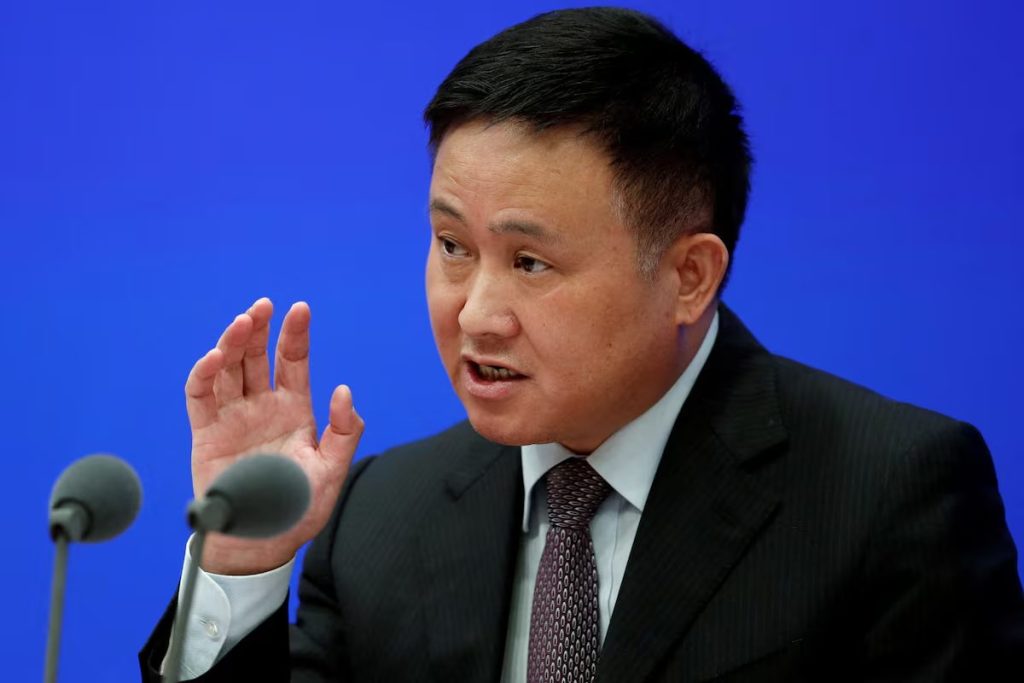 Source: Pan Gongsheng, Central Bank Governor. | Source: Reuters
Hong Kong Stocks Tumble on Central Bank Warning
According to Reuters, Hong Kong-listed companies with crypto exposure saw sharp losses following the announcement of a renewed crackdown.
Yunfeng Financial Group, which has been expanding into tokenization businesses, dropped more than 10% in early Monday trading. Bright Smart Securities fell roughly 7%, while digital-asset platform OSL Group lost over 5%.
The selloff reflected market fears that Beijing’s hardline stance could derail Hong Kong’s ambitions to become a digital asset hub.
The city passed stablecoin legislation in May and received expressions of interest from more than 40 firms seeking licenses under its new regulatory framework, including major financial institutions like Circle and Standard Chartered.
Liu Honglin, founder of Man Kun Law Firm, said the central bank statement “has erased any ambiguity, speculation and illusions” around China’s stablecoin policies, noting that “regulators have drawn a concrete red line on what used to be a vague borderline.“
Underground Mining and Enforcement Challenges Persist
Despite China’s comprehensive ban on crypto trading and mining since 2021, enforcement remains difficult.
Recent data from Luxor’s Global Hashrate Map shows China still accounts for 14.05% of Bitcoin’s total computing power, or roughly 145 exahashes per second, placing it third globally behind the United States and Russia.
Authorities have uncovered multiple underground operations in recent months.
China was once the undisputed center for Bitcoin mining. Known for its cheap power and access to leading hardware manufacturers, all of this positioned China as a leader in global Bitcoin mining. However, this changed when mining was banned by the Chin…https://t.co/pdUtTHeFKw
— Cryptonews.com (@cryptonews) October 23, 2025In February, police dismantled a cross-border banking network that laundered over $136 million using crypto to bypass financial regulations.
Investigators noted that 18 out of 49 underground banking cases in 2023 involved digital currency transactions, demonstrating how criminals adapt to exploit digital assets.
The central bank has also ordered social media platforms to shut down accounts promoting crypto trading.
In May, the Cyberspace Administration of China closed more than a dozen accounts on Weibo, Douyin, and WeChat that were spreading false information and inducing citizens to participate in virtual currency transactions through offshore exchanges.
Similarly, in August, Chinese regulators instructed brokerages and research institutions to halt the publication of studies or the hosting of seminars on stablecoins.
Local governments in Beijing, Suzhou, and Zhejiang have issued warnings about illicit fundraising linked to virtual currencies.
At the same time, over-the-counter crypto trading volumes reached an estimated $75 billion in the first nine months of 2024.
Stablecoins Draw Intensified Regulatory Scrutiny
Chinese officials have expressed particular concern about the global expansion of dollar-backed stablecoins, which they view as a strategic threat to the renminbi’s internationalization.
The sector’s total market capitalization surpasses $300 billion, with Tether and USD Coin processing over $27 trillion in settlements over the past year.

Pan Gongsheng, governor of the People’s Bank of China, previously warned that stablecoins “have amplified weaknesses in the global financial system” and fail to meet basic requirements for customer identification and anti-money laundering controls.
The central bank has blocked major Chinese tech firms, including ANT Group and JD.com, from issuing stablecoins in Hong Kong, arguing that currency issuance must remain a state monopoly.
Wang Yongli, former deputy governor of the Bank of China, wrote in June that the dominance of USD-pegged stablecoins “poses a strategic challenge” to the renminbi’s internationalization, warning that China’s efforts to promote its currency abroad could face “serious obstacles” without competitive digital alternatives.
The meeting concluded with officials vowing to deepen coordination across agencies, improve monitoring capabilities, and severely crack down on illegal activities to protect citizens’ property and maintain economic order.
Beijing continues promoting its state-backed digital yuan as the only legitimate alternative to private cryptocurrencies while maintaining zero tolerance for them.
