Hyperliquid User Loses $21 Million to Hackers After Private Key Breach

Another day, another crypto horror story—this time with a $21 million price tag.
The Anatomy of a Digital Heist
A Hyperliquid user watched their fortune evaporate when hackers bypassed security protocols and drained their wallet. The breach? A compromised private key—the digital equivalent of leaving your vault combination taped to the front door.
Security experts are calling it one of the largest individual losses this quarter, proving once again that in crypto, your keys aren't just your coins—they're your entire financial existence.
While exchanges scramble to implement new safeguards, this incident serves as a brutal reminder: the blockchain doesn't forgive mistakes. And Wall Street bankers are probably having a good chuckle over their 'secure' traditional accounts—right before they miss the next bull run.
$16M Long Trade Close Links to the Hyperliquid Private Key Breach
A mysterious aspect of the hacking incident involves the timing of certain trading activities.
Precisely when PeckShield issued its initial alert about the breach, trading records show that a Hyperliquid account executed a closure of a HYPE long position valued at $16 million.
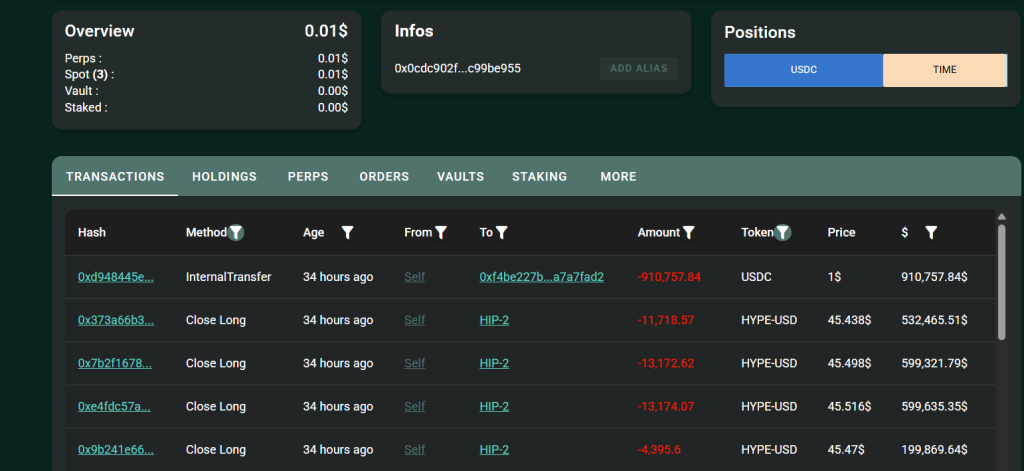
This same account also liquidated 100,000 HYPE coins, converting them into $4.4 million.
Researchers at MLM conducted an analysis of transaction records from Hypurrscan and have put forward the theory that this trading account likely belongs to the compromised user.
Their reasoning centers on the observation that these newly acquired assets were converted into the stablecoins USDC and DAI, then dispersed across numerous wallet addresses spanning both the Ethereum and Arbitrum blockchain networks.
This transaction pattern correlates closely with the movement data that PeckShield documented through Etherscan.
The scope of the attack wasn’t limited to assets held directly on the Hyperliquid platform.
Investigation findings reveal that the attacker also successfully extracted $3.1 million from the Plasma Syrup Vault liquidity pool.

These funds, denominated in MSYRUPUSDP tokens, were immediately relocated to a freshly created wallet address.
Luke Cannon, a prominent voice on X (formerly Twitter), has suggested that the victim’s losses may be even more extensive.
According to Cannon’s analysis, an additional $300,000 may have been drained from associated wallet addresses that the hacker managed to compromise.
Similar Hacking Incidents On Hyperliquid Paint a Troubling Picture
Another Hyperliquid user shared that he lost $700k in HYPE in a similar incident last month.
According to him, he’s not sure how he was hacked,he added.
Lost 700k in hype in a similar incident last month. Not sure how they hacked. No malware, no discord chats, no TG calls, no email download.
— BRVX (@TradeThreads) October 9, 2025He believes the hack was most likely achieved through Windows malware, as he hadn’t touched crypto wallets in a week prior to the hack and had gotten a new MacBook, too, but the wallet wasn’t set up on it.
Unlike smart contract bugs or exchange exploits, this attack happened because of a private key leak.
That means the attacker gained direct access to the wallet’s login credentials. Such leaks often occur due to phishing links, malware, or unsafe key storage.
Security experts have long warned that high-value accounts should always use cold wallets or multi-signature protection to prevent such incidents.
 Blockstream issued an urgent security alert warning users about a sophisticated phishing campaign targeting Jade hardware wallet owners through fake firmware update emails.#Phishing #Cryptohttps://t.co/QQMYA4Ezrm
But it seems users continue to fall victim to these exploits.
A Pattern of Private Key Breaches
Just a few weeks ago, SFUND, the official token of Seedify, plummeted by 99% after North Korean hackers extracted $1.2 million from the DAO launchpad by gaining access to a Seedify developer’s private keys.
Similarly, in September, a user of the Venus lending protocol on BNB Chain lost assets worth about $27 million due to a private key breach.
According to a report by blockchain security firm CertiK, last year alone saw a loss of $2.36 billion in total across 760 on-chain security incidents.
A whopping $1.05 billion was lost to private key breaches through over 296 incidents, accounting for 39% of the total number of attacks suffered in crypto.
Private key breach through phishing is popular due to its simplicity and effectiveness, the report says.
It is less about technological defenses and more about human vulnerability.
Blockchain transactions make phishing “particularly devastating” as they are irreversible.
It’s also observed that Ethereum saw the most security incidents overall, with 403 of the total 760 hacks, scams, and exploits, followed by Binance Smart Chain (BSC), the second-most targeted chain when it comes to phishing scams.
But now it seems Hyperliquid, as a result of its decentralized nature, is also getting into the mix for hackers and bad actors.
