Turkey Grants Authorities Power to Freeze Crypto Accounts Under New AML Framework

Turkish regulators just grabbed the keys to your digital wallet.
The Regulatory Shift
Fresh anti-money laundering legislation hands Turkish authorities unprecedented control over cryptocurrency holdings. Government agencies can now freeze suspect accounts without judicial approval—bypassing traditional banking safeguards that took decades to establish.
The Compliance Crackdown
This move positions Turkey among the most aggressive crypto regulators globally. Officials claim it targets illicit financing, but traders face immediate asset freezes during investigations. No warnings, no appeals—just frozen funds while paperwork shuffles through bureaucracy.
The Global Ripple Effect
Other nations monitoring Turkey's experiment may replicate these powers. When governments discover they can freeze digital assets faster than traditional bank accounts, 'financial innovation' suddenly becomes their favorite tool.
Another brilliant case of regulators solving yesterday's problems with tomorrow's technology—while creating entirely new ones for today's users.
 Turkey is tightening crypto AML regulations! By February 2025, all transactions over 15,000 lira will require user identification.#TurkeyCrypto #AMLhttps://t.co/krSkosCVSs
— Cryptonews.com (@cryptonews) December 25, 2024
Turkey is tightening crypto AML regulations! By February 2025, all transactions over 15,000 lira will require user identification.#TurkeyCrypto #AMLhttps://t.co/krSkosCVSs
— Cryptonews.com (@cryptonews) December 25, 2024
Users will also be required to include a transaction note of at least 20 characters for each cryptocurrency transfer.
Turkey Authorities to Freeze Crypto Accounts: Minister Warns of Exchange License Cancellation
The proposed requirements extend beyond simple reporting.
When the complete sender and recipient information isn’t shared, platforms must hold withdrawals.
Most withdrawals WOULD be delayed for 48 hours, while first-time withdrawals from new accounts would be subject to a 72-hour hold.
Turkish authorities are also setting limits on stablecoin transactions to restrict the FLOW of illegal funds, particularly those connected to fraud and illegal betting.
Users would be capped at $3,000 per day and $50,000 per month in stablecoin transfers.
Platforms that comply with the Travel Rule and gather full sender and recipient information may offer twice the daily and monthly transfer limits.
Treasury and Finance Minister Mehmet Şimşek noted that platforms failing to comply with the new requirements could face various penalties, including fines, denial of licenses, or cancellation.
The new measures follow earlier actions Turkey has taken to regulate the cryptocurrency sector.
In March, the Capital Markets Board (CMB) introduced licensing and operational requirements for crypto asset service providers (CASPs), granting it full oversight of exchanges, wallet providers, and custodians.
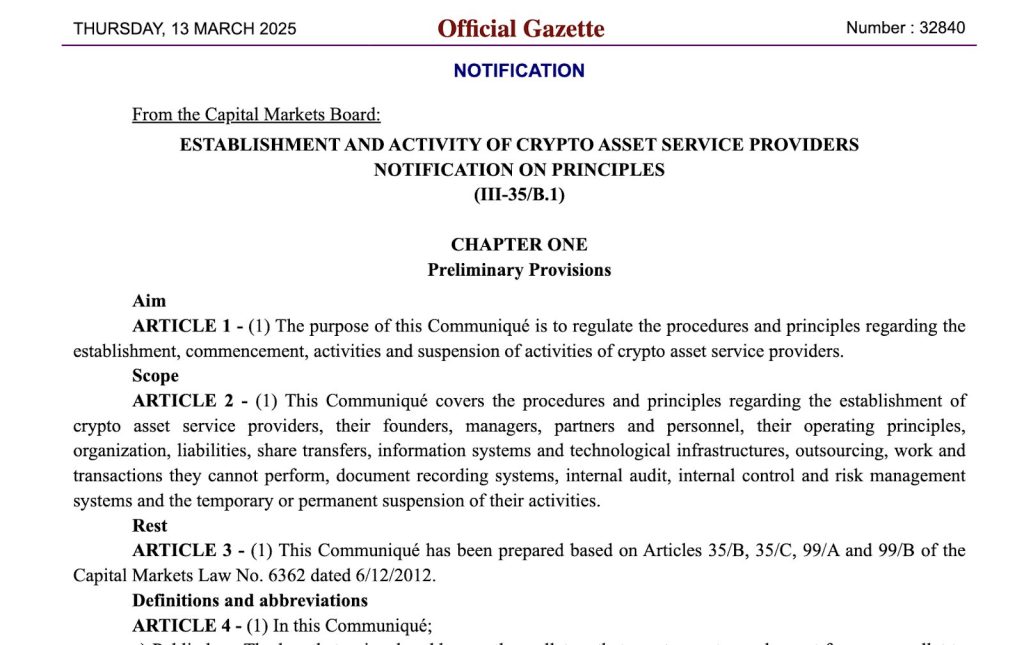
This regulatory change places considerable responsibility on crypto exchanges and service providers, requiring them to establish comprehensive customer verification systems.
While these regulations may strengthen consumer protection and protect Turkey’s financial system from illegal activities, industry experts caution about possible downsides like big players’ exit.
For example, crypto exchange Coinbase has already withdrawn its pre-application to enter Turkey’s crypto market.
Rival exchange Binance also announced it would terminate its retail referral program in Turkey to comply with local regulations.
 @Binance ends its retail referral program in Turkey due to evolving local regulations. Other services remain unaffected, as the exchange continues to adapt to Turkey’s crypto laws.#Binance #TurkeyCryptohttps://t.co/uE9gzCKu4c
Turkey Ranks 14th in Global Crypto Adoption Despite Strict AML Rules
Additionally, the Turkish regulatory framework, which forms part of broader amendments to the Capital Markets Law No. 6362, introduced minimum capital requirements for crypto companies.
Cryptocurrency exchanges must maintain a minimum of $4.1 million in reserves, while custodians must maintain a minimum of $13.7 million.
There are also requirements concerning executive backgrounds and shareholder structures.
The regulations come during increased scrutiny of the crypto sector, fueled by Turkey’s rising position in global cryptocurrency markets.
According to the latest Chainalysis 2025 Crypto Adoption report, Turkey ranked as the world’s 14th-largest crypto market by adoption this year.

Turkish regulators view this as necessary for thorough oversight to prevent misuse within the sector.
To tackle fiscal challenges, Turkish authorities are also considering a 0.03% transaction tax on crypto trades, which could increase national revenues without heavily affecting market growth.
“We have not currently included taxation on profits for crypto assets and the stock market in our agenda. There may be a very limited fee or taxation on a transaction-based basis,” Turkey’s Finance Minister Mehmet Şimşek said.
