BlackRock’s Quiet War on Your Wallet: How They’re Coming for Your Savings in 2025

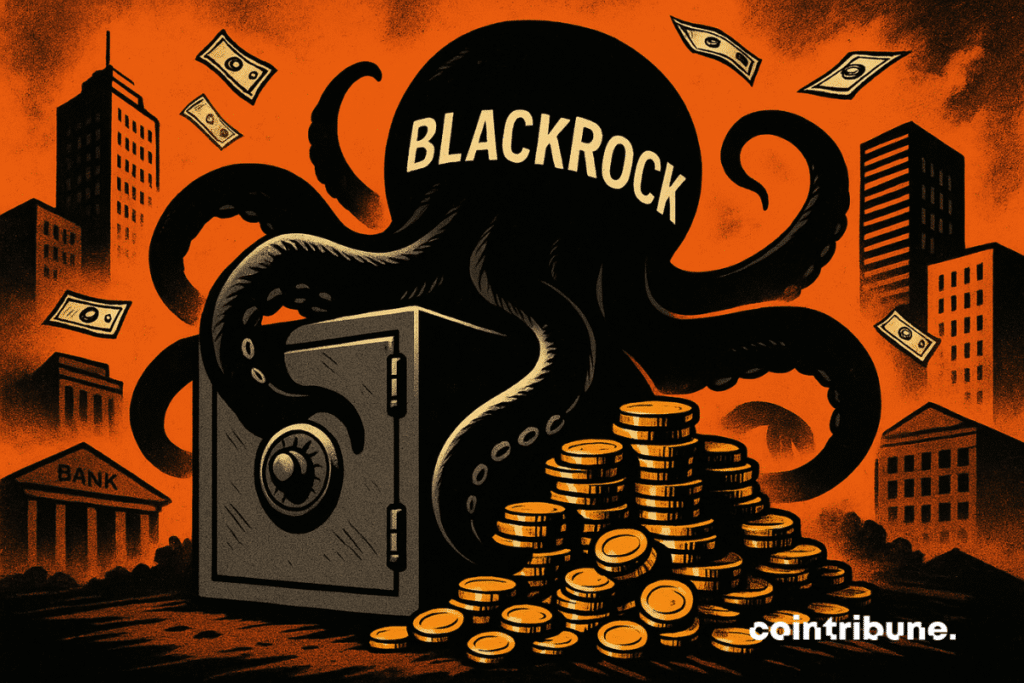
Wall Street’s trillion-dollar gorilla just sharpened its claws—and your nest egg is the target.
BlackRock’s latest playbook reads like a heist manual: algorithmic asset sweeps, stealth fee hikes, and a CBDC pipeline that could make your bank obsolete. No vaults needed—just zeros and ones.
The ‘invisible hand’ is wearing brass knuckles. While Main Street fights inflation with coupons, institutional giants are rewriting the rules of capital allocation. Your 401(k)? Just another data point in their machine-learning models.
One hedge fund manager quipped: ‘They’re not too big to fail—they’re too big to care.’ As yield-starved retirees scramble, BlackRock’s AI quietly rebalances the scales… in its favor.
Welcome to financialization 2.0—where your liquidity is their leverage.
In Brief
- BlackRock promotes a “Globalization 2.0” to redirect citizens’ savings toward local infrastructure.
- The real goal may be to privatize global infrastructure while advancing the ESG agenda.
- Savers risk having their capital locked in illiquid assets for years.
Globalization 2.0 according to BlackRock
Larry Fink, the CEO of BlackRock, acknowledges that the first globalization generated multiple problems. The increase in wealth inequalities ranks at the top of the list. However, his solution could worsen the situation rather than improve it.
The BlackRock CEO criticizes the current, especially the TRUMP tariffs. He considers these measures an inadequate response to globalization problems. Thus, he advocates for a different approach combining open markets, national benefits, and local worker protection.
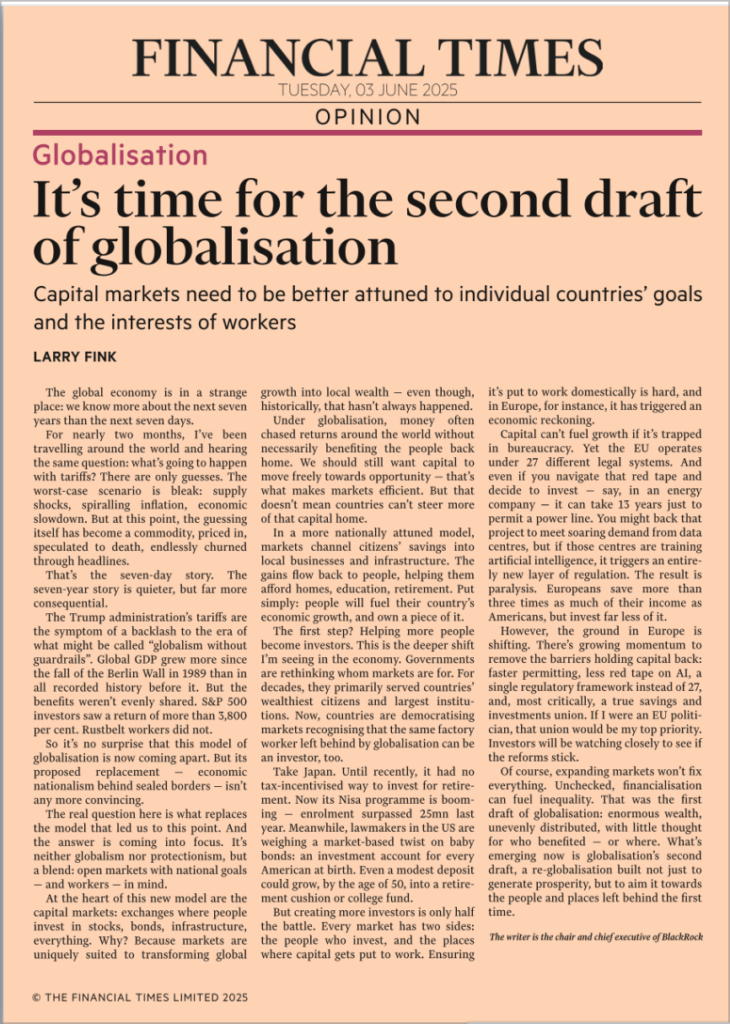
His definition of globalization reveals his intentions: “Under globalisation, money often chased returns around the world without necessarily benefiting the people back home.” Therefore, his solution is to directtowards local businesses and infrastructure. This approach WOULD theoretically allow local populations to benefit directly.
BlackRock’s plan to seize your savings
BlackRock’s strategy is based on several fundamental pillars. The first is to help more people become investors. Larry Fink cites Japan as an example, where tax changes now encourage more investments for retirement.
is the central element of the mechanism. Maria Luís Albuquerque, architect of the European Savings Union, revealed that all European workers would be default contributors to these funds. However, these pension funds are generally.
In Europe, Larry echoes the same opinion as the elites: Europeans save a lot but do not invest in Europe. He attributes this to the absence of unified capital markets. Thus, he states: “If I were a European policymaker, this union would be my top priority.”
BlackRock wants to finance its ESG agenda
BlackRock estimates thatwill be needed for infrastructure in the coming years. Neither companies nor governments have this financial capacity. Furthermore, more than $25 trillion in savings are stored in US banks, and about $13 trillion in the EU.
The real goal is clear:theand the United Nations’ sustainable development goals. Raj Raalo, CEO of Global Infrastructure Partners (acquired by BlackRock), revealed that the top priority for infrastructure investments is the decarbonization of the global economy.
BlackRock is literally acquiring global infrastructure. The company already owns a network of 43 ports in 23 countries. One in every 20 shipping containers in the world passes through these ports every year. Thisrepresents a major geopolitical issue.
Risks for savers
The infrastructure projects BlackRock wants to finance have a major downside: they are. The invested capital will be locked up for years. Savers will not be able to sell if they need additional liquidity.
This illiquidity could be the Achilles’ heel of globalization 2.0. No sensible person would accept locking up their money for years in an increasingly uncertain world. That is why BlackRock is betting on automatic retirement enrollment to circumvent this natural resistance.
Moreover, if savings massively migrate towards these investments, bond yields would increase. This rise would paradoxically make bonds even more attractive as a savings instrument. Between investing in a speculative green energy startup and a 7% bond, most savers would choose the bond.
Bitcoin versus the traditional system
Larry Fink recently made a surprising statement about bitcoin. He claims that if the United States does not control its debt,to digital assets like bitcoin.
This prediction comes in a particular context. By 2030, mandatory spending and debt servicing will exhaust all US federal revenues. Thus, investors might start to see Bitcoin as a safer bet than the US dollar.
is the other pillar of this transformation. Larry explains that this technology will democratize access to investments. However, BlackRock also wants a new digital identity verification system to accompany this evolution.
Towards a new financial paradigm led by BlackRock
BlackRock’s strategy reveals the tensions of the current financial system. On one side, governments are massively indebted and can no longer finance infrastructure. On the other, tens of thousands of billions of savings lie dormant in low-yield accounts.
This situation creates a unique opportunity for asset managers. They can position themselves as essential intermediaries between savings and investment needs. However, this position gives them considerable power over global capital allocation.
Bitcoin could benefit from this dynamic. As a decentralized and liquid asset, it offers an alternative to the traditional system. Stablecoins used to buy cryptocurrencies are also backed by US government debt. Each stablecoin purchase is therefore indirectly a purchase of US debt.
BlackRock’s globalization 2.0 raises fundamental questions about the future of the financial system. While governments struggle to finance their needs, private asset managers are becoming key players. BlackRock’s strategy invites all citizens to consider how they want to invest their money: with private managers like BlackRock or in bitcoin, a neutral and uncontrollable asset?
Maximize your Cointribune experience with our "Read to Earn" program! For every article you read, earn points and access exclusive rewards. Sign up now and start earning benefits.
