The Marshall Islands Pioneers Universal Income Trial Using Stellar’s Crypto Infrastructure
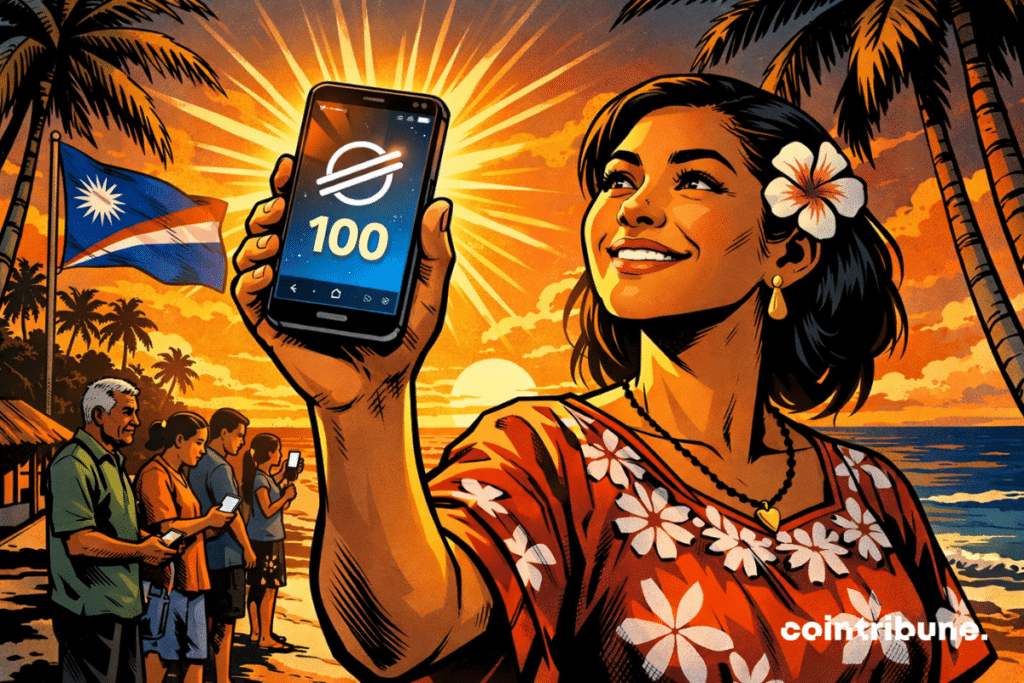
A tiny Pacific nation just rewrote the economic playbook—and Wall Street didn't see it coming.
Forget central banks and paper trails. The Marshall Islands is launching a real-world test of universal basic income (UBI) powered entirely by cryptocurrency. They're building it on the Stellar network, turning every citizen into a node in a new financial system.
The Blueprint for a Digital Safety Net
This isn't a theoretical whitepaper. It's live policy. The initiative aims to distribute a digital sovereign currency, directly into digital wallets. The goal? To provide a foundational income, streamline aid, and radically reduce transaction costs that typically bleed funds before they reach people's pockets.
Stellar's rails were chosen for speed and cost—settlements happen in seconds for fractions of a cent. It bypasses the correspondent banking maze that often strangles small island economies, offering a stunningly simple alternative to the legacy financial plumbing.
A Sovereign Experiment Under the Sun
The move places the Marshall Islands at the absolute forefront of monetary innovation. While larger nations debate digital currencies, they're deploying one. It's a bold hedge against geographic isolation and economic vulnerability, using crypto not as a speculative asset, but as critical public infrastructure.
Of course, traditional finance desks might scoff at a nation of ~60,000 leading a payments revolution. Then again, they're the same experts who thought blockchain was just for buying cartoon apes. The islands aren't just testing UBI—they're stress-testing the very idea that only the old guard can build the future of money.
 Read us on Google News
In brief
- The Marshall Islands now pay universal income via a crypto launched on Stellar.
- The USDM1 token generates yield directly for citizens, unlike classic stablecoins.
- This project also aims for social empowerment, with individual management of financial aid.
- Lomalo, the wallet used, removes technical barriers to simplify access to crypto.
Lomalo: the crypto, island remedy to banking outage
Forty thousand citizens, one goal: replace banknotes with bytes. In the Marshall Islands, the ENRA universal income program goes digital. Out with paper checks – in with USDM1, a token launched on stellar and distributed via Lomalo, a digital wallet designed by Crossmint.
While this token can serve as a means of exchange, it is especially its built-in yield that draws attention. Unlike classic stablecoins, the interest goes to the citizens. “Unlike a stablecoin, where the issuer receives the yield, here the asset holder benefits,” explains Paul Wong, director at Stellar Development Fund.
Behind Lomalo’s simplified interface – without recovery phrases or complex interfaces – lies a goal: to make crypto as fluid as the water connecting the islands. Added to this is a crucial factor: banking isolation. Since 2008, banks have become scarce, leaving only one international correspondent actor. And if this link breaks? The archipelago would be cut off from the global financial system.
This is not a hypothesis. It is a stress test. USDM1 could well be the sovereign alternative dreamed of by other countries marginalized from the traditional banking system.
Incusion: changing the social game, far from capitals
The project is not limited to a change of monetary medium. It also touches social balances. Distributing aid directly via individual digital accounts redraws power relations within households, especially among the most vulnerable.
This is what Paul Wong explains about the distribution of universal income:
When universal income is distributed to a woman, it does not go to a joint account where, historically, a man has used it for purposes other than those of the family.
The initiative fits into a broader strategy. Stellar collaborates with the UN and Germany to deploy this type of system in geopolitically unstable areas, like Ukraine or the Middle East. The goal is clear: put crypto at the service of those who have nothing, where cash is often a luxury.
States, which yesterday saw crypto as a threat to regulate, are today interested in its social and economic inclusion potential.
Key figures to keep in mind
- 2008: start of banking isolation after the global financial crisis;
- Only one bank still connected to the international financial system in the Marshalls;
- USDM1: remunerative sovereign token funded by government bonds;
- Quarterly distribution via Lomalo, frictionless wallet;
- Starlink Internet used to cover remote areas of the archipelago.
This is neither the first nor the last attempt. What is at stake in the Marshall Islands goes beyond their status as an island state. The future of crypto may well be written in these areas ignored by classic infrastructures. And what if the big leap came from there? Believing that regulation alone, like the Clarity Act, will lift prices is an illusion. Uses, concrete needs, and social urgency will be the real drivers of the global rise of cryptos.
Maximize your Cointribune experience with our "Read to Earn" program! For every article you read, earn points and access exclusive rewards. Sign up now and start earning benefits.
