Digital Euro: The Technical Infrastructure Is Ready, But Politics Slow It Down

The code is written. The servers are humming. The digital euro's skeleton is complete—yet it remains a political ghost, haunting Europe's corridors of power.
The Tech Stack That's Waiting in the Wings
Forget vaporware. This isn't a whitepaper promise. The core architecture for a central bank digital currency (CBDC) is already built, tested, and gathering digital dust. The blockchain-inspired ledgers can settle transactions in seconds, not days. The privacy frameworks are drafted. The whole system is on standby, a sleek financial jet fueled up on the tarmac with no clearance for takeoff.
Where the Gears Grind to a Halt
The slowdown isn't in the servers; it's in the committee rooms. Endless debates over privacy versus control, retail access, and the role of commercial banks create a perfect storm of bureaucratic inertia. Every nation wants a custom fit, and every politician fears the backlash—a classic case of trying to design a race car by committee, where the final design ends up looking like a heavily regulated golf cart. (After all, what's a major financial innovation without a few hundred pages of compliance paperwork to suck the life out of it?)
The Global Race Nobody Wants to Lead
While Europe deliberates, other digital currencies aren't waiting. The momentum shifts elsewhere, leaving the EU at risk of crafting a perfect solution for a market that's already moved on. The window for leadership is closing, held shut by the very hands that claim to want to open it.
 Read us on Google News
In Brief
- The ECB has completed the technical infrastructure for the digital euro, but its launch now depends on political decisions.
- Digital euro: European legislators hesitate between ensuring cash-like privacy and imposing surveillance measures.
- If the digital euro launches in 2026, euro-backed stablecoins and payment-focused cryptos in Europe could disappear, lacking differentiation against an official and regulated solution.
Digital euro: a technical infrastructure ready to revolutionize payments
The European Central Bank (ECB) has finalized the technical preparations for the digital euro, a major step towards integrating blockchain into traditional finance. Starting in 2026, central bank money settlements via distributed ledger technologies (DLT) should be possible, offering faster and cheaper transactions. This project aims to:
- Modernize payments in Europe;
- Reduce dependence on foreign systems like dollar-backed stablecoins;
- Strengthen the continent’s financial sovereignty.
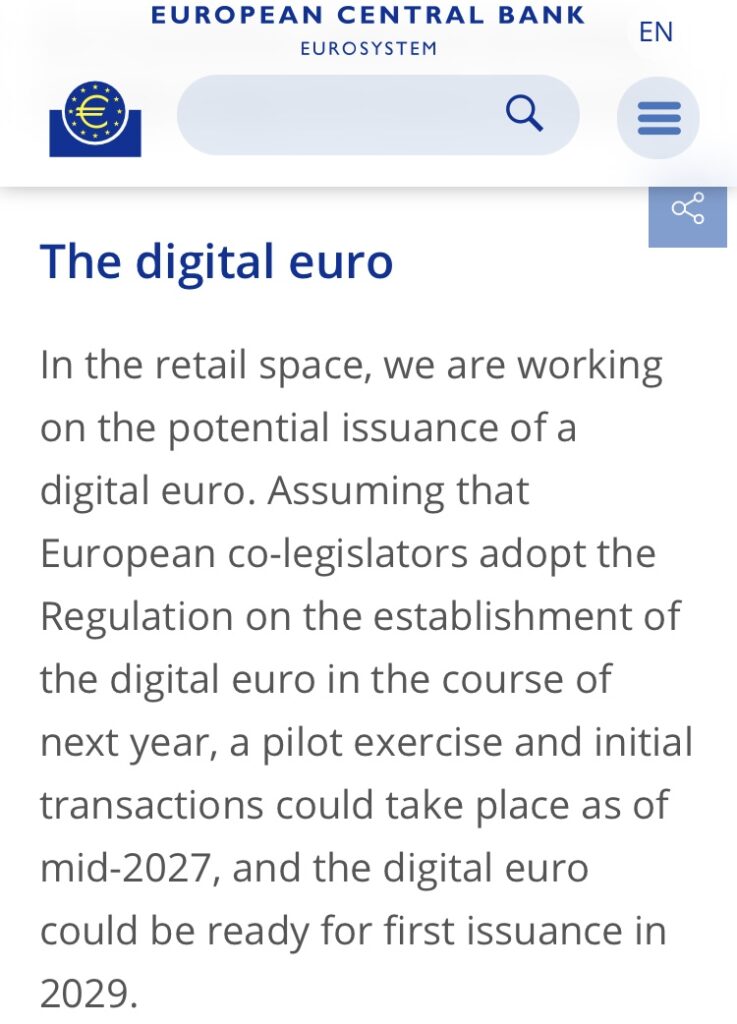
An offline version of the digital euro is even planned, with a privacy level close to cash, thanks to secure devices integrated into smartphones and smart cards. Yet, despite these advances, the ECB reminds that the ball is now in the legislators’ court. Christine Lagarde clearly stated that the technical work is finished, but the final decision rests with political institutions.
European politics slow down: between privacy and surveillance
The main obstacle to the digital euro is not technical but political. Indeed, European legislators must decide on a thorny issue: privacy. The ECB has integrated data protection features, but their enforcement will depend on laws adopted by the European Union.
On one side, citizens and digital rights advocates demand privacy levels similar to cash. On the other, European institutions, under pressure to combat money laundering and terrorist financing, could impose strict surveillance measures. A dilemma that strongly delays the project.
If the digital euro arrives in 2026, which crypto will disappear?
The arrival of the digital euro could disrupt the crypto ecosystem in Europe. Some whose utility overlaps with that of an official digital currency might disappear. Euro-backed stablecoins, like EURT or STASIS EURO, would be the first affected. Their raison d’être—to offer a digital version of the euro—would be directly challenged by an official, more secure, and regulated solution. Users could massively migrate to the digital euro, rendering these assets obsolete.
Cryptocurrencies focused on payments in Europe, like IOTA or Nano, could also suffer. These projects rely on fast and free transactions, a niche that the digital euro might fill with the advantage of institutional legitimacy. Without clear differentiation, their adoption WOULD decline.
Finally, private CBDC initiatives in Europe would be marginalized. Any private digital currency would face competition from an official solution, benefiting from a legal framework and banking integration. Only cryptos offering distinct added value, like enhanced privacy or innovative DeFi features, could survive.
The digital euro is technically ready, but its future now depends on political choices. If legislators manage to reconcile innovation and data protection, this project could redefine payments and revitalize the European economy, according to the ECB. Otherwise, it risks remaining dead letter, leaving the field open to private actors. Will Europe seize this opportunity without sacrificing its values?
Maximize your Cointribune experience with our "Read to Earn" program! For every article you read, earn points and access exclusive rewards. Sign up now and start earning benefits.
