Vitalik Buterin Confronts Ethereum’s Scaling Limits: Is This the Network’s Defining Moment?

Ethereum's architect stares down the blockchain's biggest bottleneck. The network that birthed DeFi and NFTs is hitting a wall—and everyone's watching to see if the genius can engineer an escape.
The Scaling Crunch Is Real
Transaction fees aren't just annoying—they're a barrier to mass adoption. While competitors tout cheaper, faster chains, Ethereum's core value proposition of security and decentralization faces its stiffest test. The merge was a triumph, but the next act requires a different kind of magic.
Layer-2s: Salvation or Stopgap?
Rollups are eating the world, shifting the scaling burden off the main chain. Arbitrum and Optimism now handle volumes that would clog Ethereum's base layer. It's a clever workaround, but it fragments liquidity and complexity—a band-aid on a bullet wound, some purists grumble. Meanwhile, the finance bros on Wall Street still can't decide if it's the future of global settlement or just a very expensive database for cartoon apes.
The Roadmap's Risky Gambit
Danksharding, proto-danksharding, verkle trees—the jargon hides a high-stakes engineering marathon. Each upgrade is a bet that the ecosystem's patience and developer loyalty will hold. One misstep could cede ground to sleeker, more centralized chains that promise the world but deliver a walled garden.
Vitalik's vision built a universe. Now, he has to prove it can grow beyond its own constraints—before the market finds a cheaper, easier alternative and moves on, as it always does.
 Read us on Google News
In brief
- Ethereum experienced a 25% drop in votes due to a Prysm client bug.
- Vitalik Buterin downplays, stating that a temporary loss of finality is not catastrophic.
- The focus on Prysm raises questions about software diversity in the Ethereum blockchain ecosystem.
- Already in 2023, two similar incidents revealed the same flaws without major corrections since then.
A bug, a tweet, and Ethereum skirts desynchronization
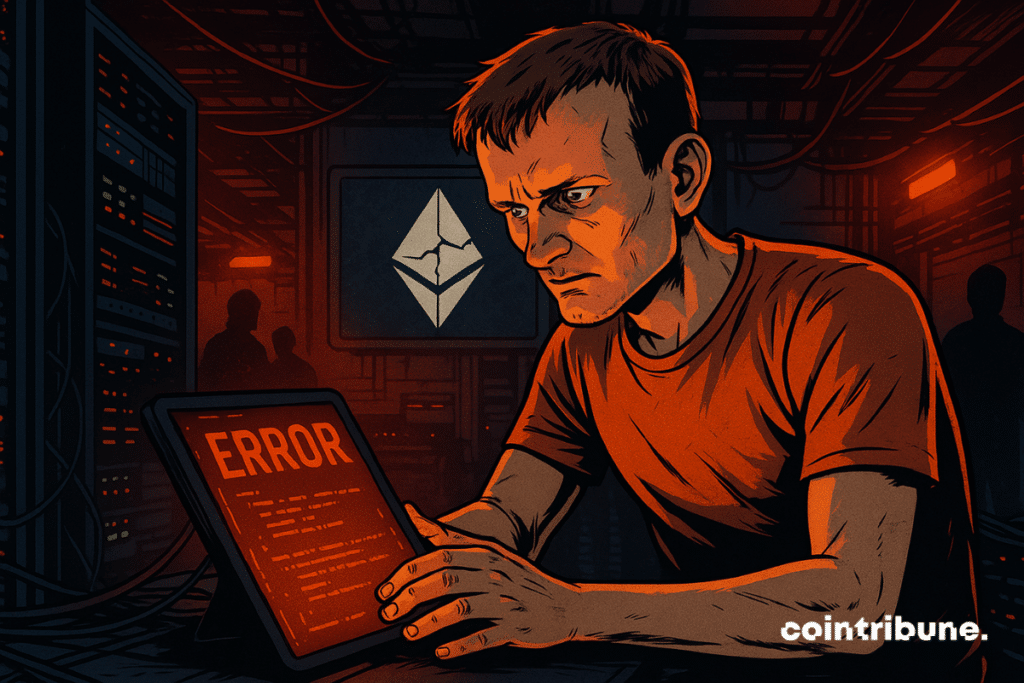
It all starts with a bug. A trivial processing error in version v7.0.0 of the Prysm client, revealed just after the Fusaka update. Result? 25% of validators go offline. Voting participation drops to 74.7%, less than 9% from the critical threshold that would push the Ethereum network into a loss of finality.
Faced with the alert, Vitalik Buterin calms things down: “There’s nothing wrong with losing finality from time to time, in my opinion.” According to him, as long as the wrong block isn’t confirmed, the network can continue functioning. Bitcoin has never had strict finality, he reminds us. But Ethereum is not Bitcoin. And its finality is not optional, but a pillar of the transition to Proof-of-Stake.
Meanwhile, transfers to Layer 2 solutions like Polygon are delayed. AggLayer suspends its transactions until finality returns. It’s not a failure, but it looks a lot like one.
Single client, single risk: the blockchain facing software monoculture
This is not the first time Prysm fails. In May 2023, a similar bug caused two finality loss incidents. Once again, the bug was concentrated on a single client, but that’s enough to weaken the entire blockchain. Because Ethereum remains too dependent on a small number of clients, despite repeated warnings.
Voices are raised. Sassal.eth, an influential community member, says bluntly:
It’s kind of crazy that almost all node operators using Prysm didn’t plan a backup solution (even crazier for professional operators).
He calls for diversifying clients, encouraging use of Lighthouse, Teku, or Nimbus.
But the problem is deeper. Ethereum’s economic model penalizes inactive validators via the inactivity leak mechanism. And some don’t understand this inconsistency. NoxOnLightsOff, another user, questions if these pauses are acceptable, why punish those who experience them?
Vitalik replies: penalties are progressive and negligible in the short term. But this answer does not satisfy everyone. It seems to minimize the consequences of a bug that, let’s repeat, deprived Ethereum of 23% of its votes for several hours.
Déjà vu in 2023: does Ethereum really learn from its mistakes?
In May 2023, Ethereum lost its finality twice within 24 hours due to bugs in Prysm and Teku. The network continued producing blocks, but without strong guarantees against reorganizations. A scenario exchanges and bridges fear. Finality is not just a technical detail: it guarantees that transactions will not be reversed.
Two years later, the same client, the same type of error. And still no effective generalized fallback mechanism. The network seems to progress… without truly learning.
Ethereum prides itself on being decentralized. But when 22% of the network relies on a single software, it borders on de facto centralization. And this exposes the entire ecosystem to a systemic risk that the market can no longer ignore.
Key figures and facts to remember
- The ETH price at the time of writing is 3,186 dollars;
- The Prysm bug caused participation to drop to 74.7%;
- Prysm represented 22 to 25% of validator clients;
- In May 2023, Ethereum had already lost finality twice in 24 hours;
- Without finality, inter-blockchain bridges suspend transfers (Polygon, AggLayer).
While criticism accumulates, Vitalik Buterin does not remain frozen. Recently, he presented a solution to reduce fee volatility on Ethereum by proposing an automatic adjustment system for minimum cost per block. One more step towards a smoother experience… provided the base remains stable.
Maximize your Cointribune experience with our "Read to Earn" program! For every article you read, earn points and access exclusive rewards. Sign up now and start earning benefits.
