Bitcoin Stalls in Recovery After Market Shutdown – What’s Next?

Bitcoin’s post-shutdown slump continues as bulls fail to regain momentum. The crypto king dipped below key support levels, leaving traders questioning whether this is a buying opportunity—or the start of a deeper correction.
Market Pulse: No dead-cat bounce here. Bitcoin’s lackluster rebound hints at exhaustion after last month’s rally. Institutional inflows? Minimal. Retail FOMO? Nowhere in sight.
Behind the Numbers: Liquidity crunch meets risk-off sentiment. Traders are pivoting to altcoins (as usual) while Wall Street quietly shorts the BTC futures curve. Classic.
The Bottom Line: Until macro conditions improve or another Elon tweet pumps the market, Bitcoin’s stuck in no-man’s land. Pro tip: Watch the Fed’s next move—because crypto hasn’t decoupled from traditional finance, no matter what the ‘hyperbitcoinization’ crowd claims.
 Read us on Google News
In Brief
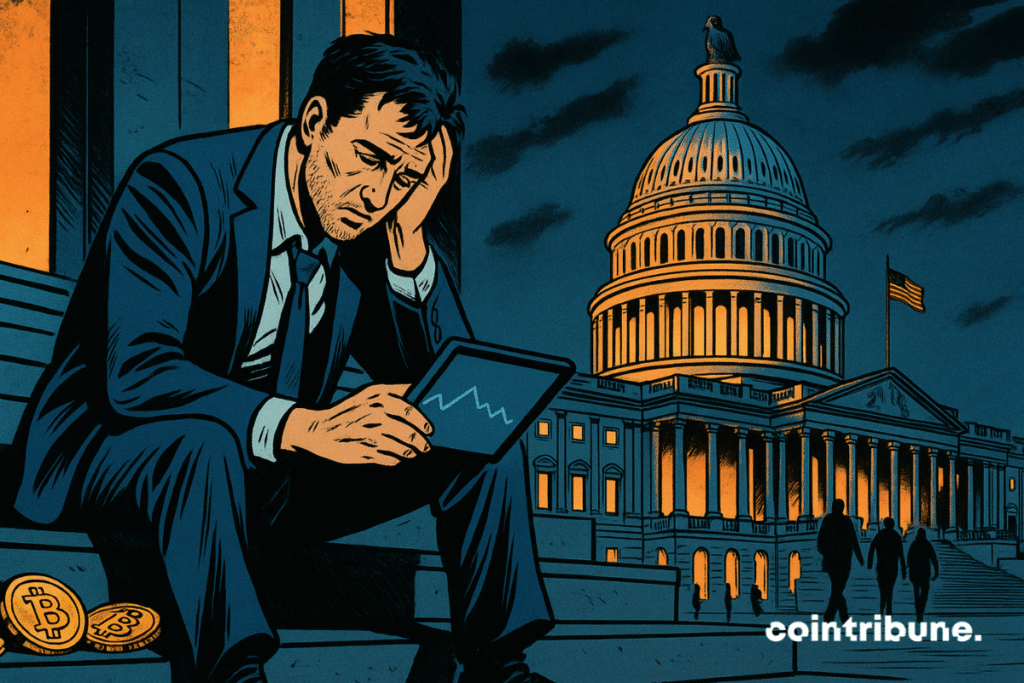
- The American shutdown, the longest in history, could have revived Bitcoin like in 2019, but the markets remain flat.
- Federal agencies like the SEC and the CFTC are paralyzed, blocking the approval of ETFs and any regulatory progress.
- The absence of a legal framework slows institutional capital inflow and limits growth prospects for the crypto market.
- Unlike in 2019, Bitcoin has dropped by 12 % since the start of the shutdown, with no immediate signs of recovery.
Institutional Paralysis with Real Consequences for Crypto
For over six weeks, major US federal agencies such as the Securities and Exchange Commission (SEC) and the Commodity Futures Trading Commission (CFTC) have been slowed down because of the budget deadlock in Congress.
The crypto ecosystem is deprived of major regulatory decisions such as the awaited approval of several ETFs. Indeed, the situation also hampers progress in legislative discussions on a regulatory framework for cryptos, even though a bill was in preparation.
Here are the concrete impacts of the shutdown on the crypto industry :
- Blocked decisions : the SEC and CFTC, operating with reduced staff, cannot evaluate or approve new crypto products (ETFs, registrations, etc.) ;
- Legislative slowdown : hopes to see a bill on crypto regulation passed by the end of this year are fading ;
- Investment freeze effect : regulatory uncertainty discourages institutional capital from entering the market massively ;
- A misleading historical comparison : in 2019, after a 35-day shutdown, Bitcoin had jumped over 300 %. However, in 2025, it has dropped by around 12 % since the start of the deadlock, with no visible rebound.
Current market conditions bear little resemblance to those of 2019. Government paralysis weighs on investor morale and deprives the crypto ecosystem of the institutional impulses it needs. In a climate more tense than five years ago, this prolonged freeze acts less as a catalyst than as a brake.
A Potential Bitcoin Rebound Hindered by Monetary Uncertainty and Vague Political Promises
Some observers nonetheless hope that the end of the shutdown could rekindle the flame in the crypto market, provided several monetary catalysts materialize.
Ben Lilly, analyst at JLabs Digital and Browns Research, believes that “several elements could create tailwinds for the crypto market”. He notably cites a probable 25 basis points cut in the Fed’s key interest rates, currently estimated at a 67 % probability, the end of quantitative tightening as soon as December, and the addition of liquidity via the Treasury General Account (TGA) at the time government activities resume.
The next few weeks set the stage for 2026
The government shutdown certainly created an air of uncertainty.
There WAS a lot of momentum in Washington D.C. as it pertains to putting a digital asset framework bill together in 2025.
This momentum came on the heels of an executive… pic.twitter.com/tQng1jgkNG
These measures could inject fuel into a market lacking momentum. However, Lilly points out that the shutdown “acted like a lead weight”, causing the crypto market and especially Bitcoin to miss out on some gains recorded by equity markets since October.
These optimistic prospects are far from universally accepted. Nic Puckrin, co-founder of Coin Bureau, remains skeptical. He highlights that “the crypto market has struggled to regain its momentum since October’s chaos”, citing the strength of the US dollar, rising Treasury yields, and the ongoing selling by long-term holders as major headwinds.
He also reminds that macroeconomic uncertainty persists, making any bullish scenario premature. On top of these technical factors are statements from Donald Trump, who promised to send a $2,000 check to low-income households funded by revenues from his tariff policies.
This type of measure triggered the 2021 surge, when $1,200 checks fueled a massive inflow of liquidity into speculative assets. However, this time, nothing is certain: the payment modalities are unclear, and the very legality of the unilaterally imposed tariffs is being challenged by the Supreme Court.
While some signals point to a possible restart of the crypto market, the current environment remains marked by deep uncertainty, both monetary and political. The lack of an immediate bitcoin rebound after the shutdown does not necessarily mean the absence of a bullish cycle, but it highlights the need for a more nuanced analysis of market drivers.
Maximize your Cointribune experience with our "Read to Earn" program! For every article you read, earn points and access exclusive rewards. Sign up now and start earning benefits.
