Why BlackRock Has Become Indispensable to Crypto ETFs

BlackRock just rewrote the crypto rulebook—and traditional finance is scrambling to keep up.
The Institutional Stamp of Approval
When the world's largest asset manager throws its weight behind crypto ETFs, markets listen. BlackRock's entry didn't just validate digital assets—it forced Wall Street to take notice of what they'd been dismissing as speculative nonsense.
Liquidity Meets Legitimacy
Their massive distribution network and institutional credibility created instant liquidity pools that dwarfed previous crypto products. Suddenly, pension funds and retirement accounts could access Bitcoin exposure without the technical hurdles—because if BlackRock's handling the custody, what's there to worry about?
The Regulatory Green Light
SEC approvals that took years for smaller players came faster for the asset management giant. Their compliance infrastructure and political connections smoothed regulatory pathways that remained blocked for others—proving that in finance, some players are just more equal than others.
Market makers now treat BlackRock's crypto ETFs as the benchmark, while competitors struggle to match their trading volumes. The firm's dominance creates a self-reinforcing cycle: more liquidity attracts more investors, which creates even more liquidity.
Love it or hate it, BlackRock didn't just join the crypto ETF race—they built the track everyone else has to run on. Another reminder that in modern finance, the house always wins—even when the house starts dealing digital cards.
 Read us on Google News
In Brief
- BlackRock’s IBIT concentrates capital, solely ensuring net growth in Bitcoin ETFs this year.
- Without BlackRock, crypto ETFs would have recorded a sharp decline since January 2025.
- Future altcoin ETFs struggle to convince without the protective shadow of the asset management giant.
- Fidelity, Ark, and Bitwise want to seize the opportunity, but trust is not yet established.
IBIT, the massive refuge for capital seeking regulated bitcoin
The numbers don’t lie: BlackRock’s iShares bitcoin Trust (IBIT) attracted $28.1 billion in 2025. Without it, the total Bitcoin ETFs show a negative balance of $1.27 billion. In other words, IBIT alone is pulling the crypto industry by the hair, rescuing it from worrying stagnation.
It’s not just an effect of size. It’s an effect of trust. For many institutions, BlackRock is the guarantee of exposure to bitcoin, but without the technical complexity of wallets or the volatility of crypto exchanges. Thanks to regulated management, Coinbase as custodian, and a transparent valuation method, IBIT ticks all the boxes of a model student.
Even Geoff Kendrick from Standard Chartered admits: the main part of bitcoin’s upward momentum in 2025 is fueled by these incoming flows.
So when Vetle Lunde (K33 Research) writes on X ” No BlackRock, no party“, it’s not a joke. It’s a diagnosis. This fund does not just participate: it solely supports an entire facade of institutional crypto market solidity.
Without BlackRock, will altcoins dance alone?
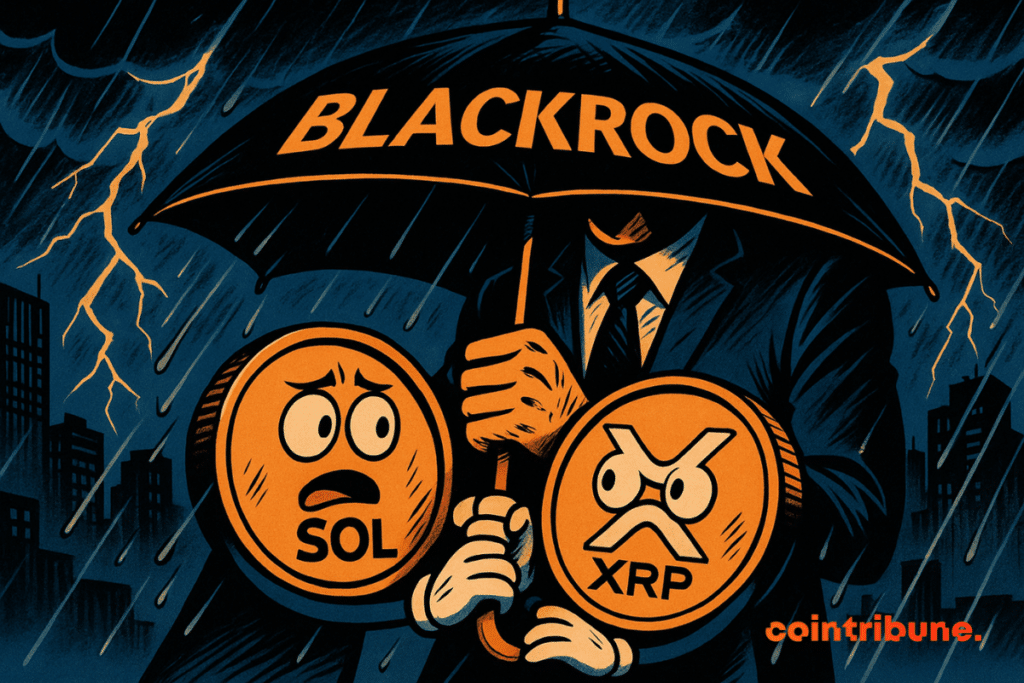
The next chapter will be played out with altcoin ETFs, and for once, BlackRock hasn’t reserved a front-line spot. No product announcement for solana or XRP on the horizon. This void raises hope among some competitors… but also doubts.
JPMorgan mentions a potential of $3 to $6 billion for a Solana ETF. Bitget even targets $6 billion. These amounts are far from negligible. But be careful with comparisons. Bitcoin ETFs reached 6% adoption of BTC’s market cap in six months. For ethereum ETFs, it’s half that.
Without BlackRock’s credibility, altcoin ETFs will have to prove themselves in a riskier market, without the backing of a globally respected brand. This could slow hesitant institutional investors. Because while IBIT reassures, nothing guarantees that alternatives for SOL or XRP will have the same safe-haven effect.
This void could certainly open the door to bold players: Fidelity, Ark Invest, or Bitwise, who wish to gain ground. But without the aura effect, these new products will likely receive less momentum, and investors won’t rush as quickly.
A BlackRock effect turned system? The balance of the crypto ecosystem in question
BlackRock currently holds about 60% of the assets of U.S. Bitcoin ETFs. It’s more than dominance; it’s a stranglehold on the image of solidity in the regulated crypto market. Yet, this power also raises a question: when a single company captures so much, what’s left for others?
The imbalance is even more striking when looking at the other side of the coin: Grayscale and its GBTC, initially seen as pioneers, have posted cumulative outflows of $24.6 billion since 2024. Even well-intentioned funds can’t keep up.
Faced with this, BlackRock’s absence in altcoins could create a strategic window. Those who dare to seize it could capture a new clientele, less attached to Wall Street giants. But trust will still need to be built.
The 5 key facts reshaping the crypto ETF landscape
- $28.1B invested in IBIT in 2025: an unmatched record;
- $92.66B assets managed by IBIT: about 4% of total BTC supply;
- Only one month of net outflows for IBIT since its launch (February 2025);
- $24.62B outflows for Grayscale: the sector’s largest retreat;
- $0 announced by BlackRock for Solana or XRP ETFs: the silence is telling.
BlackRock recently crossed the threshold of 800,000 BTC held via IBIT, further strengthening its dominant position. This figure is not just a record: it’s a signal. A reminder that institutional adoption of Bitcoin today goes through giants who know how to speak the language of Wall Street… and that of crypto.
Maximize your Cointribune experience with our "Read to Earn" program! For every article you read, earn points and access exclusive rewards. Sign up now and start earning benefits.
