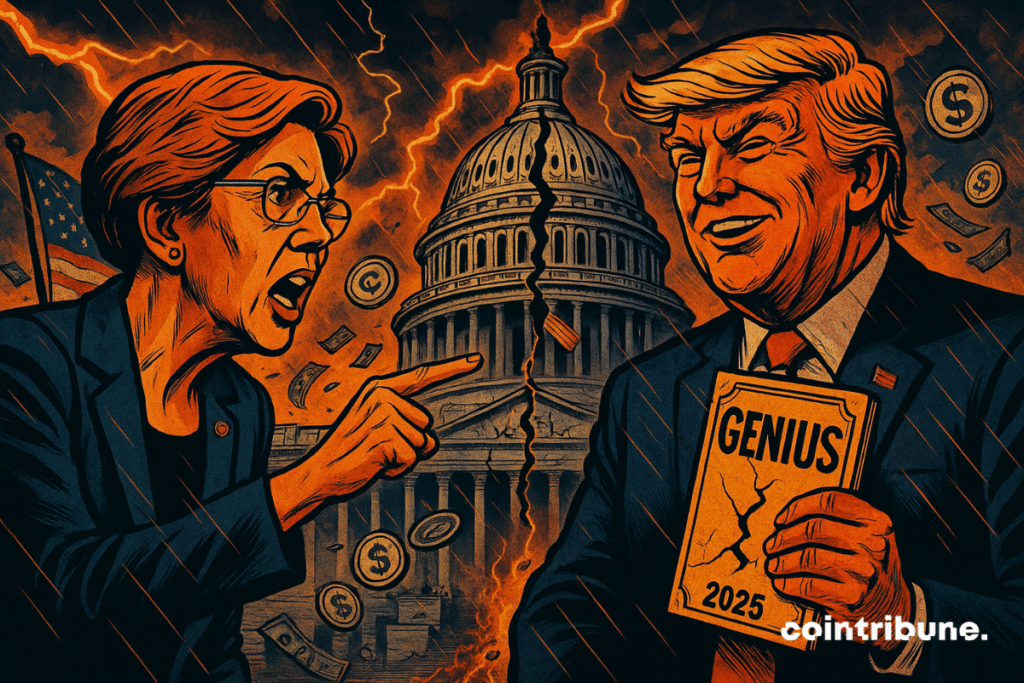
Elizabeth Warren Slams GENIUS Act: Private Interests Hijack Stablecoin Regulation

Washington's crypto clash heats up as Senator Warren takes aim at what she calls 'corporate capture' of digital dollar oversight.
Regulatory Battle Lines Drawn
The Massachusetts senator fired another salvo in her ongoing campaign against crypto industry influence, accusing the GENIUS Act of putting Wall Street profits ahead of consumer protection. Her criticism lands as lawmakers wrestle with creating frameworks for the $150 billion stablecoin market.
Private vs Public Interests Collide
Warren's opposition centers on provisions she claims would let financial giants write their own rulebook—another case of regulators becoming cheerleaders for the industries they're supposed to police. Because nothing says 'public interest' like letting banks regulate themselves.
The Stakes for Crypto's Future
This isn't just bureaucratic squabbling—the outcome could determine whether stablecoins become legitimate financial tools or remain Wall Street's latest playground. Meanwhile, the rest of us get to watch another episode of 'Congress tries to understand technology.'
The GENIUS Act debate reveals Washington's fundamental dilemma: how to foster innovation while preventing another financial meltdown. Spoiler alert—they'll probably get both wrong.
 Read us on Google News
In brief
- The GENIUS Act imposes a lightened regulation on American giants in the stablecoin market.
- Elizabeth Warren denounces conflicts of interest linked to Trump and World Liberty Financial USD.
- The absence of concrete protections raises concerns amid risks of manipulation or systemic collapse.
- Other cryptos like PYUSD have also shown the technical fragility of the stablecoin sector.
Stablecoins and the GENIUS law: a slippery slope with Trumpian scents
The GENIUS law, signed in July 2025 by Donald Trump, requires stablecoin issuers to have full backing in dollars or equivalent assets. It demands audits for sector giants (more than 50 billion dollars in capitalization). But what Warren condemns is the veneer.
In a letter addressed to the Treasury, she speaks of a regulatory framework lightened for crypto banks.
She targets directly one stablecoin in particular: USD1, issued by World Liberty Financial, a company associated with the TRUMP family. This token, according to Warren, embodies an obvious conflict of interest.
Jeff Merkley and she have also requested detailed documents about a 2 billion dollar USD1 transaction between an Emirati company and Binance.
An example among others? Perhaps. But in the senator’s eyes, the GENIUS Act could be a golden key for the powerful to rewrite the rules of the financial game… to their advantage.
Crypto and systemic risks: an open-air financial Trojan horse
What this law also reveals is the ambiguity of stablecoins: between regulation and poorly controlled freedoms. The case of Paxos is striking. In October, 300 trillion dollars in PYUSD (PayPal’s stablecoin) were created by mistake. Everything was then burned, but the incident shook the crypto world.
Warren made it a symbol. She states:
This incident demonstrates the serious risks that operational failures can pose to an issuer, market integrity, and potentially financial stability. Treasury owes the public an explanation for how it intends to address those risks and, if it cannot, the authority it needs from Congress to do so.
The senator adds that the GENIUS Act failed to establish fundamental protections to prevent stablecoins from blowing up our financial system. She also criticizes the omission of common-sense amendments to guarantee users the same protections as those offered by an app like Venmo or a traditional bank account, while maintaining the authority of the Consumer Financial Protection Bureau over law enforcement.
In this matter, crypto is not the enemy, but the revealer. Proof that faulty regulation could precipitate crises… starting from a simple bug.
Power, money, and private currencies: towards a democratic crisis?
The real heart of the debate, for Warren, is ethics. And democracy.
Who creates the money? Who controls it? Beneath the technological veneer, these are fundamentally political questions.
Yet, the GENIUS law remains silent on key points:
- No ban on digital giants issuing their own currency;
- No extension of CFPB protections to stablecoin users;
- No clarification on the use of the Stabilization Fund to save issuers in crisis;
- No official rejection of an agreement with El Salvador that could favor Tether.
And above all, a deleterious climate where the rules seem written by those who benefit from them.
For Elizabeth Warren, stablecoins are slowly becoming the favorite digital weapon of cartels, authoritarian regimes, and illicit networks. She demands that the US Treasury act immediately. The time is no longer for observation but for action, with concrete measures to fill the gaps of an overly permissive regulation.
Stablecoins: key figures to understand the debate
- The stablecoin market is now worth over 150 billion dollars;
- The Emirates/Binance transaction involved 2 billion USD1;
- The Paxos incident: 300 trillion PYUSD minted by mistake;
- Audits only concern issuers > 50 billion $;
- The CFPB remains out of the game for stablecoin users.
In reality, the distrust between Warren and the crypto world is not new. Long before the vote on the GENIUS Act, Ripple’s legal head had already accused the senator of blocking the sector’s progress. One more proof that behind the question of stablecoins lies a much deeper debate: that of monetary power in a changing world.
Maximize your Cointribune experience with our "Read to Earn" program! For every article you read, earn points and access exclusive rewards. Sign up now and start earning benefits.
