Polymarket Expands into Finance with Stock and Index ’Up/Down’ Markets - Here’s What You Need to Know

Prediction market platform Polymarket just dropped its biggest finance play yet—stock and index up/down markets that let traders bet on corporate giants and market movements.
The New Trading Arena
Forget traditional stock analysis—now you can wager on whether Apple hits new highs or the S&P 500 tanks next quarter. Polymarket's expansion brings crypto-style speculation directly to mainstream financial instruments, blurring lines between investing and gambling yet again.
How It Works
Traders buy shares predicting yes/no outcomes on stock performance within specific timeframes. The platform uses blockchain-based smart contracts to settle markets automatically—no brokers, no regulators, just pure price discovery driven by crowd wisdom (or madness).
Market Impact
This move positions Polymarket as the first major prediction market to directly challenge traditional financial derivatives. While Wall Street quants build complex algorithms, crypto degens can now place simple directional bets with a few clicks—proving once again that sometimes the simplest strategies pack the biggest punch.
As traditional finance struggles with paperwork and compliance, prediction markets keep eating their lunch—one binary option at a time.
 Read us on Google News
In brief
- Polymarket adds “up/down” markets for stocks and indices, letting users bet on price direction without a brokerage account.
- The new Finance section covers Equities, Commodities, IPOs, and more, with data verified by WSJ and Nasdaq sources.
- ICE backs Polymarket with a $2B investment, valuing it at $9B as the platform expands beyond politics and macro topics.
- MetaMask integration and 4% yield rewards strengthen Polymarket’s appeal amid rising institutional trading interest.
Prediction Market Polymarket Steps Into Equities With New Directional Bets
Polymarket is introducing “up/down” equity and index markets, allowing users to wager on whether individual stocks or benchmarks will end higher or lower by a set time, the Intercontinental Exchange (ICE)-backed prediction platform announced on Wednesday.
The feature appears within a new Finance section that groups markets into categories such as Equities, Earnings, Indices, Commodities, Acquisitions, IPOs, Fed Rates, Business, and Treasuries. Resolution sources include The Wall Street Journal and Nasdaq, ensuring transparency in results.
The launch advances Polymarket’s push into mainstream financial events. It follows last month’s debut of company earnings markets, part of the platform’s reintroduction in the United States. That rollout shifted the platform’s focus beyond politics and macroeconomic topics toward single-company outcomes.
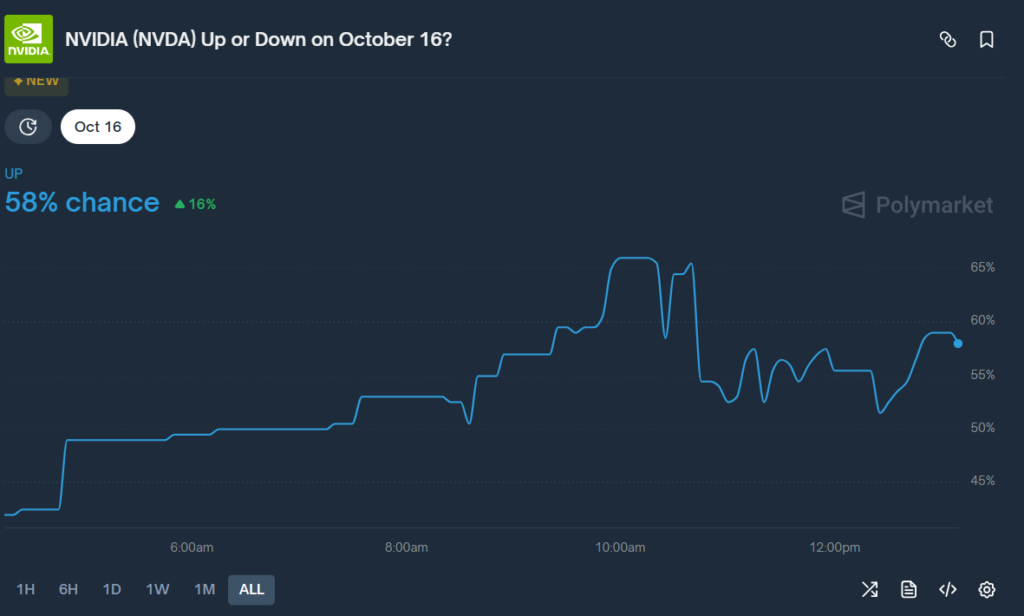
By offering direction-based contracts on individual stocks, Polymarket enables users to speculate on market movements without requiring a brokerage account or margin trading. The addition marks another step toward linking prediction markets to traditional finance, a goal tied to the platform’s effort to attract deeper liquidity and a broader user base.
Prediction Platforms Expand Into Finance With Wallet Integrations and Yield Rewards
Recent months have brought solid growth across the prediction market sector. Polymarket recently added Donald TRUMP Jr. to its advisory board, signaling plans to strengthen its presence in U.S. politics and finance. Together with rival Kalshi, the two platforms processed about $1.4 billion in trading volume last month, as institutional interest continued to climb.
Support from major financial players continues to build. ICE, the parent company of the New York Stock Exchange, has agreed to invest up to $2 billion in Polymarket, valuing it at $9 billion.
MetaMask also integrated Polymarket, enabling users to place bets directly within the wallet. In addition, Polymarket now offers up to 4% annualized returns on eligible open positions—among the most competitive rewards in the industry.
Even so, CFTC-regulated Kalshi remains Polymarket’s strongest competitor, leading in trading volume and recently raising $300 million in funding at a $5 billion valuation from investors including Sequoia Capital and Andreessen Horowitz—highlighting the sector’s intensifying race for market share.
Maximize your Cointribune experience with our "Read to Earn" program! For every article you read, earn points and access exclusive rewards. Sign up now and start earning benefits.
