Why Traders Are Fleeing Coinbase’s Tokenized Stocks For Edel Finance’s DeFi Edge

Forget synthetic shares—traders are chasing real yield and control. A quiet migration is underway, shifting capital from the familiar wrapper of tokenized stocks on centralized giants like Coinbase towards the composable, high-octane world of protocols like Edel Finance.
The Allure of Native Yield
Tokenized stocks often mimic a price—they don't generate native yield. You hold a digital IOU for Tesla, but you're not collecting dividends or earning staking rewards on that position. Edel Finance and its DeFi peers flip that model. Capital isn't just parked; it's put to work. Liquidity provisioning, lending, and leveraged strategies turn static holdings into active income engines. Why settle for tracking an asset when you can make your capital sweat?
Escaping the Wall Street 2.0 Gatekeeper
Coinbase's tokenized stock offerings are a bridge—but they come with tolls and checkpoints. They operate within a regulated, permissioned framework that mirrors traditional finance's bottlenecks. Edel Finance represents the purist's crypto ethos: non-custodial, permissionless, and globally accessible 24/7. Traders aren't just choosing a different product; they're choosing a different philosophy—one that bypasses the traditional financial gatekeepers, even the shiny new digital ones.
The Composability Advantage
In DeFi, assets are building blocks. A position on Edel Finance isn't a dead-end holding. It can be used as collateral to borrow stablecoins, funneled into a yield aggregator, or paired in a liquidity pool to earn fees. This financial Lego is absent in the walled garden of a tokenized stock. The ability to stack and intertwine protocols creates efficiency and opportunity that a standalone synthetic asset can't match—because, let's be honest, sometimes the real money isn't in the asset itself, but in the creative financial engineering around it.
It's a shift from convenience to sovereignty, from simulation to utility. While tokenized stocks offer a familiar on-ramp, they ultimately repackage old-world assets with a crypto sticker. Protocols like Edel Finance offer the raw, unfiltered potential of decentralized finance—where your returns are only limited by your risk appetite and ingenuity, not by a corporate product roadmap. After all, in a sector built to disrupt finance, why settle for a digital replica of the very system you aimed to replace?
Coinbase is signaling a bigger move into tokenized equities, with recent coverage linking tokenized stocks to its broader on-chain markets roadmap. ONDO Finance is also accelerating, with public plans to expand tokenized U.S. stocks and ETFs through new chain integrations.
As more distribution rails come online, traders are also paying closer attention to the infrastructure layer—where Edel Finance positions itself around lending, borrowing, and collateral for tokenized equities. Together, these moves point to one clear shift: tokenized equities are moving from an interesting idea to a real product category.
Tokenized Stocks on Coinbase: Why The After You Buy Layer Matters
Tokenized stocks sound simple on paper: buy stock exposure, hold it in a wallet, trade it when you want. Coinbase is helping make that story mainstream, and Brian Armstrong has been clear about the appeal: markets that close overnight and on weekends feel outdated, and tokenized assets can support instant settlement and 24/7 availability.
But once you MOVE past the first buy, traders start asking different questions:
- Can I borrow against this position without selling it?
- Can I earn yield on it the way institutions do with securities lending?
- Can I hedge or short without relying on a traditional prime broker stack?
That’s why some traders end up looking beyond Coinbase’s tokenized stocks offering itself, toward the infrastructure that makes on-chain equities do things instead of just sitting there.
Edel Finance Explained
Edel Finance positions itself as an on-chain securities lending and borrowing infrastructure built specifically for tokenized equities. It’s not trying to replace exchanges. It’s trying to power the capital markets LAYER that exchanges and issuers often don’t provide.
At a practical level, Edel is built to support:
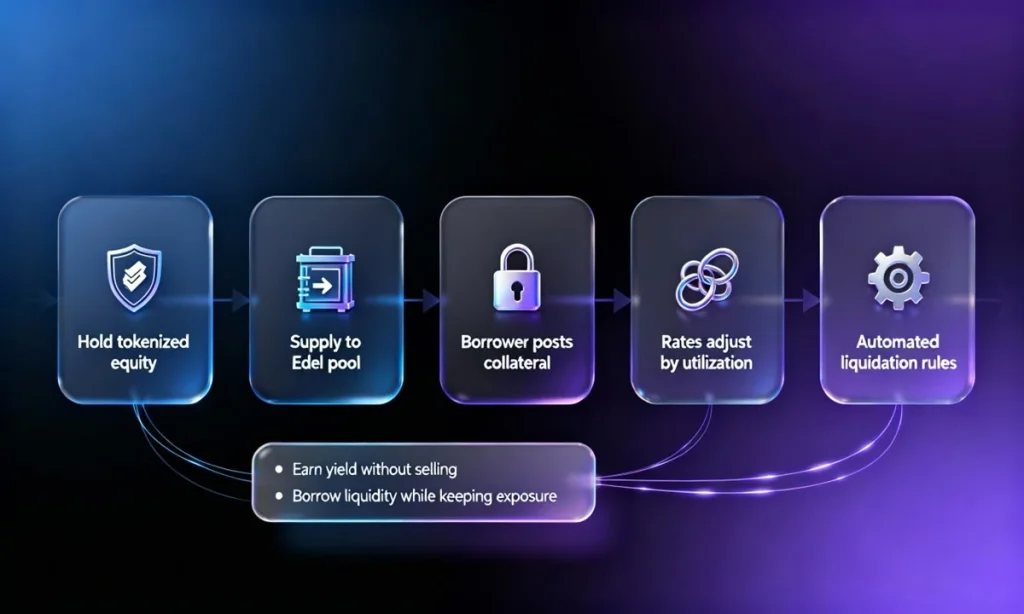
- Lending tokenized equities so holders can earn yield from borrow demand
- Borrowing stable assets against equity collateral (without selling the equity exposure)
- Transparent, utilization-driven rates (supply/demand sets borrowing costs)
- Automated collateral enforcement and liquidation logic via smart contracts
- Near-instant settlement compared to multi-day TradFi workflows
If you want to see what this looks like in practice, Edel’s Testnet and products pages lay out the building blocks in one place.
Edel’s team sums up the gap with a line that’s hard to disagree with: “Tokenized equities now exist, but without a native securities lending layer, they remain financially underutilized.”
Edel’s Rise As The Aave for Stocks
This is where the article gets subjective, because it’s a question, not a verdict.
Coinbase and Ondo are helping tokenized equities get into more hands. Edel is pitching itself as what happens after that—when people want to treat equity tokens like real financial instruments.
That’s why you’ll hear the AAVE for stocks comparison. Not because Edel is copying Aave, but because the mental model is familiar:
- You supply an asset (here, tokenized equities instead of crypto).
- Other users borrow it (or borrow against it).
- Rates adjust with utilization.
- Risk rules are enforced automatically.
For traders, this matters because stocks in traditional portfolios are often idle. They go up or down, and that’s it. Securities lending changes that by turning holdings into collateral and yield-bearing instruments.
Ondo’s public expansion plans help explain why this vertical is gaining mindshare. As more tokenized equity products appear across chains and venues, demand grows for lending, borrowing, shorting, and collateral tools that don’t depend on old gatekeepers.
Of course, none of this removes risk. On-chain lending introduces smart contract risk, liquidation risk, and product-structure risk around tokenized equities. But traders tend to prefer risks they can see and measure over risks that live behind closed doors.
Conclusion
Coinbase can make tokenized equities easy to access, and that matters for adoption. But traders also care about what happens after the buy. They want to earn yield, borrow against positions, and hedge without relying on slow, opaque intermediaries.
That is where Edel Finance comes in, as a securities lending and collateral layer built for tokenized stocks. If you prefer simple exposure, a Coinbase-style offering may be enough. If you want flexibility, you will compare lending rates, collateral rules, and liquidation risk. Either way, read the terms, size positions sensibly, and keep risk boring before you chase the next headline.
FAQs
Do tokenized stocks on Coinbase pay dividends the same way traditional stocks do?
It depends on how the tokenized product is structured and what rights it gives holders. Always check the product terms—tokenization doesn’t automatically mean you have identical shareholder rights.
Why would a trader use Edel instead of just holding tokenized equities?
Because holding is passive, Edel’s focus is lending, borrowing, and collateral use—tools traders use to earn yield, access liquidity, and manage positions without relying on traditional intermediaries.
Is on-chain securities lending riskier than traditional brokerage investing?
It can be. You add smart contracts, liquidation mechanics, and token-issuer structure into the risk mix. The upside is transparency: rules and rates can be visible on-chain, rather than hidden behind institutional agreements.
What’s the simplest way to diversify into the tokenized equities narrative?
Many investors diversify by layer: an access venue (like Coinbase), issuance rails (where Ondo plays), and infrastructure (where Edel positions itself). The right blend depends on your time horizon and risk tolerance.
