Bitcoin Cash (BCH) Surges: Here’s Why It’s Up Today

Bitcoin Cash isn't just moving—it's sprinting. The original 'spendable bitcoin' is posting significant gains while the broader market watches. Forget sideways action; this is a vertical climb.
The Scalability Play Pays Off
While legacy finance wrestles with settlement delays and eye-watering fees, BCH's architecture delivers. Its larger block size isn't just a technical spec; it's a functional advantage that cuts transaction costs and bypasses congestion. In a world where 'fast' often means 'tomorrow,' BCH settles in minutes for pennies.
Adoption Isn't Theoretical
Merchant acceptance is ticking up, not in press releases, but in actual point-of-sale systems. This isn't speculative vaporware; it's utility finding its price. The network effect is a real thing, and for a currency meant to be used, every new vendor is a brick in the foundation.
The Halving Horizon
Let's talk incentives. The approaching block reward halving looms for several major proof-of-work coins. Scarcity narratives drive markets, and smart money positions early. While traditional analysts debate P/E ratios, crypto markets price in programmed, predictable scarcity events.
A Hedge Against... Everything Else
In a crypto ecosystem increasingly dominated by complex smart contracts and decentralized apps, BCH's simplicity is its strength. It does one thing: peer-to-peer electronic cash. In a sector prone to over-engineering, that focus cuts through the noise. It's a cynical but true finance jab: sometimes the best trade is against the complexity of your own industry.
The momentum is clear. Whether this is a short-term spike or the start of a sustained re-rating, Bitcoin Cash is forcing the conversation back to fundamentals: cost, speed, and use. The market is voting, and today, it's voting for utility.
Bitcoin Cash, a cryptocurrency that is a fork of Bitcoin, has seen a sharp rise today, jumping nearly 12%, trading around $588, making it one of the top-performing cryptocurrencies.
While Bitcoin and most other major coins are trading in the red, Bitcoin Cash’s sudden surge has surprised the market, raising questions about what’s driving the rally.
Strong Buying Interest Drives Bitcoin Cash Higher
One key reason behind bitcoin Cash’s sharp rise is strong interest from retail traders. BCH started moving higher after the latest US inflation data showed CPI at 2.7%, which improved overall market sentiment.
At the same time, the coin has seen strong independent momentum, largely ignoring the Bank of Japan’s recent rate hike to 0.75%.
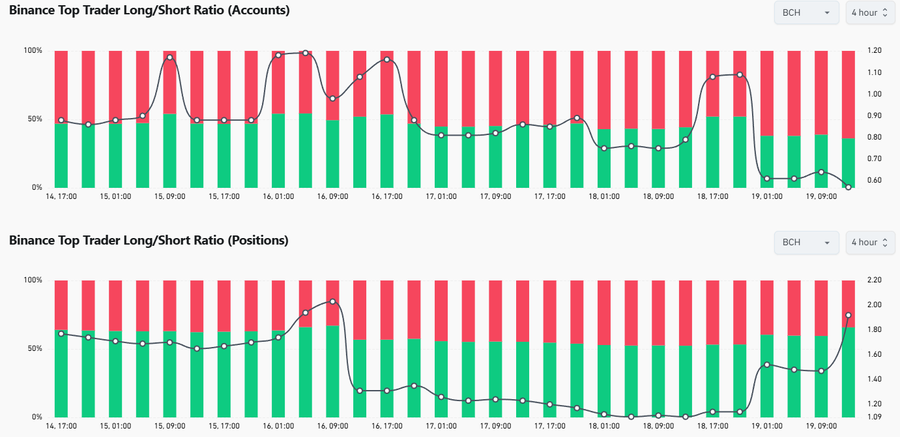
On top of it, data from Binance shows top traders are increasing their long positions in Bitcoin Cash. Both the number of traders betting on higher prices and the size of their positions have risen, suggesting strong confidence that BCH could MOVE even higher.
Rising Futures Interest Signals Confidence
Another key reason behind Bitcoin Cash’s rally is growing activity in the futures market. Recent data shows that open interest in BCH futures has reached a six-month high, meaning more traders are placing bets on higher prices ahead.
According to CoinGlass, BCH futures open interest jumped 18.69% in the last 24 hours, rising to $761.48 million. This shows fresh money is entering the market as traders take on more risk.
At the same time, the funding rate has turned positive, signaling that bullish traders are now willing to pay to keep their long positions open.
Key Resistance at $615 in Focus
Looking at the Bitcoin Cash 4-hour chart, BCH is trading above key moving averages, which is boosting bullish confidence. The price recently bounced from around $530, forming a double-bottom pattern, a signal that often points to a possible trend reversal.
Traders are now closely watching the $600–$625 zone, which acts as a strong resistance area. In particular, $615 has emerged as a major sell wall where selling pressure is high.
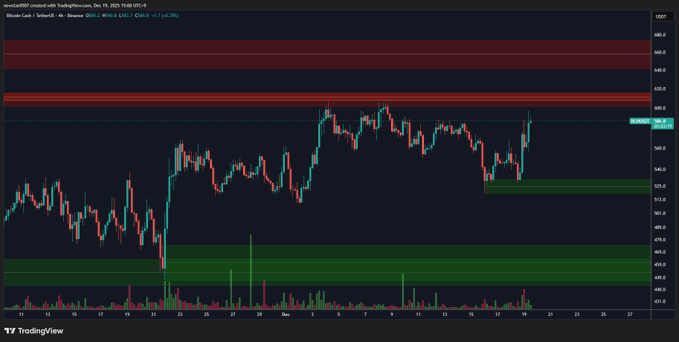
If BCH manages to break and hold above $615, analysts believe it could trigger the next leg higher, with a possible move toward $640. However, failure to clear this level may lead to short-term consolidation.
