Scroll DAO Governance Shakeup 2026: Security Council Dissolved Amid Fee Controversy Fallout

Scroll DAO has moved decisively to dissolve its decentralized Security Council and transfer control to an internal multisig team, a major governance restructuring triggered by the recent reversal of a controversial fee hike that had saddled users with over $50,000 in unexpected costs. The cost-cutting overhaul, announced on the project's official website, marks a pivotal shift in its operational model as it seeks to streamline decision-making following the significant community backlash.
Scroll Crypto Update April 2026: Why course changing now?
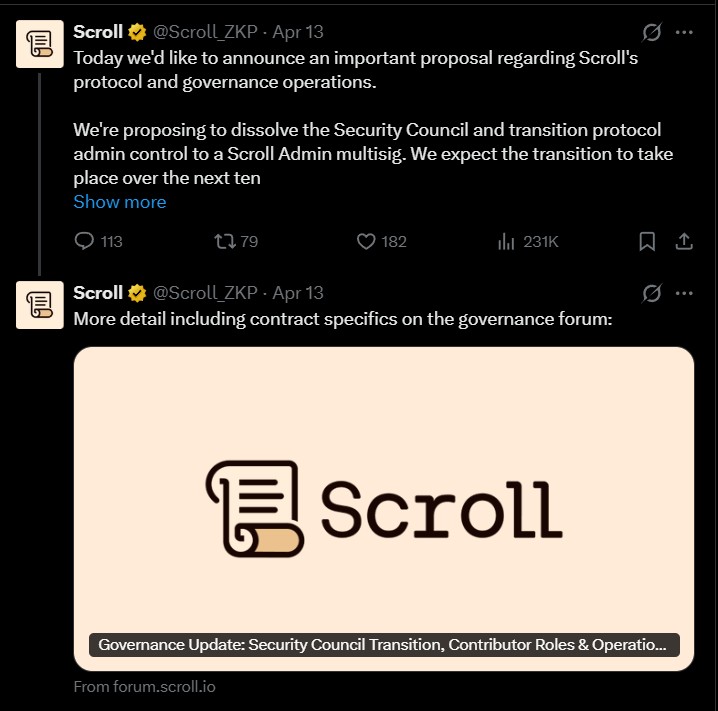
The Security Council no longer justifies its cost. The DAO plans to transfer protocol admin control to a Admin multisig over the next 10 days. That step still needs the council’s support to go live.
The proposed multisig address is 0xcca54B0916Cee2186b47E9709BEdcb7041A8F761. All contract changes will happen transparently on-chain. That means anyone can verify the updates.
The contracts set to move under the new setup include the ScrollOwner contract, the AgoraGovernor contract, and the timelock contracts. In simple terms, timelocks delay major protocol actions. They give users time to see what is changing before it happens.
Scroll DAO framed the move as a practical decision. It said it reviewed council usage over recent quarters and found the expense too high for the value delivered. At the same time, the project stressed that it still believes security councils matter for Scroll protocol resilience.
This is not a rejection of oversight. Instead, it plans to work with stakeholders on a new council structure that better fits current market conditions.
Source: Official X
Staff cuts add to the pressure.
The governance update goes beyond the Security Council. Several DAO contributor roles will end by April 30, 2026. These include Marketing Operations, Program Coordination, Accountability Lead, and Accountability Operator.
One Facilitator role tied to SEED LATAM will stay active through the second quarter of 2026. That role will manage delegate operations, push governance items forward, and handle the DAO allocation budget.
The Operations and Accountability committees will also shift into a reduced mode. Scroll said the structures will remain in place, though with less day-to-day activity. The DAO says it can scale them back up later if demand returns.
Fresh scars from the fee rollback
The timing matters. In early April, the protocol sharply raised the fee for publishing data to the Ethereum L2 mainnet. Over roughly six days, that cost rose by about 1,280 times. Users ended up paying more than $50,000 in extra costs before Scroll rolled the change back on April 9.
That episode likely raised new questions about internal control, governance checks, and operational judgment. The project did not directly link the fee issue to the Security Council change. Even so, the back-to-back events will likely shape community debate.
For traders and users, the key issue is trust. A leaner structure may reduce expenses. Yet closer internal control could also draw more scrutiny, especially after a costly fee reversal. In the broader Layer 2 market, projects still face pressure to balance decentralization, security, and sustainable operating costs as competition tightens.
Conclusion
The latest update shows how Scroll crypto governance is changing under cost pressure. The DAO says it is trimming structure, not abandoning oversight. Still, users will watch closely to see whether lower costs come at the expense of accountability.
Disclaimer: This article is for informational purposes only and does not offer financial or investment advice. Crypto projects carry technical, governance, and market risks. Readers should review official announcements and do their own research before making any decision.

Log in to Reply
Log in to comment your thoughtsComments
Related Articles
|Square
Get the BTCC app to start your crypto journey
Get started today Scan to join our 100M+ users